THE ‘ARAB SPRING’ FALLOUT
~ THE EGYPTIAN COUP
When the army deposes a democratically elected President, detains him and most of his Cabinet members in army barracks before transferring them to prison, repeatedly massacres scores of people who protest, arrests over 300 members of the President’s party, issues arrest warrants for any other prominent members of the President’s party still at liberty, freezes the assets and finances of the President’s party and its members, charges the President with offences that occurred during a popular revolution against the previous President universally considered corrupt and installs then installs itself as the new government, Dude, that’s a coup!!! We doubt the political analysis and capabilities of anybody - Egyptian, European or American – who says otherwise.
While we hold no brief for the Muslim Brotherhood in Egypt we accept they were democratically elected.
President Morsi made some bad decisions such as the appointment of a senior member of the ex-militant group Gamaa Islamiya to oversee the tourist hub of Luxor. In 1997 before they renounced violence, Gamaa Islamiya massacred 58 tourists and four Egyptians at a temple site near Luxor. Local people staged a sit-in outside the governor’s offices until Mr Morsi overturned the decision. Mr Morsi and his Freedom and Justice Party were not in charge for long enough to make a major impact on the economic situation in the country. These are matters for political agitation not justifications for a coup. That their opponents, the protest movement coalesced around Tahrir Square, were unable to make political advantage of the Jan 25 movement or unseat President Mohamed Morsi is a sign of how weak they are as a political organisation capable of addressing the country’s problems. A protest movement protests – it can say no to anything and everything - but in the 30 months since the fall of President Mubarak they have still not been able to galvanise their popular support into a coherent political ideology that can take over the reins of government, provide political guidance that represents their demands and re-energise the Egyptian economy.
With recent visits to Afrika by US President Obama and his Secretary of State John Kerry the current Interim President Adly Al-Mansour and Defence Minister General Abdul Fatah Al-Sisi were given the green light to move against the Muslim Brotherhood. This is evident in that the major charge against President Morsi is nothing he did while running Egypt but the fact that he has an alliance with the Palestinian government in the Gaza Strip, Hamas. Mr Morsi been formally accused of the premeditated murder of prisoners, officers and soldiers when he and several Muslim Brotherhood leaders were freed during a breakout at a Cairo prison in January 2011. He is alleged to have plotted attacks on jails in the uprising that overthrew President Hosni Mubarak and is also accused of conspiring with Hamas. Since their compromise in the late 1970s the Egyptian military has always acted at the behest of US and Israeli regimes which is out of step with the majority of Egyptians who do not hesitate to express their solidarity with the Palestinians against the Israeli settler regime.
The African Union is getting fed up with all these coup plotters across the continent who do not have the social, political, economic or intellectual capacity to solve their nation’s problems yet try and dress themselves up in the flag of liberation and patriotic duty. That game is played out. Many of these Afrikan leaders have lived through truly revolutionary times and know who is really for the people and who is just using the rhetoric as a hustling story. The coup plotters have proposed: formed a panel to review the constitution; constitutional amendments are to be finalised and put to referendum in four months; parliamentary elections are to be held by early 2014; and presidential elections to be called once new parliament convenes. The acting Prime Minister Hazem al-Beblawi’s made a hollow offer to the Muslim Brotherhood to join them but how can they when their entire leadership is under arrest, facing warrants and their assets have been frozen.
Hisham Qandil, who was prime minister under President Morsi, proposed his own roadmap, but there was no official response to his suggestions. President Morsi’s supporters are demanding his reinstatement and have been holding a vigil outside the Rabaa al-Adawiya mosque, in the east of the capital, and at Cairo University in Giza since he was deposed on 3 July. On Friday afternoon, state TV reported that within the next 48 hours security forces would impose a blockade on the two protest camps, allowing people to leave but not to go in. The Muslim Brotherhood’s Ahrar 25 TV meanwhile said two new sit-ins had begun - one outside the Mustafa Mahmoud mosque in the southern Mohandessin district, and another in Alf Maskan in the east, near the capital’s international airport.
President Morsi’s family appealed to the International Criminal Court to launch an investigation into the events leading up to his removal from power. The family have had no contact with the former president since he was ousted. Repression, suppression and oppression are nothing new to the Muslim Brotherhood they have faced it in many countries in North Afrika and the Middle East since their founding eight decades ago. The situation across Egypt is becoming increasingly polarised with none of the political groupings commanding enough support across the country to break the deadlock. It could get very serious for the minority Christian Copts who make up 10% of the population. The new Coptic Pope, Tawadros II, openly criticised the ousted president, calling him a divisive figure who had set Egyptians against one another. He blessed President Morsi’s removal and was in attendance when General Abdul Fattah al-Sisi announced Mr Morsi’s removal from office. That could increase the threat against the Christians by Islamists who see the Tawadros as having endorsed an anti-democratic coup.
~ LIBYA
Protesters in Libya have attacked offices linked to the Muslim Brotherhood following the assassination of a prominent political activist. Abdelsalam al-Mismari was shot dead as he left a mosque in Benghazi in eastern Libya after Friday prayers. Demonstrators stormed offices of the Justice and Construction Party, the Brotherhood’s political wing in Benghazi. While in the Libyan capital, Tripoli, protesters stormed the headquarters of the JCP and as well as those of the secular National Forces Alliance on Saturday. They smashed windows and looted furniture at the offices. In separate attacks on Friday, retired air force Col Salem al-Sarah was killed as he emerged from a mosque and police Col Khatab Abdelrahim al-Zwei was shot dead at the wheel of his car, officials said.
Interpol has issued a global security alert linked to suspected al-Qaeda involvement in recent prison breakouts in Iraq, Libya and Pakistan, and asked its members to examine if they were connected. Around 1,200 inmates broke out of a jail in the restive Libyan city of Benghazi.
~ TUNISIA
A state funeral has been held for Tunisian Mohamed Brahmi leader of the nationalist Movement of the People party who was killed on 25 July by gunmen on a motorbike in the capital, Tunis. His death has sparked widespread unrest. One protester died in overnight clashes in the southern town of Gafsa. The interior minister said Mr Brahmi, 58, was killed with the same gun as a fellow left-wing politician, Chokri Belaid, who was shot dead in February. On Sat 27 July thousands of people lined the streets of Tunis as the coffin wrapped in the national flag passed by under military escort. Supporters of Mr Brahmi have turned their grief and anger on governing Islamist party Ennahda, with relatives accusing it of complicity in the killing. The government has rejected the allegations, instead naming a Salafist radical, Boubaker Hakim, as the main suspect and that the same gun was used to kill left-wing politician Chokri Belaid in February.
The day after the murder thousands of people took part in protests after the biggest trade union, UGTT, called a general strike to denounce general “terrorism, violence and murders”. Demonstrators attacked Ennahda’s headquarters in Sidi Bouzid, Mr Brahmi’s hometown and the birthplace of the Arab Spring revolutions which have swept the Middle East.
Tunisia’s Education Minister Salem Labyedh has resigned following Mohamed Brahmi assassination. Mr Labyedh, an independent, joined the government in March following the assassination of Chokri Belaid. On Tuesday, Interior Minister Lotfi Ben Jeddou raised the possibility of resigning following the killing of at least eight soldiers by suspected al-Qaeda-linked militants near the Algerian border. A junior secular party in the coalition, Ettakatol, has also warned it will withdraw from the Constituent Assembly (CA) if a new unity government is not formed. Prime Minister Ali Larayedh said the government would fulfil its mandate and hold elections in December.
~ MALI
Elections were held in Mali on Sun 28 July. No-one in the existing transitional government is allowed to stand so they are less likely to try to fix the result but Mali’s independent electoral commission has pointed out flaws in the electoral roll. More than 6.7 million biometric voters’ cards - so called Nina cards - have been produced, based on a list that was drawn up between 2009 and 2011. Nina cards carry one fatal flaw: They do not indicate the address of the holder’s polling station. This has to be obtained by SMS. As a result of the list being outdated, no 18-year-olds and only some 19-year-olds will be able to vote in the presidential election, which will go to a run-off on Sun 11 Aug between Ibrahim Boubacar Keita from the Rally for Mali (RPM) party under the slogan ‘For Mali’s honour’ who won 39.2% of the vote in the first round and Soumaila Cisse of the Union for the Republic and Democracy (URD) party who won 19.4% of the vote.
It is less than seven months since France sent 4,500 troops to oust Islamist insurgents occupying Mali’s northern regions. Those troops have now been scaled back to 3,200, with more set to leave as a United Nations force, known as Minusma, grows to a projected 12,600 uniformed personnel by the end of the year. But security concerns remain in the north; according to the UN’s refugee agency (UNHCR) some 527,000 people remain internally displaced or in refugee camps in neighbouring countries. They are from the volatile north and the vast majority of them will not be able to vote. Two election officials were briefly abducted in Kidal by the National Movement for the Liberation of Azawad (MNLA), even though its leadership has signed a ceasefire to enable the poll to take place. Under the June deal MNLA fighters are allowed to remain in the town but they are supposed to disarm. Kidal is the only town in Mali where the Tuaregs form a majority. The MNLA had been allied to the al-Qaeda-aligned groups in early 2012, but the alliance crumbled as the Islamists gained control of most of the territory in the north.
~ NIGERIA
Nigeria is planning to withdraw a full battalion of 850 soldiers out of its contingent of 1,200 from the UN peacekeeping force in Mali following the elections. Ivory Coast President Alassane Ouattara, head of the regional group Ecowas, said the troops were needed at home to tackle militant Islamists. The Nigerian contribution will be limited to 140 police, some staff officers and a field hospital based near the northern town of Timbuktu. Nigerian soldiers are also being pulled out of the joint UN-African Union mission in Sudan’s Darfur region.
The Nigerians are part of a force of 6,000 African troops who took over from a French-led mission on 1 July. French and West African troops drove militant Islamists out of northern Mali in February. The UN force - known by its French acronym Minusma - is now working with the Malian army to provide security for the election. It is due to be expanded to 11,200 troops, plus 1,400 police, by the end of the year.
More than 2,000 people have been killed since militant group Boko Haram launched its insurgency in 2009 to create an Islamic state in the mainly Muslim north of Nigeria. A state of emergency was declared on 14 May in the north-eastern states of Adamawa, Borno and Yobe, with more than 2,000 soldiers deployed to break up Boko Haram camps and insurgent operations.
Vigilante groups have formed in the northern Nigerian city of Maiduguri to fight Boko Haram, a move welcomed by the military as it battles to quell the insurgency. Civilians have been running checkpoints since early June, after the state of emergency was declared. The Nigerian military Joint Task Force (JTF) has welcomed the presence of the vigilantes on the streets of Maiduguri. Many of the soldiers deployed in northern Nigeria are from other parts of the country and do not know the Kanuri language, the most common used in Maiduguri. But there are already some reports from Maiduguri of vigilantes killing people, rather than handing suspects over to the army.
OBITUARY
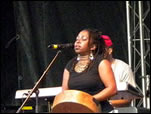
Chiwoniso Maraire (5 Mar 1976–24 July 2013). Zimbabwean singer, songwriter and mbira player. Chiwoniso has passed away of suspected pneumonia aged 37. She was the daughter of Zimbabwean mbira player and teacher Dumisani Maraire. Her mother, Linda Nemarundwe Maraire, known as Mai Chi, was also a singer.
Chiwoniso was born in the US where her father had moved his family and spent the first seven years of her life there. When she moved back to Zimbabwe she attended Mutare Girls’ High School and took evening classes at the University of Zimbabwe, where her father was teaching. She began playing mbira at the age of four and recorded her first album with her parents when she was nine. Aged 11 she was performing with her father and her siblings, Tawona and Ziyanai, in the family mbira group Mhuri yaMaraire (the Maraire Family). She also played in another of her father’s mbira groups Minanzi III (Musical Sounds 3).
When she was 15, Chiwoniso joined hip-hop trio A Peace of Ebony and then in 1996 hooked up with The Storm led by guitarist Andy Brown, who later became her husband before the couple divorced. She then fronted her own acoustic group Chiwoniso & Vibe Culture for several years. From 2001 to 2004, she was a core member of the multinational all-women band Women’s Voice. Over the last decade she had starred in film worked on soundtracks for movies and documentaries by several Zimbabwean writers and film producers. Chiwoniso was honoured by Radio France International for best newcomer for her debut album, ‘Ancient Voices’ in 1998 and was nominated in the Kora All-Africa Music Awards for best female vocals of Africa in 1999. The album entered the World Music Charts Europe three times.
Chiwoniso was involved in musical projects with the United Nations Development Programme and the 100th anniversary of the Nobel peace prize. She returned to her international solo career in 2008 with ‘Rebel Woman‘ on the Cumbancha label. The songs were in both Shona and English and included ‘Matsotsi (The Land of Thieves)’, about economic migrants unable to return home. Earlier this year she appeared at the Harare International Festival of the Arts with Baaba Maal and she was planning to go to Senegal to perform alongside Baaba Maal later this year.
She passed away at South Medical Hospital in Chitungwiza where she had been admitted 10 days earlier suffering from chest pains. She was buried at her rural home in Chakohwa village in Mutambara. Her ex-husband passed away last year and the couple leave two daughters, Chengeto and Chiedza.
FORTHCOMING NUBIART PROFILES
NUBIART: Focus on arts, business, education, health, political developments and the media.
AUG PROMOS
~ ‘LIFE FORCE MUSIC’ – Juwon Ogungbe [Second Generation - Out Now] This album kicks off with Juwon Ogungbe intoning “It’s always been a struggle to keep my head straight’ on ‘Keep On Being My Own Man’ and that sets the tone for this album of socio-political commentary and personal introspection.
Musically it is a mix of highlife, reggae, jazz, soul, dance and classical music under Juwon’s baritone. We loved ‘These Things Are Sent To Test Us’ and ‘Strong Willed’, a reggae-influenced love song which also expresses the need for resilience. ‘Doing My Black Thing’, which also gets the dance remix treatment as a bonus track, promotes the central need for people to learn and live from the examples of Afrikan history. While ‘Beautiful Thing’ is a jazzy appreciation of life.
We managed to catch Juwon and his band recently previewing an entirely different set, ‘African Divo Arts: Progress Ceremony’, a contemporary cycle of songs, chants and affirmations based on Yoruba rituals performed live with projected visuals. It encompasses concepts such as the intervention of ancestors, the need for collective work and responsibility (‘Mek We Chop Chop Together’ – do we eat to live or live to eat), an Afrikan paradise (‘City Shell’), an appeal for tolerance by followers of the Abrahamic faiths towards those who don’t share their faith or follow Traditional Afrikan Spirituality (‘Who Really Knows’), and criticism of Ajayi Crowther, who translated the King James Bible into Yoruba, for describing the orisha Eshu as a devil (‘We Give Thanks’) which earned itself a rousing encore. ‘African Divo Arts: Progress Ceremony’ is a work-in-progress which will in future feature a dance company, extended visuals and a light show. It will be performed next month as one of the final events at London’s iconic Africa Centre which will close its doors for good soon after. Web: www.juwonogungbe.co.uk
~ ‘EXILE’ - Nuru Kane [World Music Network – Out Now] Nuru Kane’s third album develops his Baye Fall Gnawa style alongside a mix of blues, reggae and Gypsy influences. The album kicks off with Nuru Kane expressing his hopes for and dedication to Afrika. The title track, Exile, is a kora-influenced track reflecting on the experiences of those forced to migrate from their homelands to escape economic hardship and political instability. ‘Yes We Kane’ is a self- endorsement of his worldview. Nuru Kane has been spending a lot of time in Europe recently and that comes to the fore on the dancehall reggae track ‘Issoire’, dedicated to his fans and supporters in the French Auvergne. Nuru Kane’s gnawa groove style can be heard on tracks such as ‘Sadye’ and also with him playing the guimbri on ‘Bambala’, a tribute to the Mouride Baye Fall leader Cheick Amadou Bamba. This fits alongside ‘Zikar’ about Sufi religious recitation. We missed Nuru Kane when he passed through London recently but this album certainly goes some way to making up for that. Visit Nuru Kane’s website: www.nurukaneandthebfg.com
NUBIART LIBRARY – AUG MEDIA
We will only review books we have read and DVDs we have seen and that are available at reasonable prices online or in shops or libraries. However, given the nature and current state of Afrikan publishing and film production there may be books and films on this list that are worth the extra effort to track down.
~ ‘A MEMEORY THIS SIZE AND OTHER STORIES: THE CAINE PRIZE FOR AFRICAN WRITING 2013’ – Various authors. [New Internationalist. ISBN: 978-1-78026-119-5] This anthology has the five shortlisted entries for this year’s prize as well as a dozen other short stories from the workshop. Nigeria’s Tope Folarin won this year’s prize for his short story ‘Miracle’ about the role of charismatic evangelical churches in diasporan Afrikan communities. By a quirk of fate - or whatever other forces are at work in the ether – Pede Hollist from Sierra Leone with ‘Foreign Aid’ was the only non-Nigerian among the four other contestants.
Our personal favourite from the anthology is Malawian Stanley Onjezani Kenani’s ‘Clapping Hands for a Smiling Crocodile’ about corporate exploitation of natural resources and the divisions it causes in a previously harmonious community in tune with its culture. It reminded us of our short story ‘Victims of the System’ from 1983. The title story Elnathan John’s ‘A Memory This Size’ looks back at the loss of a family member and the sombre memories its evokes. As with any modern anthology there has to be an e-mail / social media story and here it is Davina Kawuma’s ‘Stuck’ which accurately reflects some of the vacuousness dominating many people’s lives, especially those who think nothing of value exists unless it is tweeted, Facebooked or Google-able. They would be better devoting more time to developing their own personality and understanding the essence of human psychology and motivation.
As with any anthology it can be an uneven read and we can’t fail to agree with our literary inspiration Ngugi wa’Thiongo, who was in London recently with his writer sons for the Africa Writes Festival, that there is something strange about a prize for Afrikan literature that insists all the submissions must be in English. You would never hear about a literary prize for English writers where everything must be written in Chinese!!!
~ ALKEBU-LAN REVIVALIST MOVEMENT MOSIAH MONTH CELEBRATIONS. In 1998, The Alkebu-Lan Revivalist Movement renamed & designated the 8th Month of the year as Mosiah, coinciding with the Birthmonth of the prophet Marcus Mosiah Garvey & the UNIA-ACL’s (Papa Garvey’s organisation) “International Convention of The Afrikan People of The World”. Marcus Garvey led the largest and most comprehensive movement built in the name of Black Power, Afrikan Freedom and Self Reliance. All proud, strong and ambitious people celebrate the great events and great people of their history. ‘Rise You Mighty Race - You Can Accomplish What You Will!!! Garvey Lives!!!’ For full programme of events Tel: 020 8539 2154 / 07908 814 152. E-mail: arm6227@yahoo.co.uk
~ AFRICAN ODYSSEYS PRESENT ‘WE ♥ CARNIVAL SCREENINGS 2013’. Screenings, performance and discussion exploring the art, history, culture and politics of carnival in London and Trinidad. Films include ‘King Carnival’ (UK-USA-Germany 1973. Dir Horace Ove). With special guest Horace Ove and chair, Michael La Rose, GPI and Savannah View. On Sat 10 Aug at 11am-5pm at BFI Southbank, Belvedere Rd, London, SE1. Adm: £6, Tel: 020 7928 3232. Web: bfi.org.uk/africanodysseys
~ BLACK HISTORY STUDIES PRESENT
- ‘Exploring the Notions of Fatherhood & Black Masculinity in the UK’. On Wed 14 Aug at 7-9pm at PCS Headquarters, 160 Falcon Road, Clapham Junction, London, SW11 2LN. Adm: £5 / U-16 - Free. Dr Lez Henry, Social Anthropologist will present a lively and informative talk on Fatherhood and Black Masculinity. There will be a group discussion on how the fathering role has changed in the 21st Century and how can we support fathers in our community.
- ‘Marcus Garvey: A Giant of Black Politics’. Cabinet Launch & Quiz. On Sat 17 Aug at 5.30-9pm at the Marcus Garvey Library, Tottenham Green Centre, 1 Phillip Lane, Tottenham, London, N15 4JA. Adm: Free. This film traces Marcus Garvey’s early successes in organising Caribbean contract labour, to the phenomenal rise of his Universal Negro Improvement Association, which took America by storm in the 1920s. After Marcus Garvey’s imprisonment he returned to Jamaica, then went to London, where he passed away aged 53. His story is told by activist Mariamne Samad, UNIA members Roy Carson and Ruth Prescott and commentators Vivian Durham, Beverly Hamilton, Prof Rupert Lewis, Prof David Garrow and Sam Clayton. The documentary has a specially performed soundtrack by the legendary Mystic Revelation of Rastafari band. After the screening, there will be a fun quiz on the life of Marcus Garvey. On the night Black History Studies will be unveiling a new display cabinet donated by Black History Studies to the library.
- ‘Marcus Garvey: The Promised Ship’. On Fri 23 Aug at 7-9.30pm at the Marcus Garvey Library, Tottenham Green Centre, 1 Phillip Lane, Tottenham, London, N15 4JA. Adm: Free. ‘The Promised Ship’ is a documentary that follows the oral history of the Black Star Line, a maritime venture undertaken by Marcus Garvey, the leader of the first massive Black Power movement of the 20th Century. The Black Star Line was a steamship line intended to bring Afrikans across the Atlantic in search of their lost homelands. The old townspeople of Limon in Costa Rica recall the impact this adventure had on the banana barons and workers of the time.
- ‘WEB Du Bois: A Biography in Four Voices’. On Tues 27 Aug at 7-9pm at PCS Headquarters, 160 Falcon Road, Clapham Junction, London, SW11 2LN. Adm: £5 / U-16 - Free. In commemoration of the 50th anniversary of the death of Dr W.E.B DuBois, Black History Studies will be screening ‘WEB DuBois: A Biography in Four Voices’. The long and remarkable life of Dr. William Edward Burghardt (W.E.B) Du Bois (1868-1963) offers unique insights into an eventful century in Afrikan American history. Born three years after the end of the Civil War, Du Bois witnessed the imposition of Jim Crow, its defeat by the Civil Rights Movement and the triumph of Afrikan independence struggles. Du Bois was the consummate scholar-activist whose path-breaking works remain among the most significant and articulate ever produced on the subject of race. His contributions and legacy have been so far-reaching, that this, his first film biography, required the collaboration of four prominent African American writers. Wesley Brown, Thulani Davis, Toni Cade Bambara and Amiri Baraka narrate successive periods of Du Bois’ life and discuss its impact on their work: Part One: Black Folk and the New Century (1895-1915); Part Two: The Crisis and the New Negro (1919-1929); Part Three: A Second Reconstruction? (1934-1948); and Part Four: Color, Democracy, Colonies and Peace (1949-1963).
- ‘Marcus Garvey: Look for Me in the Whirlwind’. On Fri 30 Aug at 7-9.30pm at the Marcus Garvey Library, Tottenham Green Centre, 1 Phillip Lane, Tottenham, London, N15 4JA. Adm: Free. ‘Marcus Garvey: Look for Me in the Whirlwind’ is a controversial documentary which uses a wealth of archival footage, photographs and documents to uncover the story of this Jamaican immigrant who between 1916 and 1921 built what was the largest Black mass movement in World History. The screening will be followed by a question and answers where we will address the film and the factual inaccuracies highlighted by his son Julius W. Garvey, M.D.
For all events. Tel / Fax: 020 8881 0660. Mobile: 07951 234 233. E-mail: info@blackhistorystudies.com
~ JASON O’CONNOR COURT CASE. On Sun 9 June Jason O’Connor was viciously beaten in Camberwell, south London, by malicious, paranoid and prejudiced Metropolitan Police officers who believed that an Afrikan man making a phone call was suspicious behaviour meriting a stop and search. Absurdly Jason was subsequently charged with obstructing the police when in fact it should be the police facing charges for a brutal assault on an innocent man. He, his family and supporters have requested your attendance when the case comes up again on Thurs 15 Aug at 9.30am at Camberwell Green Magistrates Court, D’Eynsford Rd, Camberwell, London, SE5.
~ THE NATIONAL BLACK SUPPLEMENTARY SCHOOLS WEEK. NABSS is a grassroots organisation which aims to provide holistic solutions to the issues facing Afrikan families in educational institutions. This week-long seminar is a ‘must attend’ event covering a diverse range of topics with expert speakers and interactive sessions. Sessions include: Autism in BME communities; Afrikan genius past or present; Afrikan Scientists and Inventors; authors KN Chimbiri and Robin Walker; Setting up Income streams; How to be an Effective school governor; and Secrets of the Afro Comb book launch; On Fri 16-Fri 23 Aug. Tel: 07958 348 558. E-mail: info@nabss.org.uk Web: www.nabss.org.uk
~ THE AFRICAN CENTRE PRESENTS ‘THE GRIOT’S TALE’. Written and conceived by Tunde Jegede. ‘The Griot’s Tale’ represents a meeting point between music, poetry, dance and the visual image and features some of UK’s leading practitioners of Afrikan culture including choreographer Bode Lawal, actor and director Patrice Naiambana, visual artist and poet Taiwo Emmanuel Jegede, and filmmaker Sunara Begum to encourage new forms of storytelling. Exploring the role of a Griot both now and in the past, it is a story of a young man’s search for truth revealed through his journey into the unexpected and unknown drawing from sacred and ritualistic aspects of Afrikan mysticism as well as presenting contemporary styles of performance. On Tues 27 Aug–Mon 2 Sep at The Africa Centre, 38 King Street, London, WC2. Adm: £20 / £15. Web: www.africacentre.org.uk
~ ‘POPPABLE: NEW PAINTINGS BY ADJANI’. Adjani is fast becoming one of the most captivating Afrikan-Expressionist artists of our time. This solo exhibition at The Knight Webb Gallery offers a limited engagement to see the artist’s work up-close and personally. Until Sat 31 Aug at The Knight Webb Gallery, 54 Atlantic Road, Brixton, London, SW9 8PZ.
~ AUTOGRAPH EXHIBITION ‘EVER YOUNG: JAMES BARNOR’. Barnor’s archive of street and studio portraiture covers a remarkable period in history, bridging continents and photographic genres as it creates a transatlantic narrative marked by his passionate interest in people and cultures. This exhibition emerges as a direct result of major archival research undertaken by Autograph ABP in 2009-10, supported by the Heritage Lottery Fund. It features new prints made from Barnor’s digitally preserved negatives, as well as vintage photographs from the late 1940s to early 1970s including an expanded display of original ephemera such as magazine clippings, Ghanaian record covers, personal correspondences and photographs specially selected for Impressions Gallery and seen in public for the first time. Until 31 Aug at Impressions Gallery, Centenary Square, Bradford, BD1 1SD. Adm: Free.
~ THE AUSAR AUSET SOCIETY GI GONG CLASSES. Every Monday at 7.30–9pm at Hazel Road Community Centre, Hazel Road, Kensal Green, London, NW10 5PP. Adm: £5 per class. Tel: 07951- 252-427. E-mail: Tauinetwork.europe@gmail.com
~ YORKSHIRE SCULPTURE PARK PRESENTS ‘FABRIC-ATION’. Retrospective exhibition of Afrikan print fabrics and designs by Yinka Shonibare, MBE. Until Sat 1 Sep at Yorkshire Sculpture Park, West Bretton, Wakefield, West Yorkshire, WF4 4LG. Web: ysp.co.uk
~ ‘ORIGINS OF THE AFRO COMB: 6,000 YEARS OF CULTURE, POLITICS AND IDENTITY’. Exhibition of combs from pre-dynastic Egypt to the present day with full programme of seminars, gallery talks and film screenings. Until 28 Sep (MAA) and 3 Nov (FWM) at Museum of Archeology and Anthropology, Downing Street, Cambridge, CB2 3DZ. Tel; 01223 333 516. E-mail: admin@maa.cam.ac.uk Web: maa.cam.ac.uk and Fitzwilliam Museum, Trumpington Crescent, Cambridge, CB3 1RB. Tel: 01223 332 900. E-mail: fitzmuseum-enquiries@lists.cam.ac.uk Web: www.fitzmuseum.cam.ac.uk
~ NOH BUDGET FILMS PRESENT ACTIVE INQUIRY. Do you like being creative? Would you like to be part of a group who solve community problems through performing? ACTive Inquiry are inviting you to join our weekly participatory performance workshops exploring current affairs. The AI group carries out sketches, scenes, skits and other social commentary performances to raise awareness about problematic social issues. The stated goal of these performances is to make the public ‘think and ask questions’ and expose the lies around these injustices. Every Thurs at 6.30-9.30pm at Stockwell Park Community Trust, Crowhurst House, 21 Aytoun Place, Stockwell, London, SW9 0TE. Adm: £5. (Suggested donation to help cover room hire costs and refreshments but we would hate cost to be a barrier to participation so please pay what you can afford). Web: http://activeinquiry2013.eventbrite.com
Contact: Kubara Zamani, Afrikan Quest International, PO Box 35165, London, SE5 8WU. Tel: 07811 494 969. E-mail: afrikanquest@hotmail.com Web: www.southwark.tv/quest/aqhome.asp
External Links
Afrikan Quest International
~ THE EGYPTIAN COUP
When the army deposes a democratically elected President, detains him and most of his Cabinet members in army barracks before transferring them to prison, repeatedly massacres scores of people who protest, arrests over 300 members of the President’s party, issues arrest warrants for any other prominent members of the President’s party still at liberty, freezes the assets and finances of the President’s party and its members, charges the President with offences that occurred during a popular revolution against the previous President universally considered corrupt and installs then installs itself as the new government, Dude, that’s a coup!!! We doubt the political analysis and capabilities of anybody - Egyptian, European or American – who says otherwise.
While we hold no brief for the Muslim Brotherhood in Egypt we accept they were democratically elected.
President Morsi made some bad decisions such as the appointment of a senior member of the ex-militant group Gamaa Islamiya to oversee the tourist hub of Luxor. In 1997 before they renounced violence, Gamaa Islamiya massacred 58 tourists and four Egyptians at a temple site near Luxor. Local people staged a sit-in outside the governor’s offices until Mr Morsi overturned the decision. Mr Morsi and his Freedom and Justice Party were not in charge for long enough to make a major impact on the economic situation in the country. These are matters for political agitation not justifications for a coup. That their opponents, the protest movement coalesced around Tahrir Square, were unable to make political advantage of the Jan 25 movement or unseat President Mohamed Morsi is a sign of how weak they are as a political organisation capable of addressing the country’s problems. A protest movement protests – it can say no to anything and everything - but in the 30 months since the fall of President Mubarak they have still not been able to galvanise their popular support into a coherent political ideology that can take over the reins of government, provide political guidance that represents their demands and re-energise the Egyptian economy.
With recent visits to Afrika by US President Obama and his Secretary of State John Kerry the current Interim President Adly Al-Mansour and Defence Minister General Abdul Fatah Al-Sisi were given the green light to move against the Muslim Brotherhood. This is evident in that the major charge against President Morsi is nothing he did while running Egypt but the fact that he has an alliance with the Palestinian government in the Gaza Strip, Hamas. Mr Morsi been formally accused of the premeditated murder of prisoners, officers and soldiers when he and several Muslim Brotherhood leaders were freed during a breakout at a Cairo prison in January 2011. He is alleged to have plotted attacks on jails in the uprising that overthrew President Hosni Mubarak and is also accused of conspiring with Hamas. Since their compromise in the late 1970s the Egyptian military has always acted at the behest of US and Israeli regimes which is out of step with the majority of Egyptians who do not hesitate to express their solidarity with the Palestinians against the Israeli settler regime.
The African Union is getting fed up with all these coup plotters across the continent who do not have the social, political, economic or intellectual capacity to solve their nation’s problems yet try and dress themselves up in the flag of liberation and patriotic duty. That game is played out. Many of these Afrikan leaders have lived through truly revolutionary times and know who is really for the people and who is just using the rhetoric as a hustling story. The coup plotters have proposed: formed a panel to review the constitution; constitutional amendments are to be finalised and put to referendum in four months; parliamentary elections are to be held by early 2014; and presidential elections to be called once new parliament convenes. The acting Prime Minister Hazem al-Beblawi’s made a hollow offer to the Muslim Brotherhood to join them but how can they when their entire leadership is under arrest, facing warrants and their assets have been frozen.
Hisham Qandil, who was prime minister under President Morsi, proposed his own roadmap, but there was no official response to his suggestions. President Morsi’s supporters are demanding his reinstatement and have been holding a vigil outside the Rabaa al-Adawiya mosque, in the east of the capital, and at Cairo University in Giza since he was deposed on 3 July. On Friday afternoon, state TV reported that within the next 48 hours security forces would impose a blockade on the two protest camps, allowing people to leave but not to go in. The Muslim Brotherhood’s Ahrar 25 TV meanwhile said two new sit-ins had begun - one outside the Mustafa Mahmoud mosque in the southern Mohandessin district, and another in Alf Maskan in the east, near the capital’s international airport.
President Morsi’s family appealed to the International Criminal Court to launch an investigation into the events leading up to his removal from power. The family have had no contact with the former president since he was ousted. Repression, suppression and oppression are nothing new to the Muslim Brotherhood they have faced it in many countries in North Afrika and the Middle East since their founding eight decades ago. The situation across Egypt is becoming increasingly polarised with none of the political groupings commanding enough support across the country to break the deadlock. It could get very serious for the minority Christian Copts who make up 10% of the population. The new Coptic Pope, Tawadros II, openly criticised the ousted president, calling him a divisive figure who had set Egyptians against one another. He blessed President Morsi’s removal and was in attendance when General Abdul Fattah al-Sisi announced Mr Morsi’s removal from office. That could increase the threat against the Christians by Islamists who see the Tawadros as having endorsed an anti-democratic coup.
~ LIBYA
Protesters in Libya have attacked offices linked to the Muslim Brotherhood following the assassination of a prominent political activist. Abdelsalam al-Mismari was shot dead as he left a mosque in Benghazi in eastern Libya after Friday prayers. Demonstrators stormed offices of the Justice and Construction Party, the Brotherhood’s political wing in Benghazi. While in the Libyan capital, Tripoli, protesters stormed the headquarters of the JCP and as well as those of the secular National Forces Alliance on Saturday. They smashed windows and looted furniture at the offices. In separate attacks on Friday, retired air force Col Salem al-Sarah was killed as he emerged from a mosque and police Col Khatab Abdelrahim al-Zwei was shot dead at the wheel of his car, officials said.
Interpol has issued a global security alert linked to suspected al-Qaeda involvement in recent prison breakouts in Iraq, Libya and Pakistan, and asked its members to examine if they were connected. Around 1,200 inmates broke out of a jail in the restive Libyan city of Benghazi.
~ TUNISIA
A state funeral has been held for Tunisian Mohamed Brahmi leader of the nationalist Movement of the People party who was killed on 25 July by gunmen on a motorbike in the capital, Tunis. His death has sparked widespread unrest. One protester died in overnight clashes in the southern town of Gafsa. The interior minister said Mr Brahmi, 58, was killed with the same gun as a fellow left-wing politician, Chokri Belaid, who was shot dead in February. On Sat 27 July thousands of people lined the streets of Tunis as the coffin wrapped in the national flag passed by under military escort. Supporters of Mr Brahmi have turned their grief and anger on governing Islamist party Ennahda, with relatives accusing it of complicity in the killing. The government has rejected the allegations, instead naming a Salafist radical, Boubaker Hakim, as the main suspect and that the same gun was used to kill left-wing politician Chokri Belaid in February.
The day after the murder thousands of people took part in protests after the biggest trade union, UGTT, called a general strike to denounce general “terrorism, violence and murders”. Demonstrators attacked Ennahda’s headquarters in Sidi Bouzid, Mr Brahmi’s hometown and the birthplace of the Arab Spring revolutions which have swept the Middle East.
Tunisia’s Education Minister Salem Labyedh has resigned following Mohamed Brahmi assassination. Mr Labyedh, an independent, joined the government in March following the assassination of Chokri Belaid. On Tuesday, Interior Minister Lotfi Ben Jeddou raised the possibility of resigning following the killing of at least eight soldiers by suspected al-Qaeda-linked militants near the Algerian border. A junior secular party in the coalition, Ettakatol, has also warned it will withdraw from the Constituent Assembly (CA) if a new unity government is not formed. Prime Minister Ali Larayedh said the government would fulfil its mandate and hold elections in December.
~ MALI
Elections were held in Mali on Sun 28 July. No-one in the existing transitional government is allowed to stand so they are less likely to try to fix the result but Mali’s independent electoral commission has pointed out flaws in the electoral roll. More than 6.7 million biometric voters’ cards - so called Nina cards - have been produced, based on a list that was drawn up between 2009 and 2011. Nina cards carry one fatal flaw: They do not indicate the address of the holder’s polling station. This has to be obtained by SMS. As a result of the list being outdated, no 18-year-olds and only some 19-year-olds will be able to vote in the presidential election, which will go to a run-off on Sun 11 Aug between Ibrahim Boubacar Keita from the Rally for Mali (RPM) party under the slogan ‘For Mali’s honour’ who won 39.2% of the vote in the first round and Soumaila Cisse of the Union for the Republic and Democracy (URD) party who won 19.4% of the vote.
It is less than seven months since France sent 4,500 troops to oust Islamist insurgents occupying Mali’s northern regions. Those troops have now been scaled back to 3,200, with more set to leave as a United Nations force, known as Minusma, grows to a projected 12,600 uniformed personnel by the end of the year. But security concerns remain in the north; according to the UN’s refugee agency (UNHCR) some 527,000 people remain internally displaced or in refugee camps in neighbouring countries. They are from the volatile north and the vast majority of them will not be able to vote. Two election officials were briefly abducted in Kidal by the National Movement for the Liberation of Azawad (MNLA), even though its leadership has signed a ceasefire to enable the poll to take place. Under the June deal MNLA fighters are allowed to remain in the town but they are supposed to disarm. Kidal is the only town in Mali where the Tuaregs form a majority. The MNLA had been allied to the al-Qaeda-aligned groups in early 2012, but the alliance crumbled as the Islamists gained control of most of the territory in the north.
~ NIGERIA
Nigeria is planning to withdraw a full battalion of 850 soldiers out of its contingent of 1,200 from the UN peacekeeping force in Mali following the elections. Ivory Coast President Alassane Ouattara, head of the regional group Ecowas, said the troops were needed at home to tackle militant Islamists. The Nigerian contribution will be limited to 140 police, some staff officers and a field hospital based near the northern town of Timbuktu. Nigerian soldiers are also being pulled out of the joint UN-African Union mission in Sudan’s Darfur region.
The Nigerians are part of a force of 6,000 African troops who took over from a French-led mission on 1 July. French and West African troops drove militant Islamists out of northern Mali in February. The UN force - known by its French acronym Minusma - is now working with the Malian army to provide security for the election. It is due to be expanded to 11,200 troops, plus 1,400 police, by the end of the year.
More than 2,000 people have been killed since militant group Boko Haram launched its insurgency in 2009 to create an Islamic state in the mainly Muslim north of Nigeria. A state of emergency was declared on 14 May in the north-eastern states of Adamawa, Borno and Yobe, with more than 2,000 soldiers deployed to break up Boko Haram camps and insurgent operations.
Vigilante groups have formed in the northern Nigerian city of Maiduguri to fight Boko Haram, a move welcomed by the military as it battles to quell the insurgency. Civilians have been running checkpoints since early June, after the state of emergency was declared. The Nigerian military Joint Task Force (JTF) has welcomed the presence of the vigilantes on the streets of Maiduguri. Many of the soldiers deployed in northern Nigeria are from other parts of the country and do not know the Kanuri language, the most common used in Maiduguri. But there are already some reports from Maiduguri of vigilantes killing people, rather than handing suspects over to the army.
OBITUARY
Chiwoniso Maraire (5 Mar 1976–24 July 2013). Zimbabwean singer, songwriter and mbira player. Chiwoniso has passed away of suspected pneumonia aged 37. She was the daughter of Zimbabwean mbira player and teacher Dumisani Maraire. Her mother, Linda Nemarundwe Maraire, known as Mai Chi, was also a singer.
Chiwoniso was born in the US where her father had moved his family and spent the first seven years of her life there. When she moved back to Zimbabwe she attended Mutare Girls’ High School and took evening classes at the University of Zimbabwe, where her father was teaching. She began playing mbira at the age of four and recorded her first album with her parents when she was nine. Aged 11 she was performing with her father and her siblings, Tawona and Ziyanai, in the family mbira group Mhuri yaMaraire (the Maraire Family). She also played in another of her father’s mbira groups Minanzi III (Musical Sounds 3).
When she was 15, Chiwoniso joined hip-hop trio A Peace of Ebony and then in 1996 hooked up with The Storm led by guitarist Andy Brown, who later became her husband before the couple divorced. She then fronted her own acoustic group Chiwoniso & Vibe Culture for several years. From 2001 to 2004, she was a core member of the multinational all-women band Women’s Voice. Over the last decade she had starred in film worked on soundtracks for movies and documentaries by several Zimbabwean writers and film producers. Chiwoniso was honoured by Radio France International for best newcomer for her debut album, ‘Ancient Voices’ in 1998 and was nominated in the Kora All-Africa Music Awards for best female vocals of Africa in 1999. The album entered the World Music Charts Europe three times.
Chiwoniso was involved in musical projects with the United Nations Development Programme and the 100th anniversary of the Nobel peace prize. She returned to her international solo career in 2008 with ‘Rebel Woman‘ on the Cumbancha label. The songs were in both Shona and English and included ‘Matsotsi (The Land of Thieves)’, about economic migrants unable to return home. Earlier this year she appeared at the Harare International Festival of the Arts with Baaba Maal and she was planning to go to Senegal to perform alongside Baaba Maal later this year.
She passed away at South Medical Hospital in Chitungwiza where she had been admitted 10 days earlier suffering from chest pains. She was buried at her rural home in Chakohwa village in Mutambara. Her ex-husband passed away last year and the couple leave two daughters, Chengeto and Chiedza.
FORTHCOMING NUBIART PROFILES
NUBIART: Focus on arts, business, education, health, political developments and the media.
AUG PROMOS
~ ‘LIFE FORCE MUSIC’ – Juwon Ogungbe [Second Generation - Out Now] This album kicks off with Juwon Ogungbe intoning “It’s always been a struggle to keep my head straight’ on ‘Keep On Being My Own Man’ and that sets the tone for this album of socio-political commentary and personal introspection.
Musically it is a mix of highlife, reggae, jazz, soul, dance and classical music under Juwon’s baritone. We loved ‘These Things Are Sent To Test Us’ and ‘Strong Willed’, a reggae-influenced love song which also expresses the need for resilience. ‘Doing My Black Thing’, which also gets the dance remix treatment as a bonus track, promotes the central need for people to learn and live from the examples of Afrikan history. While ‘Beautiful Thing’ is a jazzy appreciation of life.
We managed to catch Juwon and his band recently previewing an entirely different set, ‘African Divo Arts: Progress Ceremony’, a contemporary cycle of songs, chants and affirmations based on Yoruba rituals performed live with projected visuals. It encompasses concepts such as the intervention of ancestors, the need for collective work and responsibility (‘Mek We Chop Chop Together’ – do we eat to live or live to eat), an Afrikan paradise (‘City Shell’), an appeal for tolerance by followers of the Abrahamic faiths towards those who don’t share their faith or follow Traditional Afrikan Spirituality (‘Who Really Knows’), and criticism of Ajayi Crowther, who translated the King James Bible into Yoruba, for describing the orisha Eshu as a devil (‘We Give Thanks’) which earned itself a rousing encore. ‘African Divo Arts: Progress Ceremony’ is a work-in-progress which will in future feature a dance company, extended visuals and a light show. It will be performed next month as one of the final events at London’s iconic Africa Centre which will close its doors for good soon after. Web: www.juwonogungbe.co.uk
~ ‘EXILE’ - Nuru Kane [World Music Network – Out Now] Nuru Kane’s third album develops his Baye Fall Gnawa style alongside a mix of blues, reggae and Gypsy influences. The album kicks off with Nuru Kane expressing his hopes for and dedication to Afrika. The title track, Exile, is a kora-influenced track reflecting on the experiences of those forced to migrate from their homelands to escape economic hardship and political instability. ‘Yes We Kane’ is a self- endorsement of his worldview. Nuru Kane has been spending a lot of time in Europe recently and that comes to the fore on the dancehall reggae track ‘Issoire’, dedicated to his fans and supporters in the French Auvergne. Nuru Kane’s gnawa groove style can be heard on tracks such as ‘Sadye’ and also with him playing the guimbri on ‘Bambala’, a tribute to the Mouride Baye Fall leader Cheick Amadou Bamba. This fits alongside ‘Zikar’ about Sufi religious recitation. We missed Nuru Kane when he passed through London recently but this album certainly goes some way to making up for that. Visit Nuru Kane’s website: www.nurukaneandthebfg.com
NUBIART LIBRARY – AUG MEDIA
We will only review books we have read and DVDs we have seen and that are available at reasonable prices online or in shops or libraries. However, given the nature and current state of Afrikan publishing and film production there may be books and films on this list that are worth the extra effort to track down.
~ ‘A MEMEORY THIS SIZE AND OTHER STORIES: THE CAINE PRIZE FOR AFRICAN WRITING 2013’ – Various authors. [New Internationalist. ISBN: 978-1-78026-119-5] This anthology has the five shortlisted entries for this year’s prize as well as a dozen other short stories from the workshop. Nigeria’s Tope Folarin won this year’s prize for his short story ‘Miracle’ about the role of charismatic evangelical churches in diasporan Afrikan communities. By a quirk of fate - or whatever other forces are at work in the ether – Pede Hollist from Sierra Leone with ‘Foreign Aid’ was the only non-Nigerian among the four other contestants.
Our personal favourite from the anthology is Malawian Stanley Onjezani Kenani’s ‘Clapping Hands for a Smiling Crocodile’ about corporate exploitation of natural resources and the divisions it causes in a previously harmonious community in tune with its culture. It reminded us of our short story ‘Victims of the System’ from 1983. The title story Elnathan John’s ‘A Memory This Size’ looks back at the loss of a family member and the sombre memories its evokes. As with any modern anthology there has to be an e-mail / social media story and here it is Davina Kawuma’s ‘Stuck’ which accurately reflects some of the vacuousness dominating many people’s lives, especially those who think nothing of value exists unless it is tweeted, Facebooked or Google-able. They would be better devoting more time to developing their own personality and understanding the essence of human psychology and motivation.
As with any anthology it can be an uneven read and we can’t fail to agree with our literary inspiration Ngugi wa’Thiongo, who was in London recently with his writer sons for the Africa Writes Festival, that there is something strange about a prize for Afrikan literature that insists all the submissions must be in English. You would never hear about a literary prize for English writers where everything must be written in Chinese!!!
Chiwoniso Maraire
Nubiart Diary
~ ALKEBU-LAN REVIVALIST MOVEMENT MOSIAH MONTH CELEBRATIONS. In 1998, The Alkebu-Lan Revivalist Movement renamed & designated the 8th Month of the year as Mosiah, coinciding with the Birthmonth of the prophet Marcus Mosiah Garvey & the UNIA-ACL’s (Papa Garvey’s organisation) “International Convention of The Afrikan People of The World”. Marcus Garvey led the largest and most comprehensive movement built in the name of Black Power, Afrikan Freedom and Self Reliance. All proud, strong and ambitious people celebrate the great events and great people of their history. ‘Rise You Mighty Race - You Can Accomplish What You Will!!! Garvey Lives!!!’ For full programme of events Tel: 020 8539 2154 / 07908 814 152. E-mail: arm6227@yahoo.co.uk~ AFRICAN ODYSSEYS PRESENT ‘WE ♥ CARNIVAL SCREENINGS 2013’. Screenings, performance and discussion exploring the art, history, culture and politics of carnival in London and Trinidad. Films include ‘King Carnival’ (UK-USA-Germany 1973. Dir Horace Ove). With special guest Horace Ove and chair, Michael La Rose, GPI and Savannah View. On Sat 10 Aug at 11am-5pm at BFI Southbank, Belvedere Rd, London, SE1. Adm: £6, Tel: 020 7928 3232. Web: bfi.org.uk/africanodysseys
~ BLACK HISTORY STUDIES PRESENT
- ‘Exploring the Notions of Fatherhood & Black Masculinity in the UK’. On Wed 14 Aug at 7-9pm at PCS Headquarters, 160 Falcon Road, Clapham Junction, London, SW11 2LN. Adm: £5 / U-16 - Free. Dr Lez Henry, Social Anthropologist will present a lively and informative talk on Fatherhood and Black Masculinity. There will be a group discussion on how the fathering role has changed in the 21st Century and how can we support fathers in our community.
- ‘Marcus Garvey: A Giant of Black Politics’. Cabinet Launch & Quiz. On Sat 17 Aug at 5.30-9pm at the Marcus Garvey Library, Tottenham Green Centre, 1 Phillip Lane, Tottenham, London, N15 4JA. Adm: Free. This film traces Marcus Garvey’s early successes in organising Caribbean contract labour, to the phenomenal rise of his Universal Negro Improvement Association, which took America by storm in the 1920s. After Marcus Garvey’s imprisonment he returned to Jamaica, then went to London, where he passed away aged 53. His story is told by activist Mariamne Samad, UNIA members Roy Carson and Ruth Prescott and commentators Vivian Durham, Beverly Hamilton, Prof Rupert Lewis, Prof David Garrow and Sam Clayton. The documentary has a specially performed soundtrack by the legendary Mystic Revelation of Rastafari band. After the screening, there will be a fun quiz on the life of Marcus Garvey. On the night Black History Studies will be unveiling a new display cabinet donated by Black History Studies to the library.
- ‘Marcus Garvey: The Promised Ship’. On Fri 23 Aug at 7-9.30pm at the Marcus Garvey Library, Tottenham Green Centre, 1 Phillip Lane, Tottenham, London, N15 4JA. Adm: Free. ‘The Promised Ship’ is a documentary that follows the oral history of the Black Star Line, a maritime venture undertaken by Marcus Garvey, the leader of the first massive Black Power movement of the 20th Century. The Black Star Line was a steamship line intended to bring Afrikans across the Atlantic in search of their lost homelands. The old townspeople of Limon in Costa Rica recall the impact this adventure had on the banana barons and workers of the time.
- ‘WEB Du Bois: A Biography in Four Voices’. On Tues 27 Aug at 7-9pm at PCS Headquarters, 160 Falcon Road, Clapham Junction, London, SW11 2LN. Adm: £5 / U-16 - Free. In commemoration of the 50th anniversary of the death of Dr W.E.B DuBois, Black History Studies will be screening ‘WEB DuBois: A Biography in Four Voices’. The long and remarkable life of Dr. William Edward Burghardt (W.E.B) Du Bois (1868-1963) offers unique insights into an eventful century in Afrikan American history. Born three years after the end of the Civil War, Du Bois witnessed the imposition of Jim Crow, its defeat by the Civil Rights Movement and the triumph of Afrikan independence struggles. Du Bois was the consummate scholar-activist whose path-breaking works remain among the most significant and articulate ever produced on the subject of race. His contributions and legacy have been so far-reaching, that this, his first film biography, required the collaboration of four prominent African American writers. Wesley Brown, Thulani Davis, Toni Cade Bambara and Amiri Baraka narrate successive periods of Du Bois’ life and discuss its impact on their work: Part One: Black Folk and the New Century (1895-1915); Part Two: The Crisis and the New Negro (1919-1929); Part Three: A Second Reconstruction? (1934-1948); and Part Four: Color, Democracy, Colonies and Peace (1949-1963).
- ‘Marcus Garvey: Look for Me in the Whirlwind’. On Fri 30 Aug at 7-9.30pm at the Marcus Garvey Library, Tottenham Green Centre, 1 Phillip Lane, Tottenham, London, N15 4JA. Adm: Free. ‘Marcus Garvey: Look for Me in the Whirlwind’ is a controversial documentary which uses a wealth of archival footage, photographs and documents to uncover the story of this Jamaican immigrant who between 1916 and 1921 built what was the largest Black mass movement in World History. The screening will be followed by a question and answers where we will address the film and the factual inaccuracies highlighted by his son Julius W. Garvey, M.D.
For all events. Tel / Fax: 020 8881 0660. Mobile: 07951 234 233. E-mail: info@blackhistorystudies.com
~ JASON O’CONNOR COURT CASE. On Sun 9 June Jason O’Connor was viciously beaten in Camberwell, south London, by malicious, paranoid and prejudiced Metropolitan Police officers who believed that an Afrikan man making a phone call was suspicious behaviour meriting a stop and search. Absurdly Jason was subsequently charged with obstructing the police when in fact it should be the police facing charges for a brutal assault on an innocent man. He, his family and supporters have requested your attendance when the case comes up again on Thurs 15 Aug at 9.30am at Camberwell Green Magistrates Court, D’Eynsford Rd, Camberwell, London, SE5.
~ THE NATIONAL BLACK SUPPLEMENTARY SCHOOLS WEEK. NABSS is a grassroots organisation which aims to provide holistic solutions to the issues facing Afrikan families in educational institutions. This week-long seminar is a ‘must attend’ event covering a diverse range of topics with expert speakers and interactive sessions. Sessions include: Autism in BME communities; Afrikan genius past or present; Afrikan Scientists and Inventors; authors KN Chimbiri and Robin Walker; Setting up Income streams; How to be an Effective school governor; and Secrets of the Afro Comb book launch; On Fri 16-Fri 23 Aug. Tel: 07958 348 558. E-mail: info@nabss.org.uk Web: www.nabss.org.uk
~ THE AFRICAN CENTRE PRESENTS ‘THE GRIOT’S TALE’. Written and conceived by Tunde Jegede. ‘The Griot’s Tale’ represents a meeting point between music, poetry, dance and the visual image and features some of UK’s leading practitioners of Afrikan culture including choreographer Bode Lawal, actor and director Patrice Naiambana, visual artist and poet Taiwo Emmanuel Jegede, and filmmaker Sunara Begum to encourage new forms of storytelling. Exploring the role of a Griot both now and in the past, it is a story of a young man’s search for truth revealed through his journey into the unexpected and unknown drawing from sacred and ritualistic aspects of Afrikan mysticism as well as presenting contemporary styles of performance. On Tues 27 Aug–Mon 2 Sep at The Africa Centre, 38 King Street, London, WC2. Adm: £20 / £15. Web: www.africacentre.org.uk
~ ‘POPPABLE: NEW PAINTINGS BY ADJANI’. Adjani is fast becoming one of the most captivating Afrikan-Expressionist artists of our time. This solo exhibition at The Knight Webb Gallery offers a limited engagement to see the artist’s work up-close and personally. Until Sat 31 Aug at The Knight Webb Gallery, 54 Atlantic Road, Brixton, London, SW9 8PZ.
~ AUTOGRAPH EXHIBITION ‘EVER YOUNG: JAMES BARNOR’. Barnor’s archive of street and studio portraiture covers a remarkable period in history, bridging continents and photographic genres as it creates a transatlantic narrative marked by his passionate interest in people and cultures. This exhibition emerges as a direct result of major archival research undertaken by Autograph ABP in 2009-10, supported by the Heritage Lottery Fund. It features new prints made from Barnor’s digitally preserved negatives, as well as vintage photographs from the late 1940s to early 1970s including an expanded display of original ephemera such as magazine clippings, Ghanaian record covers, personal correspondences and photographs specially selected for Impressions Gallery and seen in public for the first time. Until 31 Aug at Impressions Gallery, Centenary Square, Bradford, BD1 1SD. Adm: Free.
~ THE AUSAR AUSET SOCIETY GI GONG CLASSES. Every Monday at 7.30–9pm at Hazel Road Community Centre, Hazel Road, Kensal Green, London, NW10 5PP. Adm: £5 per class. Tel: 07951- 252-427. E-mail: Tauinetwork.europe@gmail.com
~ YORKSHIRE SCULPTURE PARK PRESENTS ‘FABRIC-ATION’. Retrospective exhibition of Afrikan print fabrics and designs by Yinka Shonibare, MBE. Until Sat 1 Sep at Yorkshire Sculpture Park, West Bretton, Wakefield, West Yorkshire, WF4 4LG. Web: ysp.co.uk
~ ‘ORIGINS OF THE AFRO COMB: 6,000 YEARS OF CULTURE, POLITICS AND IDENTITY’. Exhibition of combs from pre-dynastic Egypt to the present day with full programme of seminars, gallery talks and film screenings. Until 28 Sep (MAA) and 3 Nov (FWM) at Museum of Archeology and Anthropology, Downing Street, Cambridge, CB2 3DZ. Tel; 01223 333 516. E-mail: admin@maa.cam.ac.uk Web: maa.cam.ac.uk and Fitzwilliam Museum, Trumpington Crescent, Cambridge, CB3 1RB. Tel: 01223 332 900. E-mail: fitzmuseum-enquiries@lists.cam.ac.uk Web: www.fitzmuseum.cam.ac.uk
~ NOH BUDGET FILMS PRESENT ACTIVE INQUIRY. Do you like being creative? Would you like to be part of a group who solve community problems through performing? ACTive Inquiry are inviting you to join our weekly participatory performance workshops exploring current affairs. The AI group carries out sketches, scenes, skits and other social commentary performances to raise awareness about problematic social issues. The stated goal of these performances is to make the public ‘think and ask questions’ and expose the lies around these injustices. Every Thurs at 6.30-9.30pm at Stockwell Park Community Trust, Crowhurst House, 21 Aytoun Place, Stockwell, London, SW9 0TE. Adm: £5. (Suggested donation to help cover room hire costs and refreshments but we would hate cost to be a barrier to participation so please pay what you can afford). Web: http://activeinquiry2013.eventbrite.com
Contact: Kubara Zamani, Afrikan Quest International, PO Box 35165, London, SE5 8WU. Tel: 07811 494 969. E-mail: afrikanquest@hotmail.com Web: www.southwark.tv/quest/aqhome.asp
Afrikan Quest International
External Links
Afrikan Quest International
Ligali is not responsible for the content of third party sites
Get involved and help change our world