MARK DUGGAN KILLING VERDICT
All sane people were shocked - though possibly not surprised - when the inquest jury brought back the verdict on Wed 8 Jan 2014 that the Metropolitan Police had lawfully killed Mark Duggan on Thurs 4 Aug 2011 although accepting that he was unarmed when officer V53 shot him twice terminating his life with extreme prejudice. The jury system was again exposed for its inability to deliver justice in cases involving excessive police force, Afrikan victims and false media propaganda. The majority of jury members can be considered to have ‘bottled it’ and shown supreme cowardice in the face of factual evidence, witness statements and police incompetence. The decision allows British police forces to continue to behave as though it is open season to harass, intimidate, frame, abuse and kill Afrikans with impunity.
The gun was found 20ft away from Mark Duggan’s body on the other side of a wall and fence. It was often reported as being between 3-6m away in order to make out that it was found near the body as if it had been dropped as Mark Duggan fell. None of the officers at the scene, the taxi driver or the resident filming the incident from a nearby block of flats saw how the gun, which did not have any of Mark Duggan’s DNA on it, or the sock it was wrapped in, reached there in the time Mark Duggan was stopped and shot despite officer V53 claiming that Mark Duggan pointed a gun at him as if to fire. Mark did not come out the car with the gun and it has been revealed that the cab windows do not open so there was no way he could have thrown something of that size through the window. We start getting into the Cress Theory of Color Confrontation, as expressed by Dr Frances Cress Welsing in her book ‘The Isis Papers: The Key to the Colors’, where police prejudice, racism, paranoia and malice makes them believe or perceive that every Afrikan man is carrying a gun. They told this lie with the killing Azelle Rodney in London when it was proved that the officer who shot him had lied as it was shown he could not see the trajectory he claimed justified the firing of seven shots into an unarmed man. We saw it again in New York with the killing of Amadou Diallo where the NYPD in their divinely ordained ‘intelligence’ tried to claim that a man’s wallet was a gun. And that is only the As!!!
The police also claim that these Afrikan men they encounter are the strongest, most violent men they have ever encountered in their 25 years as a police officer and rugby prop forward. This is to justify strangling men, tasering and beating people with truncheons and then telling them not to move or try and protect their body from further blows, positional asphyxia, officers putting their knee in a man’s back while he is on the ground, ignoring people’s pleas that they can’t breathe and waiting until people go limp while handcuffed before checking if the person is still alive.
The police first claimed Mark Duggan shot at them and an officer was only saved from serious injury because the shot miraculously shattered his police radio. It turned out that shot was fired by the same officer who shot Mark. Mark Duggan had no gunshot residue on his hands or clothes. And before anyone thinks we’ve missed something the ‘split second’ that the police claimed they had to decide whether to fire would not allow even Harry Houdini to remove and discard gloves.
The police then claimed Mark Duggan was among the 48 most dangerous criminals in Europe so why was he going to pick up a gun that had been used by Kevin Hutchison-Foster in a previous assault. Anyone caught with that gun would have been charged with the assault as well as the gun possession thus increasing their jail time - a bit of a stupid move for a Mr Big! The editor of the local paper which covers Tottenham crime stories said neither he nor any of his journalists had ever come across the name of Mark Duggan who had lived in the area all his life. Mark Duggan’s convictions were for cannabis possession and handling stolen goods. Hardly the Krays, Richardsons, Biggs or Adams. Although he was questioned for more serious crimes he was never convicted of any and in certain areas police would drop a Section 44 or Section 60 Order dragnet which allowed them to stop and search people without a reason so being questioned is not an indicator of having any connection to an incident.
The car Mark Duggan was travelling in was quickly removed from the scene for four hours before the forensics work was completed then returned allowing the police time to plant or clear evidence as suits their version of events. As for the police version the officers involved in the shooting refused to answer questions under oath from the (non-) Independent Police Complaints Commission. That is why these inquiries take so long as police are working on behalf of the IPCC yet ensuring that their confederates do not have to face any charges for their clear abuses of power and process. So by the time the story reaches a jury the version presented is full of grey areas, omissions, elisions and media propaganda from journalists who have paid police for stories. The jury is then given the runaround by lawyers and misdirected by the judge and court clerks as obvious lines of inquiry are ruled out. On top of that the jury members have their own prejudices, intellectual limitations and ignorance. It is easy to find 10 people in London we disagree with and whose opinions we would never seek and would certainly never follow so we don’t have to agree with a jury’s decision if it is a miscarriage of justice that is a reflection and expression of a criminal political system and a perversion of justice.
After the verdict the Metropolitan Police Assistant Commissioner Mark Rowley kept repeating his mantra that no police officers go to work to kill people. Well we could start with the police beating and killing of David Oluwale in 1969 who was thrown in the River Aire in Leeds. The judge in his infinite wisdom did not believe the police would behave in such a manner and said that just because people wear police uniforms, act like police and claim to be police doesn’t mean they are police. The police propaganda offensive continued even after the verdict when they put out statements that they had ‘intelligence’ that the family vigil planned for Sat 11 Jan was being infiltrated by those seeking to engage in ‘violence’. Then after the event passed off peacefully the coroner announced a plan to co-opt and neutralise members of the Duggan family by giving them an advisory role on how the police organise their future shootouts. British justice at its finest!!!
OBITUARIES
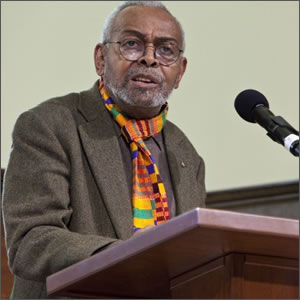
~ AMIRI BARAKA (Everett LeRoi Jones) [7 Oct 1934 – 9 Jan 2014]. Poet, author, playwright, scriptwriter, activist. Amiri Baraka has passed away in hospital in New Jersey where he had been in intensive care unit for one month prior to his death. He had suffered for years with diabetes.
Born and raised in Newark, New Jersey, Amiri Baraka won a scholarship to Rutgers University in 1951, transferring in 1952 to Howard University, which he left without obtaining a degree. Baraka also studied at Columbia University and the New School for Social Research without obtaining a degree. In 1954, he joined the US Air Force as a gunner, reaching the rank of sergeant. After an anonymous letter to his commanding officer accusing him of being a communist led to the discovery of Soviet writings, Baraka was given a dishonorable discharge for violation of his oath of duty.
Baraka moved to Greenwich Village working initially in a warehouse for music records sparking his deep interest in jazz. At the same time he came into contact with avant-garde Beat Generation, Black Mountain poets and New York School poets. In 1958 he married Hettie Cohen, with whom he had two daughters, Kellie Jones (b. 1959) and Lisa Jones (b.1961). He and Hettie founded Totem Press, which publishing Jack Kerouac and Allen Ginsberg They also jointly founded a quarterly literary magazine ‘Yugen’, which ran for eight issues (1958–62). Baraka also worked as editor and critic for the literary and arts journal ‘Kulchur’ (1960–65). With Diane di Prima he edited the first twenty-five issues (1961–63) of the magazine ‘The Floating Bear’. In the autumn of 1961 he co-founded the New York Poets Theatre with di Prima, choreographers Fred Herko and James Waring, and actor Alan S. Marlowe. He and di Prima had a daughter, Dominique, born in June 1962.
Baraka visited Cuba in July 1960 with a Fair Play for Cuba Committee delegation and reported his impressions in his essay ‘Cuba libre’. In 1961 he co-authored a ‘Declaration of Conscience’ in support of Fidel Castro‘s government. Baraka also was a member of the Umbra Poets Workshop of emerging Afrikan Nationalist writers (Ishmael Reed, and Lorenzo Thomas among others) on the Lower East Side.
Baraka saw poetry as a weapon of action. His poetry demanded violence against those he felt were responsible for an unjust society. He published his first poetry collection ‘Preface to a Twenty Volume Suicide Note’ in 1961. Among his better-known works are the non-fiction book ‘Blues People: Negro Music in White America’ and the poetry collection ‘The Dead Lecturer’. He received an Obie Award in 1964 for his play ‘Dutchman’.
After the 1965 assassination of Malcolm X, Baraka played a principal role in the creation of the Black Arts Movement, as the head of a theatre and school in Harlem. He also divorced his wife, writer Hettie Cohen, with whom he had founded the literary magazine Yugen. “The Black Artist’s role in America is to aid in the destruction of America as he knows it,” Baraka wrote in his landmark Black Art manifesto published that year. In 1967, he was arrested in Newark for having allegedly carried an illegal weapon and resisting arrest during the Newark riots, and was sentenced to three years in prison which was reversed on appeal.
It was in 1967, while Baraka was teaching in San Francisco he visited Maulana Karenga in Los Angeles and became an advocate of his philosophy of Kawaida, an Afrikan-centred philosophy that produced the Nguzo Saba, Kwanzaa, and an emphasis on Afrikan names. It was at this time that he adopted the name Imamu Amear Baraka. He dropped the honorific Imamu and eventually changed Amear (Prince) to Amiri. Baraka means ‘blessing, in the sense of divine favor.’ In 1970 he strongly supported Kenneth A. Gibson‘s candidacy for mayor of Newark; Gibson was elected the city’s first Afro-American Mayor.
Baraka’s separation from the Black Arts Movement began because he saw certain Afrikan writers – capitulationists, as he called them – countering the Black Arts Movement that he created. In 1979 he became a lecturer in Stony Brook University‘s eventually becoming professor emeritus of Africana Studies Department. In 1989 Baraka won an American Book Award for his works as well as a Langston Hughes Award. In 1990 he co-authored the autobiography of Quincy Jones, and 1998 was a supporting actor in Warren Beatty‘s film ‘Bulworth‘. In 1996, Baraka contributed to the AIDS benefit album ‘Offbeat: A Red Hot Soundtrip‘ produced by the Red Hot Organization. Baraka collaborated with hip-hop group The Roots on the song ‘Something in the Way of Things (In Town)’ on their 2002 album ‘Phrenology‘.
Baraka taught at Yale and George Washington Universities and spent 20 years teaching at the State University of New York. In 2002, during the Geraldine R Dodge Poetry Festival in Stanhope, New Jersey, Baraka, as poet laureate of New Jersey, first read his 2001 poem ‘Somebody Blew Up America’, about the 11 Sep 2001 attacks for which was accused of ‘anti-Semitism’. [Editor’s Note: ‘Jews’ / ‘Yehudi’, etc, have taken the terms ‘Semitic’ / ‘Semite’ / ‘Semitism’ to refer exclusively to them which is not a definition we at Nubiart Diary will ever accept as we base our understanding on historical, geographical and linguistic accuracy and will address that extensively in forthcoming issues.] Baraka refused then-New Jersey Governor Jim McGreevey’s request for him to resign and, in response, a state law was passed eliminating the position of poet laureate. In support of Baraka a nine-member advisory board named him the poet laureate of the Newark Public Schools in December 2002.
Baraka received honors from a number of prestigious foundations, including: fellowships from the Guggenheim Foundation and the National Endowment for the Arts, the Langston Hughes Award from the City College of New York, the Rockefeller Foundation Award for Drama, an induction into the American Academy of Arts and Letters the Before Columbus Foundation Lifetime Achievement Award and The PEN Open Book Award, formerly known as the Beyond Margins Award, in 2008 for ‘Tales of the Out and the Gone’.
Amiri Baraka is survived by his second wife Amina - whom he married in 1966 - and eight children. One daughter, Shani Baraka, was murdered in 2003.
Works
Poetry
• 1961: ‘Preface to a Twenty Volume Suicide Note’
• 1964: ‘The Dead Lecturer: Poems’
• 1969: ‘Black Magic’
• 1970: ‘It’s Nation Time’
• 1970: ‘Slave Ship’
• 1975: ‘Hard Facts’
• 1980: ‘New Music, New Poetry (India Navigation)’
• 1995: ‘Transbluesency: The Selected Poems of Amiri Baraka / LeRoi Jones’
• 1995: ‘Wise, Why’s Y’s’
• 1996: ‘Funk Lore: New Poems’
• 2003: ‘Somebody Blew Up America & Other Poems’
• 2005: ‘The Book of Monk’
Drama
• 1964: ‘Dutchman’
• 1964: ‘The Slave’
• 1967: ‘The Baptism and The Toilet’
• 1966: ‘A Black Mass‘
• 1969: ‘Four Black Revolutionary Plays’
• 1978: ‘The Motion of History and Other Plays’
Fiction
• 1965: ‘The System of Dante’s Hell‘
• 1967: ‘Tales’
• 2006: ‘Tales of the Out & the Gone’
Non-fiction
• 1963: ‘Blues People: Negro Music in White America‘
• 1965: ‘Home: Social Essays’
• 1968: ‘Black Music’
• 1971: ‘Raise Race Rays Raize: Essays Since 1965’
• 1979: ‘Poetry for the Advanced’
• 1981: ‘Reggae or not!’
• 1984: ‘Daggers and Javelins: Essays 1974–1979’
• 1984: ‘The Autobiography of LeRoi Jones / Amiri Baraka’
• 1987: ‘The Music: Reflections on Jazz and Blues’
• 2003: ‘The Essence of Reparations’
Edited works
• 1968: ‘Black Fire: An Anthology of Afro-American Writing’ (co-editor, with Larry Neal)
• 1969: ‘Four Black Revolutionary Plays’
• 1983: ‘Confirmation: An Anthology of African American Women’ (edited with Amina Baraka)
• 1999: ‘The LeRoi Jones / Amiri Baraka Reader’
• 2000: ‘The Fiction of LeRoi Jones / Amiri Baraka’
• 2008: ‘Billy Harper: Blueprints of Jazz, Volume 2’ (Audio CD)
Filmography
• ‘One P.M.’ (1972)
• ‘Fried Shoes Cooked Diamonds’ (1978)
• ‘Black Theatre: The Making of a Movement’ (1978)
• ‘Poetry in Motion‘ (1982)
• ‘Furious Flower: A Video Anthology of African American Poetry 1960–95, Volume II: Warriors’ (1998)
• ‘Through Many Dangers: The Story of Gospel Music’ (1996)
• ‘Bulworth‘ (1998)
• ‘Piñero‘ (2001)
• ‘Strange Fruit’ (2002)
• ‘Ralph Ellison: An American Journey’ (2002)
• ‘Chisholm ‘72: Unbought & Unbossed’ (2004)
• ‘Keeping Time: The Life, Music & Photography of Milt Hinton’ (2004)
• ‘Hubert Selby Jr: It / ll Be Better Tomorrow‘ (2005)
• ‘500 Years Later‘ (2005) (voice)
• ‘The Ballad of Greenwich Village’ (2005)
• ‘The Pact’ (2006)
• ‘Retour à Gorée (Return to Goree)’ (2007)
• ‘Polis Is This: Charles Olson and the Persistence of Place’ (2007)
• ‘Revolution ‘67’ (2007)
• ‘Turn Me On’ (2007) (TV)
• ‘Oscene’ (2007)
• ‘Corso: The Last Beat’ (2008)
• ‘The Black Candle‘ (2008)
• ‘Ferlinghetti: A City Light’ (2008)
• ‘Motherland‘ (2010)
~ EUSEBIO DA SILVA FERREIRA [25 Jan 1942- 5 Jan 2014]. Footballer, sports administrator and ambassador. The Mozambican and Portuguese footballing legend Eusebio has passed away from a heart attack at the age of 71.
Born in Mozambique when it was still a Portuguese colony, Eusebio started his football career with Sporting Lourenco-Marques, a nursery club of Sporting Lisbon, but was signed by the other big Portuguese club Benfica for £7,500 at the age of 19. He helped Benfica beat Real Madrid 5-3 in the European Cup final in 1962 and won 10 league championships and five cups in his 15 years at the club. Eusebio scored 733 times in 745 professional matches and was Portugal’s leading scorer seven times. Internationally he scored 41 goals for Portugal in 64 internationals. He was named European Footballer of the Year in 1965 and was the top scorer at the 1966 World Cup in England with nine goals including four against North Korea. His figure was soon added to Madame Tussauds’ waxwork collection. Eusebio continued to play at the highest level until 1974, but knee problems had begun to slow him down. In 1975, he moved to the North American Soccer League and then returned to Portugal in 1976-77 to play for SC Beira Mar, before further spells in the USA and Mexico. On his retirement from playing in 1978 he became a football ambassador for Benfica and Portugal.
Tens of thousands of people turned out to pay their last respects to Eusebio. At Benfica’s Luz stadium, where the funeral service was held, 10,000 fans sang and let off firecrackers. His coffin was placed on a golden plinth at the centre of the pitch before the hearse took it on a circuit of the stadium. Tributes were also paid at a Mass held in the city’s Seminary Church attended by dignitaries including the Portuguese Prime Minister Pedro Passos Coelho. Portugal declared three days of national mourning for Eusebio, who has been described as Portugal’s first and greatest football superstar. When we were playing football growing up it was as much an honour to be called Eusebio as any of the other great players such as Pele and Rivelinho. Former Mozambique President Joaquim Chissano said: “I have lost a friend. Portuguese football has lost one of its greatest idols. Football brought Mozambique and Portugal together, and everyone in Mozambique is proud of Eusebio.”
Eusebio leaves a wife and two daughters.
CORRECTION
The first paragraph of our obituary for Dr Abiola Ogunsola in Nubiart Diary No. 307 should have read:
~ DR ABIOLA OGUNSOLA (2 Nov 1953-9 Dec 2013). Educator, social and community activist. We first met Abiola in the summer of 1988 when she was working at the Lambeth Women and Children’s Health Project and our job was to look after the centre where they were based. From our first conversation we found her always to be such a helpful person full of ideas and inspiration. Whenever we spoke to her or saw her name attached to an event or article we knew it would reflect her commitment to people’s betterment whether it be in health, business, politics or just achieving their own personal goals. We interviewed her 11 years ago for the first Afrikan Quest project on attitudes to crime and prison where she contributed insights from both her life in Britain and in Yoruba society. She also introduced us to her sister who contributed in-depth insights to our radio programmes on the Nigerian elections in her role as an election observer.
FORTHCOMING NUBIART PROFILES
NUBIART: Focus on arts, business, education, health, political developments and the media.
~ 27 Jan: Afrikan Worldview News Round-Up.
JAN PROMOS
~ ‘SOUTAK’ - Aziza Brahim [Glitterbeat Records - Out 10 Feb] Aziza was born in 1976 in a Saharawi refugee camp on the border of Algeria and Western Sahara, where her mother had settled in late 1975 having fled the advancing Moroccan occupying armies. At the age of 11, Aziza received scholarships to study in Cuba, but later on was unable to pursue a university degree in music. She returned to the refugee camps in 1995, pursuing her musical career there before moving to Spain.
These life experiences influence an album on which Aziza Brahim has written all the songs and plays the tabal (the traditional Saharawi hand-drum), as well as rhythm guitar. Poems that she had heard from her grandmother El-Jadra Mint Mabruk, known as the poet of the rifle in the Sahrawi refugee camps, have also been used as lyrics on the album. The first track ‘Gdeim Izik’ is about the ‘Camp of Dignity’ which was destroyed by the Moroccan-backed authorities with many deaths, injuries and arrests. The song ‘Julud’, is a moving tribute dedicated to Aziza’s mother and reflects her unyielding faith in the Saharawi political struggle. The light Latin groove of ‘Lagi’ (‘Refugee’) with its Spanish guitar to the fore is about Aziza’s life spent mainly in refugee camps and for all the other refugees from across Afrika. ‘Aradana’ is a strongly percussive track about the men missing from exile, incarceration and those who have passed away. ‘La Palabra’ is a desert blues of the kind that the Glitterbeat label is specialising in.
Aziza says of the album ‘Soutak’ (‘Your Voice’): “I wanted to further explore the range of possibilities found in the Haul, the Saharawi’s traditional rhythmic sources, played on the tabal and a source of inspiration for the Desert Blues.”
~ ‘MALAGASY BLUES SONG’ - Lala Njava [Riverboat Records / World Music Network – Out Now] From the other end of the continent but in a similar vein Madagascar-born Lala Njava drops a 10-track album imbued with her deep, warm, trance-like voice with its rich timbre. Growing up she was surrounded by antsa, the traditional musical style from her home area which was mainly played in ceremonies for the purposes of entrancing its participants and he learnt her singing style from Mama Sana, a local shaman. Having previously performed with her family group Lala’s first solo album ‘Malagasy Blues Song’ is grounded deeply in Malagasy music tradition.
The album kicks off with ‘Soa Gnanay’ where Lala recalls the beauty of Madagascar and invites people to visit. ‘Dinako’ means ‘Promise’ and is her reflections and her desire to give something back to her island and people. On ‘Pardon à l’Afrika’ she condemns Europe for the fact it has never genuinely apologised for the colonisation of Africa. The title track allows Lala to draw on all her musical influences. The final track ‘Mosera’ is a condemnation of the child sex tourism that some perverts and unscrupulous merchants are inflicted on the island.
The Madagascan accordion player Régis Gizavo, well known for his work with Cesaria Evora, Lura and Manu Dibango, lends a hand. Almost all songs are written, arranged and produced by Lala and her brothers Maximin, Pata and Dozzy who are also in her live band. Lala founded the NGO Dames d’Amour in 2003 with her sisters Monika and Nicole to support Malagasy children and women. In Brussels they opened the D’âme d’amour shop selling Madagascan handcraft and helping families with small loans or communities to build new roofs for schools or water supply wells. On top of the ongoing political instability that has dominated Madagascar life for the last few years an outbreak of the deadly pneumonic plague has been reported in the country in the last few months. Lala is donating some of the revenues from this CD to the NGO Graine de Vie to support the planting of trees on the island.
NUBIART LIBRARY – JAN MEDIA
We will only review books we have read and DVDs we have seen and that are available at reasonable prices online or in shops or libraries. However, given the nature and current state of Afrikan publishing and film production there may be books and films on this list that are worth the extra effort to track down.
~ ‘UTOPIA’. Dir: John Pilger & Alan Lowery [Dartmouth Films & Secret Country Films]
“We lost all control and we feel useless because of that...They classed us as flora and fauna so they wouldn’t have to negotiate with us.” – Bob Randall, songwriter and Aboriginal cultural activist
John Pilger’s powerful film exposes the ongoing genocide against the Aboriginal / First Nations population by white Australia. Pilger returns to a community he first visited as a reporter for ‘The Secret Country’, nearly three decades ago to see what, if any, changes there have been. He finds the poverty is just as stark, the racism continues, the incarceration rate and deaths in custody continue with new prisons being built exclusively to warehouse (‘rack and stack’) Aborigines. It comes as no surprise to hear repeatedly throughout the film that the Australian state of Queensland was one of the models for South African apartheid. Only apartheid was more visible with its official separate taps, seats, residential areas and cultural denigration whereas the Australians do it by default and continue with the policy to this day. The current Aboriginal incarceration rate is 6-8 times what it was for Afrikans in the final years of apartheid.
The Aborigines even compare their situation unfavourable to that of other First Nations who have faced similar colonisation challenges. Whereas others in Canada or America signed treaties with the invaders that they can use to claim certain land rights the Aborigines never signed any of those ‘forked tongue’ treaties making it difficult to enforce indigenous land and cultural claims. Land such as the tourist areas of Uluru (Ayers Rock) and Botany Bay and the mineral rich Northern Territory should be providing an income for Aborigines to rebuild their communities, improve housing and the infrastructure, provide education and meaningful employment and training instead white Australia continually denies them the means to improve their situation and instead constantly oppose and denigrate any Aboriginal attempts at self-improvement.
Another assault on Aboriginal culture and family life was ‘The Intervention’ when politicians and their operatives perpetrated a disgusting lie that paedophile rings operated across Aboriginal communities with elder men passing children around between them. There was absolutely no evidence for that from anyone concerned with Aboriginal issues yet even the Australian PM used it as an excuse to bring in draconian laws that only affected Aborigines and allowed even more child removals. It is telling that more children are being removed from families now than during the years of ‘The Stolen Generation’ with $80m being spent on surveillance and removal and only $500,000 on support to keep families together.
The bonus on the DVD is over 4 hours of extended interviews with many of the contributors where the true horrors of Aboriginal life are fleshed out even more graphically. This DVD is essential viewing for all concerned about the welfare of some of the earliest Afrikan migrants in a part of the diaspora that doesn’t get enough of our attention.
~ MARK DUGGAN INQUEST VERDICT PUBLIC MEETING. Hosted by Diane Abbott MP. The verdict of the Mark Duggan inquest raises a number of issues. The question on everyone’s mind is how the verdict of a ‘lawful killing’ was reached, even though the jurors concluded that Mark Duggan was unarmed, when he was shot. This meeting will bring together community activists, legal professionals and others to voice their concerns and to find ways to challenge the treatment that members of the community are experiencing at the hands of the police. On Mon 13 Jan at 6.30pm at House of Commons, London, SW1A 0AA. Web: www.dianeabbott.org.uk
~ INAPP GENERAL PEOPLE’S ASSEMBLY. On Sat 18 Jan at 4.30-9.30pm at Queen Mother Moore School, Nelson’s Row, Clapham, London SW4 7JR)
~ V&A FREE EVENTS - AFRO SUPA HEROES & WW1
- ‘First World War: Stories of the Empire’. On Fri 24 Jan at 6-9pm at Sackler Centre, V&A, South Kensington, London, SW7. Adm: Free. Start the centenary year with an evening of talks and films exploring the role of Afrikan and Asian soldiers from the Empire during the First World War. Find out how you can get support and funding for projects to tell the stories that matter to you and ensure the full picture of First World War history is shared.
Web: http://www.vam.ac.uk/whatson/event/3047/date/20140124/
- ‘Friday Night Live - Supa World’. On Fri 7 Feb at 6.30-9.45pm at V&A, Museum Of Childhood, Cambridge Heath Road, Bethnal Green, London, E1. Adm: Free. An immersive experience to celebrate the Afro Supa Hero display with performances; a comic and action hero salon; a hands-on pop-up archive of childhood comics and characters; create a personal graphic novel supa-star; share the passions of comic and action hero fanatics and US ‘badass’ personalities. Web: http://www.museumofchildhood.org.uk/whats-on/events-and-activities-calendar/friday-night-live-supa-world
~ PETRIE MUSEUM PRESENTS ‘STONES AND SYMBOLISM: ANALYSING VALUES IN EGYPTIAN ROCKS’. Stones, their sources, and why some were valued over others, is an aspect of royal and elite consumption of these materials that receives least attention. This seminar aims to address issues of stone preferences during antiquity, the power of source and symbolism, technology and crafting through an object handling session. On Wed 29 Jan at 6-7.30pm at The Rock Room, UCL Earth Sciences, 1st Floor, South Wing Corridor, Wilkins Building, London, WC1E 6BT. Adm: Free.
~ BUNDU DIA KONGO (BDK). Afrikan cultural and spiritual group working towards the spiritual and psychological growth and development of Afrikans all over the world. Let us make a positive change now. Learn about Afrikan prophets, Afrikan history and Afrikan spiritual practices at our weekly Zikua.
- Sun at 1.30–4.30pm at Chestnuts Community & Arts Centre, 280 St Ann’s Road, Tottenham, London, N15 5BN. Tel: Makaba - 07951 059 853.
- Sun at 12.30–3.15pm at Malika House, 81 George Street, Lozells, Birmingham, B19 1Sl. Tel: Mbuta Mayala – 07404 789 329.
~ THE AUSAR AUSET SOCIETY GI GONG CLASSES. Every Monday at 7.30–9pm at Hazel Road Community Centre, Hazel Road, Kensal Green, London, NW10 5PP. Adm: £5 per class. Tel: 07951- 252-427. E-mail: Tauinetwork.europe@gmail.com
~ ‘AFRO SUPA HERO’. This exhibition of Jon Daniel’s action figures, comic books and games offer an insight into the experience of a boy of Afrikan Caribbean heritage growing up in 1960s and 1970s Britain, in search of his identity. Born in East Sheen in southwest London Jon Daniel found his positive role models in the Caribbean culture of his family and the Afrikan-American culture of the US. In his late twenties, Jon began collecting primarily 1970s action figures, feeling that they most strongly embodied the era of his childhood. In the display Meteor Man, Mr T and Lieutenant Uhura stand alongside real-life icons Muhammad Ali, Martin Luther King and Nelson Mandela. Also on show are games and comics including ‘Black Lightning’, ‘The Falcon’ and ‘Lobo’, one of a two-issue series featuring the first leading Afrikan American character in the genre. Until Sun 9 Feb 2014 at 10am-5.45pm at the Museum of Childhood, Cambridge Heath Road, London, E2. Adm: Free. Web: www.museumofchildhood.org.uk
~ ROYAL MUSEUMS GREENWICH PRESENT YINKA SHONIBARE MBE AT GREENWICH. The series of works include a new site-specific commission and sculptures never before seen in the UK. The works respond to the historic surroundings of the Queen’s House, National Maritime Museum and Royal Observatory Greenwich, while also exploring themes of Britishness, trade and empire, commemoration and national identity, which are central to both Shonibare’s work and the Museum’s collections. There will be works referencing the life and death of Admiral Lord Nelson including The Fake Death Pictures series, Nelson’s Ship in a Bottle, Wind Sculpture and Cheeky Little Astronomer, The exhibition will be supported by a full programme of events including curator’s tours, talks and debates. Until Sun 23 Feb 2014 at 10am-5pm at National Maritime Museum, Queen’s House and Royal Observatory Greenwich, Romney Road, Greenwich, London, SE10. Adm: Free (except Flamsteed House at the Royal Observatory). Tel: 020 8312 6565. Web: www.rmg.co.uk
~ ‘AUTOGRAPH ABP PRESENTS CONGO DIALOGUES: ALICE SEELEY HARRIS AND SAMMY BALOJI’. A rarely seen archive dating from 1904, created by English missionary Alice Seeley Harris in the Congo Free State. These pioneering photographs publicly exposed the violent consequences of human rights abuses at the turn of the century, and are exhibited alongside newly commissioned work from acclaimed contemporary Congolese artist Sammy Baloji. ‘Congo Dialogues’ marks the 175th anniversary of Anti-Slavery International and the invention of photography. The Alice Seeley Harris archive was last shown to the public 110 years ago. From Thurs 16 Jan - Fri 7 Mar at Rivington Place, London, EC2A 3BA. Adm: Free.
~ ‘BEN OKRI ON AYUBA SULEIMAN DIALLO: A DIALOGUE ACROSS TIME’. The eighteenth-century portrait of Ayuba Suleiman Diallo is the earliest known British portrait of a freed enslaved Afrikan. Fascinated with Diallo’s enigmatic story, poet Ben Okri responds to the subject in a new poem, ‘Diallo’s Testament’, as part of his involvement in the portrait’s tour of partner venues around the UK. Until Sun 16 Mar 2014 at the National Portrait Gallery, Trafalgar Square, London, WC2. Adm: Free.
Contact: Kubara Zamani, Afrikan Quest International, PO Box 35165, London, SE5 8WU. Tel: 07811 494 969. E-mail: afrikanquest@hotmail.com Web: www.southwark.tv/quest/aqhome.asp
External Links
Afrikan Quest International
All sane people were shocked - though possibly not surprised - when the inquest jury brought back the verdict on Wed 8 Jan 2014 that the Metropolitan Police had lawfully killed Mark Duggan on Thurs 4 Aug 2011 although accepting that he was unarmed when officer V53 shot him twice terminating his life with extreme prejudice. The jury system was again exposed for its inability to deliver justice in cases involving excessive police force, Afrikan victims and false media propaganda. The majority of jury members can be considered to have ‘bottled it’ and shown supreme cowardice in the face of factual evidence, witness statements and police incompetence. The decision allows British police forces to continue to behave as though it is open season to harass, intimidate, frame, abuse and kill Afrikans with impunity.
The gun was found 20ft away from Mark Duggan’s body on the other side of a wall and fence. It was often reported as being between 3-6m away in order to make out that it was found near the body as if it had been dropped as Mark Duggan fell. None of the officers at the scene, the taxi driver or the resident filming the incident from a nearby block of flats saw how the gun, which did not have any of Mark Duggan’s DNA on it, or the sock it was wrapped in, reached there in the time Mark Duggan was stopped and shot despite officer V53 claiming that Mark Duggan pointed a gun at him as if to fire. Mark did not come out the car with the gun and it has been revealed that the cab windows do not open so there was no way he could have thrown something of that size through the window. We start getting into the Cress Theory of Color Confrontation, as expressed by Dr Frances Cress Welsing in her book ‘The Isis Papers: The Key to the Colors’, where police prejudice, racism, paranoia and malice makes them believe or perceive that every Afrikan man is carrying a gun. They told this lie with the killing Azelle Rodney in London when it was proved that the officer who shot him had lied as it was shown he could not see the trajectory he claimed justified the firing of seven shots into an unarmed man. We saw it again in New York with the killing of Amadou Diallo where the NYPD in their divinely ordained ‘intelligence’ tried to claim that a man’s wallet was a gun. And that is only the As!!!
The police also claim that these Afrikan men they encounter are the strongest, most violent men they have ever encountered in their 25 years as a police officer and rugby prop forward. This is to justify strangling men, tasering and beating people with truncheons and then telling them not to move or try and protect their body from further blows, positional asphyxia, officers putting their knee in a man’s back while he is on the ground, ignoring people’s pleas that they can’t breathe and waiting until people go limp while handcuffed before checking if the person is still alive.
The police first claimed Mark Duggan shot at them and an officer was only saved from serious injury because the shot miraculously shattered his police radio. It turned out that shot was fired by the same officer who shot Mark. Mark Duggan had no gunshot residue on his hands or clothes. And before anyone thinks we’ve missed something the ‘split second’ that the police claimed they had to decide whether to fire would not allow even Harry Houdini to remove and discard gloves.
The police then claimed Mark Duggan was among the 48 most dangerous criminals in Europe so why was he going to pick up a gun that had been used by Kevin Hutchison-Foster in a previous assault. Anyone caught with that gun would have been charged with the assault as well as the gun possession thus increasing their jail time - a bit of a stupid move for a Mr Big! The editor of the local paper which covers Tottenham crime stories said neither he nor any of his journalists had ever come across the name of Mark Duggan who had lived in the area all his life. Mark Duggan’s convictions were for cannabis possession and handling stolen goods. Hardly the Krays, Richardsons, Biggs or Adams. Although he was questioned for more serious crimes he was never convicted of any and in certain areas police would drop a Section 44 or Section 60 Order dragnet which allowed them to stop and search people without a reason so being questioned is not an indicator of having any connection to an incident.
The car Mark Duggan was travelling in was quickly removed from the scene for four hours before the forensics work was completed then returned allowing the police time to plant or clear evidence as suits their version of events. As for the police version the officers involved in the shooting refused to answer questions under oath from the (non-) Independent Police Complaints Commission. That is why these inquiries take so long as police are working on behalf of the IPCC yet ensuring that their confederates do not have to face any charges for their clear abuses of power and process. So by the time the story reaches a jury the version presented is full of grey areas, omissions, elisions and media propaganda from journalists who have paid police for stories. The jury is then given the runaround by lawyers and misdirected by the judge and court clerks as obvious lines of inquiry are ruled out. On top of that the jury members have their own prejudices, intellectual limitations and ignorance. It is easy to find 10 people in London we disagree with and whose opinions we would never seek and would certainly never follow so we don’t have to agree with a jury’s decision if it is a miscarriage of justice that is a reflection and expression of a criminal political system and a perversion of justice.
After the verdict the Metropolitan Police Assistant Commissioner Mark Rowley kept repeating his mantra that no police officers go to work to kill people. Well we could start with the police beating and killing of David Oluwale in 1969 who was thrown in the River Aire in Leeds. The judge in his infinite wisdom did not believe the police would behave in such a manner and said that just because people wear police uniforms, act like police and claim to be police doesn’t mean they are police. The police propaganda offensive continued even after the verdict when they put out statements that they had ‘intelligence’ that the family vigil planned for Sat 11 Jan was being infiltrated by those seeking to engage in ‘violence’. Then after the event passed off peacefully the coroner announced a plan to co-opt and neutralise members of the Duggan family by giving them an advisory role on how the police organise their future shootouts. British justice at its finest!!!
OBITUARIES
~ AMIRI BARAKA (Everett LeRoi Jones) [7 Oct 1934 – 9 Jan 2014]. Poet, author, playwright, scriptwriter, activist. Amiri Baraka has passed away in hospital in New Jersey where he had been in intensive care unit for one month prior to his death. He had suffered for years with diabetes.
Born and raised in Newark, New Jersey, Amiri Baraka won a scholarship to Rutgers University in 1951, transferring in 1952 to Howard University, which he left without obtaining a degree. Baraka also studied at Columbia University and the New School for Social Research without obtaining a degree. In 1954, he joined the US Air Force as a gunner, reaching the rank of sergeant. After an anonymous letter to his commanding officer accusing him of being a communist led to the discovery of Soviet writings, Baraka was given a dishonorable discharge for violation of his oath of duty.
Baraka moved to Greenwich Village working initially in a warehouse for music records sparking his deep interest in jazz. At the same time he came into contact with avant-garde Beat Generation, Black Mountain poets and New York School poets. In 1958 he married Hettie Cohen, with whom he had two daughters, Kellie Jones (b. 1959) and Lisa Jones (b.1961). He and Hettie founded Totem Press, which publishing Jack Kerouac and Allen Ginsberg They also jointly founded a quarterly literary magazine ‘Yugen’, which ran for eight issues (1958–62). Baraka also worked as editor and critic for the literary and arts journal ‘Kulchur’ (1960–65). With Diane di Prima he edited the first twenty-five issues (1961–63) of the magazine ‘The Floating Bear’. In the autumn of 1961 he co-founded the New York Poets Theatre with di Prima, choreographers Fred Herko and James Waring, and actor Alan S. Marlowe. He and di Prima had a daughter, Dominique, born in June 1962.
Baraka visited Cuba in July 1960 with a Fair Play for Cuba Committee delegation and reported his impressions in his essay ‘Cuba libre’. In 1961 he co-authored a ‘Declaration of Conscience’ in support of Fidel Castro‘s government. Baraka also was a member of the Umbra Poets Workshop of emerging Afrikan Nationalist writers (Ishmael Reed, and Lorenzo Thomas among others) on the Lower East Side.
Baraka saw poetry as a weapon of action. His poetry demanded violence against those he felt were responsible for an unjust society. He published his first poetry collection ‘Preface to a Twenty Volume Suicide Note’ in 1961. Among his better-known works are the non-fiction book ‘Blues People: Negro Music in White America’ and the poetry collection ‘The Dead Lecturer’. He received an Obie Award in 1964 for his play ‘Dutchman’.
After the 1965 assassination of Malcolm X, Baraka played a principal role in the creation of the Black Arts Movement, as the head of a theatre and school in Harlem. He also divorced his wife, writer Hettie Cohen, with whom he had founded the literary magazine Yugen. “The Black Artist’s role in America is to aid in the destruction of America as he knows it,” Baraka wrote in his landmark Black Art manifesto published that year. In 1967, he was arrested in Newark for having allegedly carried an illegal weapon and resisting arrest during the Newark riots, and was sentenced to three years in prison which was reversed on appeal.
It was in 1967, while Baraka was teaching in San Francisco he visited Maulana Karenga in Los Angeles and became an advocate of his philosophy of Kawaida, an Afrikan-centred philosophy that produced the Nguzo Saba, Kwanzaa, and an emphasis on Afrikan names. It was at this time that he adopted the name Imamu Amear Baraka. He dropped the honorific Imamu and eventually changed Amear (Prince) to Amiri. Baraka means ‘blessing, in the sense of divine favor.’ In 1970 he strongly supported Kenneth A. Gibson‘s candidacy for mayor of Newark; Gibson was elected the city’s first Afro-American Mayor.
Baraka’s separation from the Black Arts Movement began because he saw certain Afrikan writers – capitulationists, as he called them – countering the Black Arts Movement that he created. In 1979 he became a lecturer in Stony Brook University‘s eventually becoming professor emeritus of Africana Studies Department. In 1989 Baraka won an American Book Award for his works as well as a Langston Hughes Award. In 1990 he co-authored the autobiography of Quincy Jones, and 1998 was a supporting actor in Warren Beatty‘s film ‘Bulworth‘. In 1996, Baraka contributed to the AIDS benefit album ‘Offbeat: A Red Hot Soundtrip‘ produced by the Red Hot Organization. Baraka collaborated with hip-hop group The Roots on the song ‘Something in the Way of Things (In Town)’ on their 2002 album ‘Phrenology‘.
Baraka taught at Yale and George Washington Universities and spent 20 years teaching at the State University of New York. In 2002, during the Geraldine R Dodge Poetry Festival in Stanhope, New Jersey, Baraka, as poet laureate of New Jersey, first read his 2001 poem ‘Somebody Blew Up America’, about the 11 Sep 2001 attacks for which was accused of ‘anti-Semitism’. [Editor’s Note: ‘Jews’ / ‘Yehudi’, etc, have taken the terms ‘Semitic’ / ‘Semite’ / ‘Semitism’ to refer exclusively to them which is not a definition we at Nubiart Diary will ever accept as we base our understanding on historical, geographical and linguistic accuracy and will address that extensively in forthcoming issues.] Baraka refused then-New Jersey Governor Jim McGreevey’s request for him to resign and, in response, a state law was passed eliminating the position of poet laureate. In support of Baraka a nine-member advisory board named him the poet laureate of the Newark Public Schools in December 2002.
Baraka received honors from a number of prestigious foundations, including: fellowships from the Guggenheim Foundation and the National Endowment for the Arts, the Langston Hughes Award from the City College of New York, the Rockefeller Foundation Award for Drama, an induction into the American Academy of Arts and Letters the Before Columbus Foundation Lifetime Achievement Award and The PEN Open Book Award, formerly known as the Beyond Margins Award, in 2008 for ‘Tales of the Out and the Gone’.
Amiri Baraka is survived by his second wife Amina - whom he married in 1966 - and eight children. One daughter, Shani Baraka, was murdered in 2003.
Works
Poetry
• 1961: ‘Preface to a Twenty Volume Suicide Note’
• 1964: ‘The Dead Lecturer: Poems’
• 1969: ‘Black Magic’
• 1970: ‘It’s Nation Time’
• 1970: ‘Slave Ship’
• 1975: ‘Hard Facts’
• 1980: ‘New Music, New Poetry (India Navigation)’
• 1995: ‘Transbluesency: The Selected Poems of Amiri Baraka / LeRoi Jones’
• 1995: ‘Wise, Why’s Y’s’
• 1996: ‘Funk Lore: New Poems’
• 2003: ‘Somebody Blew Up America & Other Poems’
• 2005: ‘The Book of Monk’
Drama
• 1964: ‘Dutchman’
• 1964: ‘The Slave’
• 1967: ‘The Baptism and The Toilet’
• 1966: ‘A Black Mass‘
• 1969: ‘Four Black Revolutionary Plays’
• 1978: ‘The Motion of History and Other Plays’
Fiction
• 1965: ‘The System of Dante’s Hell‘
• 1967: ‘Tales’
• 2006: ‘Tales of the Out & the Gone’
Non-fiction
• 1963: ‘Blues People: Negro Music in White America‘
• 1965: ‘Home: Social Essays’
• 1968: ‘Black Music’
• 1971: ‘Raise Race Rays Raize: Essays Since 1965’
• 1979: ‘Poetry for the Advanced’
• 1981: ‘Reggae or not!’
• 1984: ‘Daggers and Javelins: Essays 1974–1979’
• 1984: ‘The Autobiography of LeRoi Jones / Amiri Baraka’
• 1987: ‘The Music: Reflections on Jazz and Blues’
• 2003: ‘The Essence of Reparations’
Edited works
• 1968: ‘Black Fire: An Anthology of Afro-American Writing’ (co-editor, with Larry Neal)
• 1969: ‘Four Black Revolutionary Plays’
• 1983: ‘Confirmation: An Anthology of African American Women’ (edited with Amina Baraka)
• 1999: ‘The LeRoi Jones / Amiri Baraka Reader’
• 2000: ‘The Fiction of LeRoi Jones / Amiri Baraka’
• 2008: ‘Billy Harper: Blueprints of Jazz, Volume 2’ (Audio CD)
Filmography
• ‘One P.M.’ (1972)
• ‘Fried Shoes Cooked Diamonds’ (1978)
• ‘Black Theatre: The Making of a Movement’ (1978)
• ‘Poetry in Motion‘ (1982)
• ‘Furious Flower: A Video Anthology of African American Poetry 1960–95, Volume II: Warriors’ (1998)
• ‘Through Many Dangers: The Story of Gospel Music’ (1996)
• ‘Bulworth‘ (1998)
• ‘Piñero‘ (2001)
• ‘Strange Fruit’ (2002)
• ‘Ralph Ellison: An American Journey’ (2002)
• ‘Chisholm ‘72: Unbought & Unbossed’ (2004)
• ‘Keeping Time: The Life, Music & Photography of Milt Hinton’ (2004)
• ‘Hubert Selby Jr: It / ll Be Better Tomorrow‘ (2005)
• ‘500 Years Later‘ (2005) (voice)
• ‘The Ballad of Greenwich Village’ (2005)
• ‘The Pact’ (2006)
• ‘Retour à Gorée (Return to Goree)’ (2007)
• ‘Polis Is This: Charles Olson and the Persistence of Place’ (2007)
• ‘Revolution ‘67’ (2007)
• ‘Turn Me On’ (2007) (TV)
• ‘Oscene’ (2007)
• ‘Corso: The Last Beat’ (2008)
• ‘The Black Candle‘ (2008)
• ‘Ferlinghetti: A City Light’ (2008)
• ‘Motherland‘ (2010)
~ EUSEBIO DA SILVA FERREIRA [25 Jan 1942- 5 Jan 2014]. Footballer, sports administrator and ambassador. The Mozambican and Portuguese footballing legend Eusebio has passed away from a heart attack at the age of 71.
Born in Mozambique when it was still a Portuguese colony, Eusebio started his football career with Sporting Lourenco-Marques, a nursery club of Sporting Lisbon, but was signed by the other big Portuguese club Benfica for £7,500 at the age of 19. He helped Benfica beat Real Madrid 5-3 in the European Cup final in 1962 and won 10 league championships and five cups in his 15 years at the club. Eusebio scored 733 times in 745 professional matches and was Portugal’s leading scorer seven times. Internationally he scored 41 goals for Portugal in 64 internationals. He was named European Footballer of the Year in 1965 and was the top scorer at the 1966 World Cup in England with nine goals including four against North Korea. His figure was soon added to Madame Tussauds’ waxwork collection. Eusebio continued to play at the highest level until 1974, but knee problems had begun to slow him down. In 1975, he moved to the North American Soccer League and then returned to Portugal in 1976-77 to play for SC Beira Mar, before further spells in the USA and Mexico. On his retirement from playing in 1978 he became a football ambassador for Benfica and Portugal.
Tens of thousands of people turned out to pay their last respects to Eusebio. At Benfica’s Luz stadium, where the funeral service was held, 10,000 fans sang and let off firecrackers. His coffin was placed on a golden plinth at the centre of the pitch before the hearse took it on a circuit of the stadium. Tributes were also paid at a Mass held in the city’s Seminary Church attended by dignitaries including the Portuguese Prime Minister Pedro Passos Coelho. Portugal declared three days of national mourning for Eusebio, who has been described as Portugal’s first and greatest football superstar. When we were playing football growing up it was as much an honour to be called Eusebio as any of the other great players such as Pele and Rivelinho. Former Mozambique President Joaquim Chissano said: “I have lost a friend. Portuguese football has lost one of its greatest idols. Football brought Mozambique and Portugal together, and everyone in Mozambique is proud of Eusebio.”
Eusebio leaves a wife and two daughters.
CORRECTION
The first paragraph of our obituary for Dr Abiola Ogunsola in Nubiart Diary No. 307 should have read:
~ DR ABIOLA OGUNSOLA (2 Nov 1953-9 Dec 2013). Educator, social and community activist. We first met Abiola in the summer of 1988 when she was working at the Lambeth Women and Children’s Health Project and our job was to look after the centre where they were based. From our first conversation we found her always to be such a helpful person full of ideas and inspiration. Whenever we spoke to her or saw her name attached to an event or article we knew it would reflect her commitment to people’s betterment whether it be in health, business, politics or just achieving their own personal goals. We interviewed her 11 years ago for the first Afrikan Quest project on attitudes to crime and prison where she contributed insights from both her life in Britain and in Yoruba society. She also introduced us to her sister who contributed in-depth insights to our radio programmes on the Nigerian elections in her role as an election observer.
FORTHCOMING NUBIART PROFILES
NUBIART: Focus on arts, business, education, health, political developments and the media.
~ 27 Jan: Afrikan Worldview News Round-Up.
JAN PROMOS
~ ‘SOUTAK’ - Aziza Brahim [Glitterbeat Records - Out 10 Feb] Aziza was born in 1976 in a Saharawi refugee camp on the border of Algeria and Western Sahara, where her mother had settled in late 1975 having fled the advancing Moroccan occupying armies. At the age of 11, Aziza received scholarships to study in Cuba, but later on was unable to pursue a university degree in music. She returned to the refugee camps in 1995, pursuing her musical career there before moving to Spain.
These life experiences influence an album on which Aziza Brahim has written all the songs and plays the tabal (the traditional Saharawi hand-drum), as well as rhythm guitar. Poems that she had heard from her grandmother El-Jadra Mint Mabruk, known as the poet of the rifle in the Sahrawi refugee camps, have also been used as lyrics on the album. The first track ‘Gdeim Izik’ is about the ‘Camp of Dignity’ which was destroyed by the Moroccan-backed authorities with many deaths, injuries and arrests. The song ‘Julud’, is a moving tribute dedicated to Aziza’s mother and reflects her unyielding faith in the Saharawi political struggle. The light Latin groove of ‘Lagi’ (‘Refugee’) with its Spanish guitar to the fore is about Aziza’s life spent mainly in refugee camps and for all the other refugees from across Afrika. ‘Aradana’ is a strongly percussive track about the men missing from exile, incarceration and those who have passed away. ‘La Palabra’ is a desert blues of the kind that the Glitterbeat label is specialising in.
Aziza says of the album ‘Soutak’ (‘Your Voice’): “I wanted to further explore the range of possibilities found in the Haul, the Saharawi’s traditional rhythmic sources, played on the tabal and a source of inspiration for the Desert Blues.”
~ ‘MALAGASY BLUES SONG’ - Lala Njava [Riverboat Records / World Music Network – Out Now] From the other end of the continent but in a similar vein Madagascar-born Lala Njava drops a 10-track album imbued with her deep, warm, trance-like voice with its rich timbre. Growing up she was surrounded by antsa, the traditional musical style from her home area which was mainly played in ceremonies for the purposes of entrancing its participants and he learnt her singing style from Mama Sana, a local shaman. Having previously performed with her family group Lala’s first solo album ‘Malagasy Blues Song’ is grounded deeply in Malagasy music tradition.
The album kicks off with ‘Soa Gnanay’ where Lala recalls the beauty of Madagascar and invites people to visit. ‘Dinako’ means ‘Promise’ and is her reflections and her desire to give something back to her island and people. On ‘Pardon à l’Afrika’ she condemns Europe for the fact it has never genuinely apologised for the colonisation of Africa. The title track allows Lala to draw on all her musical influences. The final track ‘Mosera’ is a condemnation of the child sex tourism that some perverts and unscrupulous merchants are inflicted on the island.
The Madagascan accordion player Régis Gizavo, well known for his work with Cesaria Evora, Lura and Manu Dibango, lends a hand. Almost all songs are written, arranged and produced by Lala and her brothers Maximin, Pata and Dozzy who are also in her live band. Lala founded the NGO Dames d’Amour in 2003 with her sisters Monika and Nicole to support Malagasy children and women. In Brussels they opened the D’âme d’amour shop selling Madagascan handcraft and helping families with small loans or communities to build new roofs for schools or water supply wells. On top of the ongoing political instability that has dominated Madagascar life for the last few years an outbreak of the deadly pneumonic plague has been reported in the country in the last few months. Lala is donating some of the revenues from this CD to the NGO Graine de Vie to support the planting of trees on the island.
NUBIART LIBRARY – JAN MEDIA
We will only review books we have read and DVDs we have seen and that are available at reasonable prices online or in shops or libraries. However, given the nature and current state of Afrikan publishing and film production there may be books and films on this list that are worth the extra effort to track down.
~ ‘UTOPIA’. Dir: John Pilger & Alan Lowery [Dartmouth Films & Secret Country Films]
“We lost all control and we feel useless because of that...They classed us as flora and fauna so they wouldn’t have to negotiate with us.” – Bob Randall, songwriter and Aboriginal cultural activist
John Pilger’s powerful film exposes the ongoing genocide against the Aboriginal / First Nations population by white Australia. Pilger returns to a community he first visited as a reporter for ‘The Secret Country’, nearly three decades ago to see what, if any, changes there have been. He finds the poverty is just as stark, the racism continues, the incarceration rate and deaths in custody continue with new prisons being built exclusively to warehouse (‘rack and stack’) Aborigines. It comes as no surprise to hear repeatedly throughout the film that the Australian state of Queensland was one of the models for South African apartheid. Only apartheid was more visible with its official separate taps, seats, residential areas and cultural denigration whereas the Australians do it by default and continue with the policy to this day. The current Aboriginal incarceration rate is 6-8 times what it was for Afrikans in the final years of apartheid.
The Aborigines even compare their situation unfavourable to that of other First Nations who have faced similar colonisation challenges. Whereas others in Canada or America signed treaties with the invaders that they can use to claim certain land rights the Aborigines never signed any of those ‘forked tongue’ treaties making it difficult to enforce indigenous land and cultural claims. Land such as the tourist areas of Uluru (Ayers Rock) and Botany Bay and the mineral rich Northern Territory should be providing an income for Aborigines to rebuild their communities, improve housing and the infrastructure, provide education and meaningful employment and training instead white Australia continually denies them the means to improve their situation and instead constantly oppose and denigrate any Aboriginal attempts at self-improvement.
Another assault on Aboriginal culture and family life was ‘The Intervention’ when politicians and their operatives perpetrated a disgusting lie that paedophile rings operated across Aboriginal communities with elder men passing children around between them. There was absolutely no evidence for that from anyone concerned with Aboriginal issues yet even the Australian PM used it as an excuse to bring in draconian laws that only affected Aborigines and allowed even more child removals. It is telling that more children are being removed from families now than during the years of ‘The Stolen Generation’ with $80m being spent on surveillance and removal and only $500,000 on support to keep families together.
The bonus on the DVD is over 4 hours of extended interviews with many of the contributors where the true horrors of Aboriginal life are fleshed out even more graphically. This DVD is essential viewing for all concerned about the welfare of some of the earliest Afrikan migrants in a part of the diaspora that doesn’t get enough of our attention.
Amiri Baraka (7 Oct 1934 – 9 Jan 2014)
Nubiart Diary
~ MARK DUGGAN INQUEST VERDICT PUBLIC MEETING. Hosted by Diane Abbott MP. The verdict of the Mark Duggan inquest raises a number of issues. The question on everyone’s mind is how the verdict of a ‘lawful killing’ was reached, even though the jurors concluded that Mark Duggan was unarmed, when he was shot. This meeting will bring together community activists, legal professionals and others to voice their concerns and to find ways to challenge the treatment that members of the community are experiencing at the hands of the police. On Mon 13 Jan at 6.30pm at House of Commons, London, SW1A 0AA. Web: www.dianeabbott.org.uk~ INAPP GENERAL PEOPLE’S ASSEMBLY. On Sat 18 Jan at 4.30-9.30pm at Queen Mother Moore School, Nelson’s Row, Clapham, London SW4 7JR)
~ V&A FREE EVENTS - AFRO SUPA HEROES & WW1
- ‘First World War: Stories of the Empire’. On Fri 24 Jan at 6-9pm at Sackler Centre, V&A, South Kensington, London, SW7. Adm: Free. Start the centenary year with an evening of talks and films exploring the role of Afrikan and Asian soldiers from the Empire during the First World War. Find out how you can get support and funding for projects to tell the stories that matter to you and ensure the full picture of First World War history is shared.
Web: http://www.vam.ac.uk/whatson/event/3047/date/20140124/
- ‘Friday Night Live - Supa World’. On Fri 7 Feb at 6.30-9.45pm at V&A, Museum Of Childhood, Cambridge Heath Road, Bethnal Green, London, E1. Adm: Free. An immersive experience to celebrate the Afro Supa Hero display with performances; a comic and action hero salon; a hands-on pop-up archive of childhood comics and characters; create a personal graphic novel supa-star; share the passions of comic and action hero fanatics and US ‘badass’ personalities. Web: http://www.museumofchildhood.org.uk/whats-on/events-and-activities-calendar/friday-night-live-supa-world
~ PETRIE MUSEUM PRESENTS ‘STONES AND SYMBOLISM: ANALYSING VALUES IN EGYPTIAN ROCKS’. Stones, their sources, and why some were valued over others, is an aspect of royal and elite consumption of these materials that receives least attention. This seminar aims to address issues of stone preferences during antiquity, the power of source and symbolism, technology and crafting through an object handling session. On Wed 29 Jan at 6-7.30pm at The Rock Room, UCL Earth Sciences, 1st Floor, South Wing Corridor, Wilkins Building, London, WC1E 6BT. Adm: Free.
~ BUNDU DIA KONGO (BDK). Afrikan cultural and spiritual group working towards the spiritual and psychological growth and development of Afrikans all over the world. Let us make a positive change now. Learn about Afrikan prophets, Afrikan history and Afrikan spiritual practices at our weekly Zikua.
- Sun at 1.30–4.30pm at Chestnuts Community & Arts Centre, 280 St Ann’s Road, Tottenham, London, N15 5BN. Tel: Makaba - 07951 059 853.
- Sun at 12.30–3.15pm at Malika House, 81 George Street, Lozells, Birmingham, B19 1Sl. Tel: Mbuta Mayala – 07404 789 329.
~ THE AUSAR AUSET SOCIETY GI GONG CLASSES. Every Monday at 7.30–9pm at Hazel Road Community Centre, Hazel Road, Kensal Green, London, NW10 5PP. Adm: £5 per class. Tel: 07951- 252-427. E-mail: Tauinetwork.europe@gmail.com
~ ‘AFRO SUPA HERO’. This exhibition of Jon Daniel’s action figures, comic books and games offer an insight into the experience of a boy of Afrikan Caribbean heritage growing up in 1960s and 1970s Britain, in search of his identity. Born in East Sheen in southwest London Jon Daniel found his positive role models in the Caribbean culture of his family and the Afrikan-American culture of the US. In his late twenties, Jon began collecting primarily 1970s action figures, feeling that they most strongly embodied the era of his childhood. In the display Meteor Man, Mr T and Lieutenant Uhura stand alongside real-life icons Muhammad Ali, Martin Luther King and Nelson Mandela. Also on show are games and comics including ‘Black Lightning’, ‘The Falcon’ and ‘Lobo’, one of a two-issue series featuring the first leading Afrikan American character in the genre. Until Sun 9 Feb 2014 at 10am-5.45pm at the Museum of Childhood, Cambridge Heath Road, London, E2. Adm: Free. Web: www.museumofchildhood.org.uk
~ ROYAL MUSEUMS GREENWICH PRESENT YINKA SHONIBARE MBE AT GREENWICH. The series of works include a new site-specific commission and sculptures never before seen in the UK. The works respond to the historic surroundings of the Queen’s House, National Maritime Museum and Royal Observatory Greenwich, while also exploring themes of Britishness, trade and empire, commemoration and national identity, which are central to both Shonibare’s work and the Museum’s collections. There will be works referencing the life and death of Admiral Lord Nelson including The Fake Death Pictures series, Nelson’s Ship in a Bottle, Wind Sculpture and Cheeky Little Astronomer, The exhibition will be supported by a full programme of events including curator’s tours, talks and debates. Until Sun 23 Feb 2014 at 10am-5pm at National Maritime Museum, Queen’s House and Royal Observatory Greenwich, Romney Road, Greenwich, London, SE10. Adm: Free (except Flamsteed House at the Royal Observatory). Tel: 020 8312 6565. Web: www.rmg.co.uk
~ ‘AUTOGRAPH ABP PRESENTS CONGO DIALOGUES: ALICE SEELEY HARRIS AND SAMMY BALOJI’. A rarely seen archive dating from 1904, created by English missionary Alice Seeley Harris in the Congo Free State. These pioneering photographs publicly exposed the violent consequences of human rights abuses at the turn of the century, and are exhibited alongside newly commissioned work from acclaimed contemporary Congolese artist Sammy Baloji. ‘Congo Dialogues’ marks the 175th anniversary of Anti-Slavery International and the invention of photography. The Alice Seeley Harris archive was last shown to the public 110 years ago. From Thurs 16 Jan - Fri 7 Mar at Rivington Place, London, EC2A 3BA. Adm: Free.
~ ‘BEN OKRI ON AYUBA SULEIMAN DIALLO: A DIALOGUE ACROSS TIME’. The eighteenth-century portrait of Ayuba Suleiman Diallo is the earliest known British portrait of a freed enslaved Afrikan. Fascinated with Diallo’s enigmatic story, poet Ben Okri responds to the subject in a new poem, ‘Diallo’s Testament’, as part of his involvement in the portrait’s tour of partner venues around the UK. Until Sun 16 Mar 2014 at the National Portrait Gallery, Trafalgar Square, London, WC2. Adm: Free.
Contact: Kubara Zamani, Afrikan Quest International, PO Box 35165, London, SE5 8WU. Tel: 07811 494 969. E-mail: afrikanquest@hotmail.com Web: www.southwark.tv/quest/aqhome.asp
Afrikan Quest International
External Links
Afrikan Quest International
Ligali is not responsible for the content of third party sites
Get involved and help change our world