BRITISH VISIT OF MOHAN SIDDI, SIDDI JANA VIKAS SANGHA OF INDIA
“Our main aim is education and government and at the same time to keep the cultural identity of Siddis. If you murder any person they will die at the time but if you are killing somebody’s culture that is murder from generation to generation. I want to keep my own identity which is unique from others.” - Mohan Siddi, Secretary, Siddi Jana Vikas Sangha
Mohan Siddi, Secretary of the Siddi Jana Vikas Sangha, was invited to Britain by the RMT Black Solidarity Committee to be the keynote speaker at the GAC-UK 8th Reparations Conference held at the Bernie Grant Centre in north London on Sat 23 Aug. We managed to catch his presentation and also had a subsequent interview with him to get an in-depth view on life for Afrikans who have been living in India for centuries.
The Afrikans who arrived in the Indian sub-continent were employed in a number of trades - bodyguards, merchants, sailors, master builders and musicians – as well as those Afrikans enslaved by Arabs, Portuguese, the British and Dutch. Those from Goa who ran away settled in forested areas. In India they are called Sidi or Siddis; in Pakistan, the Sheedees; and in Sri Lanka they are called Kaffirs. The Afrikan diaspora in the region numbers about 200,000. In India they are mainly based in Karnataka, Gujarat, Maharashtra and Andhar Pradesh. The largest populations are in Gujarat with 75,000 and Karnataka, where Mohan grew up, with 30,000. There is a Siddi Palace still active near Mumbai but although the site is maintained by the Siddis ownership has been usurped. Although no Siddis speak an Afrikan language there are a few Swahili words spoken by those in Gujarat. “When you think about slavery we cannot say they are only from the border [Afrika’s eastern coast], they can be from central Afrika.”
Siddi contributions to the Indian independence struggle are hidden while those who fought alongside the British are the cause of many demeaning comments from the general Indian population. “They used us to fight against the Indians – the British. After independence they left us and went we had no other option. If we go back to Indians they say, ‘you used to fight us’.
We ran away in the forest and we cultivated some of the places for ourselves. When we had done that then slowly other Indians came and took our places and enslaved us. So to get jobs we followed the master’s religion.”
The Siddis have been influenced and adopted many of the regional religions. They are Hindus although they tend to be discriminated against and forced to worship outside the temples under the caste system that is still functioning. Laws of Manu refuse the rights of groups to challenge religious corruption. Those Siddis that are Muslims are mainly Sunni while those who adopted Christianity tend to be Catholic. Most Siddis revere Bava Gor as a Sufi-style saint and they have annual devotional ceremonies as well as regular worship. Some Siddis, such as Mohan, also still revere Siddinyas, a deity that he told us was brought from Afrika and they celebrate every April with singing and dancing using their own Daman rhythms. Additionally, there are localised deities.
Siddis are employed mainly in agricultural tasks. For those who live in the forests that includes paper production, harvesting honey and hunting. The Siddis have potent herbal medicine, which is the same Ayurvedic medicine promoted here yet we are never told which parts of the knowledge comes from the Siddis. Hindus have gained control over much of the land through deception meaning that the Siddis are completely dependent on them for an income. Brahmins have exploited the Siddis and bonded labour still exists across India. When Siddis can’t afford to pay for wedding celebrations Brahmins will only pay them if they buy goods from tied shops with high mark-ups and no accountability that keep the Siddis permanently in debt. Siddis are a labouring class treated as servants. Siddi girls often work as domestic servants but they are not allowed to enter a Brahmin’s house and are not allowed to eat off plates using banana leaves instead. Children are forced to clean toilets to earn an income and one of the conference delegates suggested they approach UNESCO for support in addressing those issues. Siddis are often jailed if a dispute arises over rent and housing conditions with their landlord. “When people call us Siddi we are not happy as it is seen as meaning labourer or servants.”
Three of the groups at the lower levels of the caste system are: BC – Backward Caste; SC – Scheduled Caste; and ST - Scheduled Tribe. Caste seats are reserved in parliament but not for Scheduled Tribes. In 2003 Siddis achieved Scheduled Tribe status and although there are over 100 NGOs claiming to help Siddis few are led by Siddis and they see very little benefit for their involvement in campaigns and support for protests. “They are promoting their religion and bringing the funds for us, constructing schools, but when you go back to the schools you have to pay fees. Even there is a hospital which the Siddis made with the funding from Christianity.
Not much development has happened.”
.
Siddis suffer from a lack of representation at all levels of the Indian political system and they are well behind the Dalits in this respect. Dalits are represented in parliament and have an improving economic position. Mohan felt Ambedkar, the Dalit activist and social thinker, neglected the Siddi community in India. “We are not represented politically. We are not even in the state nor district representation. Political opportunity should come for us – at least one Siddi representing then we can rise.”
Mohan was the first Siddi from his area to go to university. He studied at a Christian Adventist College and has a BA in Sociology and is working on his MPhil at Bangalore University. He wants to focus on education to retrieve land. Siddis sit at the back of class in school and don’t get to answer. They find it difficult to progress as they can’t afford to pay the corruption and bribes necessary to progress in much of India.
They face severe challenges to migrate to cities to look for wider opportunities as they have few influential contacts. Siddis need education and to learn English and computers to increase their scope to work in the burgeoning new technology industries. Government work requires knowledge of other regional languages and only recently a document in the Siddi language was not accepted at an Indian Embassy. Mohan highlighted some of the opportunities he has perceived for Afrikans in Britain during his time here: “You have opportunity to go to colleges and schools. You are speaking English and talking back to the western world. Siddis are still at the level of speaking Hindu and not linking to the Afrikan world. We should not assimilate into different religions.”
Mohan went to South Africa for a PAC Conference earlier this year and that was where he met Glenroy Watson from the RMT Black Solidarity Committee who arranged for him to visit Britain and he met with anti-slavery groups in Britain. Many Siddis don’t have much knowledge of Afrikan culture. They are told the old propaganda that Afrika is full of poverty and HIV and a place they should avoid and not want to identify with so previously they never knew about reparations and few identified with the struggles of the Afrikan diaspora.
Mohan was asked if he was aware the original inhabitants of India were Afrikans and if the Siddis have any connections with them? He explained that Siddis have often started networks with other organisations but there is still the question of who is in control. “We are in touch with other Scheduled Tribe activist groups but we have less opportunity than them. We are part of them but when you come to decision-making there is no opportunity for us. They are using us as others have used us. We have to stand behind them to show them big numbers. In South Africa Gandhi fought for Black people but even in Gujarat he never did anything – maybe he was busy elsewhere!”
There was a Siddi Development Society active since 1986. It fell apart after a dispute causing the retardation of the Siddi cause and welfare.
Mohan condemned the exploitation of Siddi entertainers and cultural performers such as Sidi Goma, the most well-known. Some have performed internationally but he felt they had not been accorded due respect and receive little support and attention from the branches of the Indian government. In his community they have women and youth group dancers. He called for a wider respect for Siddis: “When they want entertainment from us they will make us nice but when we go back to work nothing has changed. In 2003 we got status, Scheduled Tribe. Before we were nothing.
In Karnataka state we are number 51 – the 51st group of the Scheduled Tribe. So when you talk about government facility, opportunity all will go to 50 communities so to reach Siddis it is very difficult because we don’t know how to apply for the schemes. When you see the government officials most of them are from higher tribes so they are the ones discriminating. We are starting self-sustaining slowly, it will take time. In India to get a scholarship you must have a 70% attendance. That means you have to pay your money and you have to get admission. Then at the end of the year you will be refunded. For us the initial problem is to go and enter into the school because of the funds so we cannot go for higher education. Then our education is in a regional language, Kannada, so when you want to come out from the state it is difficult in terms of language. Then to get a job in England or the US you need English and then computer language.
“At the same time all the population have to pay high bribe, corruption, political influence. It is very difficult to get government jobs. It is happening if you want to get to a good college – medical engineering. I studied up to 12th standard in the regional language. Then a brother from the US came to study at the same college. He heard about the Siddi community and he started to help. That is how I went to this college. He wanted to spread the religious gospel also. I am one of the successful students.
“I want to learn more about Africa so the centre where I go is the Centre for Afrikan Studies. I would like to come here and study and go back and work for the Afrikan diaspora to link up Pakistan, Sri Lanka, Bangladesh, everywhere there is the Siddis. I would like to make the main focus on them and I would like to study their socio-economical status and to get them education.”
Since 1986 Siddis such as the hurdler policewoman Kamala Siddi, have become prominent in sports. The former Sports Minister was very supportive and some Siddis got jobs through a sports quota scheme. Web: http://www.openthemagazine.com/article/sports/yes-they-could-have
Web: http://www.radioaustralia.net.au/international/radio/onairhighlights/india-pins-its-commonwealth-games-medal-hopes-on-the-minority-siddis
We asked Mohan what support and solidarity can be provided by those in the Afrikan diaspora: “I am to work in education, culture and livelihoods for self-employment to support the children. They should get some kind of employment or financial support for their parents. I want to create an alternative space to get the employment for them – small-scale industry, some kind of production. We are environmentally-friendly. We are living in forests so get some kind of honey harvesting.
They can help us to start a small school. They can give us opportunities to study in the Afrikan continent.”
Mohan organised the Yellapur Sound Tripping video with Sneha for MTV which can still be seen on the Siddi Jana Vikas Sangha website: http://siddijanavikas.blogspot.co.uk/
DISCUSSION ARTICLE
THE VITAMIN D CONTROVERSY – WHY WE MUST HAVE OUR OWN RESEARCH INSTITUTES
It pains me to hear health advocates heavily promoting the usage of vitamin D supplements, how we as the heavily melanised are advised to take them. What for? The problem is we don’t do research, probably because we don’t think to or perhaps we are too complacent. We are content to rely on the information being given to us by Western World View of Science & Medicine. There is an idiom ‘too many chiefs and not enough Indians’. Something similar is happening with us; however it is too many nutritional practitioners and not enough African conscious medical researchers, statisticians and epidemiologists to investigate and analyse research studies working together in collaboration. Here one will find the root cause of what is really going on. In actual fact, one doesn’t need to go that far. What happened to common sense and the ability to discern with all due respect?
Being low in vitamin D is neither a causative factor nor a prerequisite for chronic ailments especially when one doesn’t present with clinical nor radiological evidence of rickets. As for the elderly and vitamin D supplementation - ever heard of snake oil? This substance decreases with age according to my research findings (makes sense to call it a hormone). Did they not tell you? Some of us are on a cocktail of supplements to delay the ageing process including dying our hair back to black maintaining that youthful-looking appearance. We don’t respect silver coloured hair nor ageing. What a sick society we are living in. I am digressing here. So your blood serum vitamin D is low but you are in sound health and your level artificially rises from supplemental intake; after your DNA has been altered. Does that mean your quality of life will improve? Are we to believe this is the new panacea especially for Africans? We should know by now that we are different. Western / European scientific research shows us this. We should also be cautious as Africans on medical research conducted on us or done for us! Know your history.
Vitamin D is generally associated with bone health. Although as a whole we may generally be lower in vitamin D, our bone profile compared to our European counterparts is far superior. There are of course a minority of individuals who may benefit from vitamin D supplementation. They normally exhibit clinical symptoms. Various healing modalities are also available to explore. Has anyone asked what the symptoms of vitamin D deficiency are under their current findings? It is ‘us’ that will inform Big Pharma of what they are - wake up people. We do not ask the experts what I feel to be obvious questions such as what population group are they using as the benchmark for optimum blood serum vitamin D levels.
What is new are that Scientists are claiming that there are various vitamin D receptors throughout the body being responsible for metabolism and a whole host of various bodily functions. This vitamin is now being called a hormone-by some.
Scientists have also found out that heavily melanised people tend to be lower in blood serum vitamin D than Caucasians, though there are exceptions to every statement or theory it seems.
This is where it gets interesting. According to their research - no… theory - we are more likely to suffer from various pathological diseases because our vitamin D levels are generally lower.
This is not just about finding a causative factor between those who are heavily melanised and diseases but all those with ailments. This substance plays a role in every system of the body. Is there a correlation? Scientists need to find one - this is a eureka moment for them.
There are now thousands of clinical studies on vitamin D from cancer to lupus to smoking and on it goes to test their theory. There is money to be made here.
The key to understanding what is really going on here is not whether or not one has a practice or clinic, it is not about the number of patients or clients one sees being low or deficient in vitamin D. General Practitioners (GP’s) are given information which they act upon. Few GP’s research because they just don’t have the time.
It is about understanding the politics of Big Pharma, being aware of how medical decisions are being made and understanding Western / European scientific methodology. Of course there is more.
One cannot put the sun under the microscope nor on a laboratory bench, so what in fact are you taking into your body? Anyone who considers themselves a Naturalite / Italite and takes vitamin D supplements are not being true to themselves. Whatever has been developed in the laboratory, vegans want a ‘vegan version’. Good on you Scientists, so now we have vegan vitamin D supplements – there is a market here. Vitamin D supplementation may have a value but be empowered to know what is going on. Supplementation is needed considering the environment we are living in but let us be mindful. Supplementation can be in the form of taking herbs and from time immemorial we as Africans have been taking herbs in their natural form. Supplementation is another article within itself.
There are of course vested interests in this vitamin D furore. The major players are the Pharmaceuticals, the Nutriceuticals (whereby the Pharmaceuticals too manufacture supplements), the Food Industry and those individuals with commercial interests including some health advocates. The Food Industry and fortified vitamin D is another interesting story! I’m in a potential lucrative position. Offers of enticing discounts can be made to practitioners by manufacturers of supplements.
My research on vitamin D began with a number of personal experiences. More questions than answers were generated. This was not solely desk top research but swapping ‘money-making time out’; for ‘investment time in’ to analyse journals in research institutes, cross referencing research, liaising with health professionals including the ‘players’ and it didn’t end there. Add to that knowing a little about one’s history including being aware of racism and sexism in medicine and science and hey presto the pieces of the jigsaw puzzle was becoming clearer.
Medical decisions are made using a scientific methodology called evidence-based medicine. Decisions are made using evidence from clinical research, assessing risks and benefits of treatments. The general public is not aware that there are numerous flaws with evidence-based medicine including not treating the person as a whole but as a part or parts. Evidence-based medicine is superior to an anecdote, which is what you tell your GP. One also doesn’t hear about trials that do not work only the ones that appear to work.
Scientists come up with theories. They need to be tested and confirmed to be conclusive. This is done by following a scientific method. However, this method excludes many things. Many theories end up becoming a fact even though results can prove inconclusive with anomalies – so it is with vitamin D. Please note; this is an oversimplification of what actually takes place. However, who’s fact? Remember, Europeans at one time in history thought the world was flat.
“If it ain’t broke, don’t fix it”. My concerns are the effects of longitudinal studies of vitamin D intervention on healthy individuals who are heavily melanised but low in a substance the scientific establishment seems to have an interest in.
One may well ask Brenda about testimonials on vitamin D supplementation. Ever heard of the placebo effect? Check it out. Big Pharma is aware of this. I am aware of two cases where taking the supplements seemed to have helped these clients, one of whom was a Caucasian teenager. However, one doesn’t know the full history. My main concerns are that’s some GP’s are prescribing these supplements as a panacea for all and every- so it seems. One attendee I met at a presentation I held shared with us her experience. She had incurred back pain as a result of a fall. Her GP prescribed her high dose vitamin D supplementation. I have heard several odd stories since then.
Suzar wrote a book called Drugs Masquerading as Food. Here we have drugs masquerading as supplements and exploitation by the Nutriceutical Industry. Part of my research involved sending an email with a list of questions to a Nutriceutical company. I even left a telephone message on the voicemail of the Research & Development Department. I didn’t get a response. Eventually, I ended up speaking to a UK Sales Representative / Nutritionist who couldn’t fully answer my questions. I understand they thought I was a journalist and even then excuses were made in the company not having direct contact with myself. Not all vitamin D supplements are equal. They vary vastly in terms of source of vitamin D, dosage form, concentration, efficacy, potency and effectiveness. Did you know it comes as vaccines too? Whoopee! How about a range for children? Yep, it’s there. Only a minority of vitamin D supplements are tested. Prior to the year 2012, you may have been prescribed unlicensed vitamin D supplements from your GP. Some are (food) supplements and some are drugs. Labels can be intentionally misleading too. I observe surreptitiously from afar, the interaction between customers and a health advisor when I am in health shops at how they ‘hard sell’ vitamin D supplements. It is amusing to watch, in particular the information given pertaining to vitamin D – to customers of all hues who make general enquiries or have been advised. Vitamin D is one of the top three selling supplements.
Experts cannot agree on whether this vitamin is indeed a vitamin or a hormone or both. In my opinion this goes back to who is playing and funding. Let’s go back to the definition of what a vitamin is and we will realise that this is in fact a misnomer that is happening here.
I was one of 2 Africans out of just over 300 delegates who attended the first International UK conference on vitamin D. One may well ask why more of us health advocates weren’t present at this conference. There are no excuses, as I met a GP there who flew from Australia! We should have been there in numbers as this furore affects us the most. This conference was mainly about the latest research findings on vitamin D. The other African sibling didn’t have my lenses. I was there because I had a number of questions to ask having done prior research. This was a 3 day conference.
For those of you who are sceptics, pay attention to the latter part of the title of the conference I attended earlier this year – ‘From the Gamete to the Grave’. Draw your own conclusion. The mission of Big Pharma is evident. Expect more ‘evidence’ to come out within the next 2 - 6 years, including other timeframes they have given themselves, of why we need to depend on vitamin D supplementation; for everyone and for any dis-ease you can think of. I rest my case.
By the end of the second day I had written a statement to read out on the final day. I didn’t read out the statement because the conference was running late. Here I was ready to make a statement. Was this statement from myself as an individual, representing a group of conscious Africans or was I representing the African nation as a whole?
My concern was the seemingly arrogance of the scientific establishment- how Mother Nature knows not what she is doing. European / Western views of health looks through their own lenses and not through the lenses of other world views and their healing modalities which they consider inferior.
There certainly was subtle racism. I was immediately brought back to a science conference I had attended around 1989 / 1990 whereby the ‘experts’ were talking about the origin of AIDS. The inference was that African women were having sex with green monkeys.
Our ancestors didn’t survive over 500 years of enslavement to depend on a derivative from sheep’s wool, irradiated mushrooms or synthetic analogues for the rest of their lives.
We need our own African Health & Research Institute; formed by us and for us. There needs to be a collaborative body to attend conferences, healing our own, facilitating workshops, providing materials to read and having an archive of what we as Africans have contributed to health and medicine as well as the immense discrimination our fore parents have gone through right through to the present.
The next conference is in the year 2016. I am hoping we will be present as an African Health Institute counterattacking cultural bias. Currently there are talks of forming one. The time has come to set aside our egos and work together as a whole. Within the health profession domain I observe and discern competitiveness, ego, bickering, sabotage and backbiting. It is okay to agree to disagree - with respect. There will always be differences of opinion and there is in fact more than one truth.
It is an accomplishment to have an established practice, having the most letters after one’s name, the most twitter followers, being the most charismatic, making the most money, writing the most books. Yes, we need the academically trained as well as those well established with a wealth of experience who has not studied in academia. In all of this, there is something missing…a collective consciousness not a capitalistic one, bringing forth our own unique gifts, purpose, skills and experience sharing a common objective - setting up an African Health & Research Institute. One that teaches and values the skills of critical, analytical and innovative thinking. This should really start when our children are in school, whether it be private, grammar or comprehensive. There is an A-Level course in Critical Thinking so those learning techniques should be developed for other relevant Key Stages of the National Curriculum.
It seems from my experience and observation that we do not want to take time out to do serious research. The fact is a small minority feel that there isn’t a need for a research institute or department (I hope they will see different after reading this article). We need proper scientific capability. This is not about re-inventing the wheel but ensuring that a scientific framework works for us. Who can we blame but ourselves that decisions are made on our behalf? Research cost time and no one is paid unless one is working for the NHS, an academic institution or intelligence agency, the government, an NGO or the pharmaceutical establishment. We weren’t there in numbers so that we could be seen and stand as a representative body. Am I alone in this or to use the phrase am I going where angels fear to tread?
Healthy South Africans in Africa are currently being giving vitamin D supplementation as part of a clinical trial. Will the medical / scientific establishment be ready for compensation in decades to come for overdosing (there are serious side effects happening at this moment in time with those who are heavily melanised as the main victims) as well as advising on unnecessary supplementation?
Brenda Lee (BSc, MSc, IFST)
Currently writing on her investigative research experience. For details of Brenda’s Oct-Nov talks check: www.vitamindafrikandiet.info
WITHDRAW THE RACIST EXHIBITION ‘EXHIBIT B - THE HUMAN ZOO’
by Sara Myers • 16,763 supporters
PETITION UPDATE
***IMPORTANT DATES FOR YOUR DIARY***
Sara Myers
Birmingham
5 Sep 2014
— Greetings ALL,
We have now set some protest dates they can be found here:
We are encouraging everyone to come out and show out, bring your horns, whistles, banners, and most importantly yourselves!!! the “Show must NOT go on”
LOBBY PROTEST: https://www.facebook.com/events/283781875143727/283946005127314/?notif_t=plan_mall_activity
HAND IN MASS PETITION PROTEST:
https://www.facebook.com/events/770371516354614/770663552992077/?notif_t=plan_mall_activity
We have great support from Proff Griff (Public Enemy) tweeting the petition link and from Akala who has written a brilliant piece in such of the petition which can be found here:
http://illastate.posthaven.com/the-human-zoo-and-the-masturbation-of-white-guilt
As well as T.O Molefe from South Africa his article can be found here:
http://www.citypress.co.za/columnists/human-zoo-false-consciousness/
Gillian Schutte a white South African campaigner and founder of Media for Justice has made a remarkably funny YouTube video which can be found here:
https://www.youtube.com/watch?v=VclGvtClAkI&feature=youtu.be
Continue to tweet, Facebook and share the petition you can join our Facebook page:
https://www.facebook.com/boycotthumanzoo?fref=ts and you can tweet us @boycotthumanzoo
You are free to change your profile pictures to the campaign artwork which can be found on our page, spread the word and continue to share the petition!
We won’t stop until they stop! #boycottthehumanzoo
Yours in Unity
Sara xx
THE GUARDIAN AND THE N-WORD - PCC RULING
From: Nia Reynolds
E-mail: blackstockfilms@gmail.com
The following may or may not be of interest. I do not intend to end my campaign. It seems to me that all progressive and right-thinking individuals ought to have a position on this matter and the courage of their conviction to act.
Commission’s decision in the case of
Reynolds v The Guardian
The complainant was concerned about the newspaper’s un-edited use of the “N word”. She had drawn the Commission’s attention to a number of articles reporting various public figures’ use of the word, in which their comments had not been edited. The complainant had also noted a comment piece about racism, which had discussed the use of the word. The newspaper had published a language blog, explaining their reasoning for not editing quotations and acknowledging the sensitivity surrounding the term. The complainant did not consider this a sufficient defence for the word’s usage in print. She considered that “N*****” would be more appropriate than the full term, as used by the newspaper.
The Commission acknowledged the complainant’s concern that, in repeating a racist term, the newspaper had breached Clause 12 (Discrimination) of the Editors’ Code of Practice, which states that “the press must avoid prejudicial or pejorative reference to an individual’s race, colour, religion, gender, sexual orientation or to any physical or mental illness or disability”. The Commission understood that the term used was an offensive, and indeed a pejorative one.
The Commission noted that the newspaper’s use of the term was always appeared in the context of reports of comments made by others; the prejudicial reference was not the newspaper’s but that of various public figures. The newspaper was entitled to report these comments directly. Further, the Commission emphasised that the terms of Clause 12 are designed to protect individuals and do not apply to groups or categories of people. The Commission noted that, in all but one incident reported; the word had been used in general terms and had not referred to any individual. The Commission further noted that, in any discussion of the term, the newspaper had chosen to edit it, and had only printed it in full in direct quotations.
The Commission understood that the complainant had objected to the newspaper’s decision to print the word in full. However, it made clear that publications were free to make style decisions, provided that in doing so they did not breach the terms of the Code. In this instance, the Commission noted that the newspaper had engaged with the issue, publishing a blog in which it acknowledged that the use of the term was sensitive, but that, in the interests of transparency, it did not wish to censor direct quotes. The Commission understood that there were divergent views on this issue, but made clear that the newspaper was entitled to take the position which it had. The Commission was satisfied that the use of the term in the articles under complaint was not a pejorative reference in itself, but rather a repetition of comments made by others. The newspaper was entitled to reproduce these comments in the context of news stories, informing readers as to what had been said and allowing them to form their own opinions. The Commission further noted that the newspaper had used the reports as a basis for a discussion on the use of the term, and modern racism in general. While the Commission fully understood the complainant’s concerns, it did not establish a breach of Clause 12.
Reference no. 143848
Bianca Strohmann
Complaints Officer
Press Complaints Commission
Halton House
20/23 Holborn
London
EC1N 2JD
Tel: 020 7831 0022
Website: www.pcc.org.uk
CONDOLENCES
It was with great sadness that we learned of the passing of journalist, promoter and cultural activist Flip Fraser, the co-creator with JD Douglas (dialogue) and Khareem Jamal (music) of one of the greatest musicals of all-time, ‘Black Heroes in the Hall of Fame’. It was one of the first plays we saw when we moved to London and the white label 12-inch single of the theme tune is one of our most prized discs. We were honoured to interview Flip Fraser in 2007 when he was rehearsing a revival of ‘Black Heroes in the Hall of Fame’ at the Palace Pavilion and broadcast it on the Nubiart radio show we had at the time on Sound Radio. He will be sorely missed. Below is a resume of his life and works taken from his website.
ABOUT FLIP FRASER
Born in Kingston, Jamaica, I attended Vaz Prep School and Jamaica College before migrating to the UK at 15 years of age. Completed High School and later attended Bradford University and later Tennessee State University in the Music City of Nashville, USA.
My experience in the fields of music, promotions and entertainment began as a young record promoter working with producer Junior Lincoln as Promotions Manager where my responsibility was to pave the way for mainstream airplay for the artistes on the burgeoning reggae labels Bamboo, Ashanti, Vulcan and Groundation and Trojan - promoting records artistes like Sharon Forrester, Dennis Brown, The Heptones, Winston Francis, Count Prince Miller, Johnny Clarke, Linval Thompson, Twinkle Brothers, Ras Michael & the Sons of Negus, Sly & Robbie, Ken Boothe, Errol Dunkley, Gregory Isaacs, Heptones, Dobbie Dobson, Cimarons, Fred Locks, Blood Fire Possee, Israel Vibration and producers Bunny ‘Striker’ Lee, Tommy Cowan, Count Shelly and many others. It was during this period that my interest in the Media took root.
I was invited to be a music columnist for the West Indian World newspaper and later asked to write reviews and reggae features for the prestigious national publication Sounds magazine, working with top music journalists like Vivienne Goldman and Carl Gayle.
This eventually led to an opportunity to be a guest presenter and co-producer of several “one off” reggae programmes for BBC Radio One with top radio jocks like Kid Jensen & Janice Long and Mikey ‘Dread at the Control’ Campbell.
In 1980 I was recruited as Music and Entertainment Editor of the Caribbean Times newspaper and West Indian Digest magazine after writing a tribute to the hero of my generation, Bob Marley when he passed away. The article was the front page lead story for both publications and I was soon promoted to be Assistant Editor for the Caribbean Times, and helped to establish the weekly publication as the leading newspaper in the Black community.
During this time I also introduced the popular ’Search for a Star’ talent competition which was sponsored by the paper with the aim of promoting the paper to the youth in the Black Community.
The competition enjoyed massive support from the community and with the encouragement and participation of major reggae stars like Musical Youth, Dennis Brown, Freddie McGregor, Gregory Isaacs, Jean Adebambo, Janet Kay, Alton Ellis, Eek a Mouse, Prince Lincoln, Maxi Priest and The Blackstones (to name just a few) who acted as judges and performed live PA’s promoting their latest releases.
In 1982 I was recruited by the late publisher Val McCalla to create and launch the GLC funded Voice
newspaper organization and appointed as the founding editor. By 1984 the Voice was the best selling Black newspaper and today has maintained its position as the most widely read paper in the UK nearly 30 years after it was launched at the Notting Hill Carnival.
In 1983 I devised the popular and visionary Black Beat International music magazine for the organization, and after severing ties with the Voice organization in 1985 I joined Camden Local Council as a ‘Special Projects Arts & Entertainment Officer’ to help devise the Camden Caribbean Festival in 1986.
This was when I tested the waters of staging big stage musicals when I devised and produced the ground breaking musical ”Caribana” with a cast of over 80 singers, dancers and actors! The production played to a full house (but for one night only) at a jam packed Astoria Theatre in London’s West End and was the flagship event for the Camden Caribbean Festival. The feedback was excellent and the experience inspired the creation of Black Heroes In The Hall Of Fame which I created and produced in collaboration with JD Douglas (dialogue) and Khareem Jamal (music) and with the help of a modest grant from Camden Council to commemorate and recognize the centenary of Marcus Garvey in July 1987.
Since then the production has toured all the major provincial theatres in major UK cities - Birmingham, Nottingham, Bristol, Manchester, Liverpool, the Hackney Empire Theatre before becoming the first ‘all Black’ musical to perform a major season in the London’s West End circuit at the Astoria Theatre.
In 1991 the production performed its first overseas tour in Jamaica, and in 1992 toured the USA for the first time, thanks to promoter Quentin Perry from Detroit.
In 1994 Black Heroes returned to the USA and received more critical acclaim and a myriad of Awards and Honours including the prestigious Spirit of Detroit Award, Keys to the County of Dade in Miami, and a Mayoral Proclamation declaring February 5th as ‘Black Heroes Day’ in Washington DC. while breaking box office records at theatres like The Music Hall (Detroit), the New Regal Theatre (Chicago), The Convention Centre in Cleveland, Ohio and the Compton Theatre at Howard University (Washington DC)
OTHER PROJECTS
1997: Teamed up with associate Joyce King to establish The Computer Training Centre (CTC) as the first corporate computer training centre in Kingston Jamaica.
2002: Helped to create Black UK Online (BUKO) in conjunction with Shirley McGreal and Mike Best (both former editors of the Voice) as an online news site for the Black Community. The site was dedicated to the late Val McCalla, publisher of the Voice.
2005: Devised and co-produced The House of Reggae, a weekly showcase for ‘live’ Reggae Music at the Palace Pavilion nightspot in Clapton, London in London - in conjunction with associate Bertie ‘Stammer’ Grant record producer / engineer and legendary club owner Admiral Ken Edwards.
2012: Created Black Heroes Foundation as an online non-profit organization Promoting The 2014 Revival Of “Black Heroes in the Hall of Fame” & Promoting Cultural Awareness & Recognition Of Black Achievement.
Web: www.flipfraser.yolasite.com/
FORTHCOMING NUBIART PROFILES
NUBIART: Focus on arts, business, education, health, political developments and the media.
We at Afrikan Quest / Nubiart Diary are looking at the possibility of curating a photographic exhibition in a London gallery on aspects of our work and some of the issues we have recently covered in Nubiart Diary. If any of our readers wish to contribute advice or finances towards the cost of bringing this about then please contact us by phone (07811 494 969) or e-mail (afrikanquest@hotmail.com) to discuss the matter. NTW!!!
SEP PROMOS
~ ‘LÁNDINI’ - Aurelio [Real World Records / Distributed by Proper. Released 15 Sep.] With this powerful and vibrant 12-track album the Honduran Garifuna singer-songwriter (and former national politician) Aurelio returns to his Garifuna roots. ‘Lándini (Landing)’ is an engrossing blend of upbeat, Latin rhythms with heartfelt melodies many written by Aurelio with his mother Maria Martinez. One of the unique characteristics of Garifuna music is a kind of double reading; even though you don’t understand the lyrics, you feel that there’s something more in there. There’s a sadness, a melancholy throughout, but the rhythms remain really lively. On first hearing the CD my mind flashed to the songs of the mighty Bonga, the Angolan singer-songwriter and former Olympic athlete, as Aurelio plays that same prominent role in expressing the hopes, emotions and fears on behalf of the Garifuna as every song envelopes you and demands the full attention of your mind, body, spirit and soul.
The landing of the title track is where the villagers would return to in their boats after a hard days’ work plying their trade on the river.
There they would sing and tell stories in their Kalinago language and it was here that Aurelio learnt the traditions and culture. Paranda is an old style of music, and the only type of Garifuna music played with the guitar. It’s festive, and is sung in the villages during celebrations such as Christmas, when groups of men go from house to house all night long, singing the songs. “This album is purely Garifuna, and the entire spirit of the music reflects the Garifuna experience. My mother is the sole inspiration for this album. She’s the best example I have in my life of what a human being should be, my main consultant and confidante.”
NUBIART LIBRARY – SEP MEDIA
We will only review books we have read and DVDs we have seen and that are available at reasonable prices online or in shops or libraries. However, given the nature and current state of Afrikan publishing and film production there may be books and films on this list that are worth the extra effort to track down.
~ ‘ACIRFA WONDERLAND’ – Pauline Edwards. [Xlibris UK. ISBN: 978-1-4990-8683-6] We bumped into Pauline at a UNIA-ACL Centenary event in early August after not seeing her for several years and she gave us her new book to review. We had helped her with some proofreading and editing work on her previous book, the gritty autobiographical ‘Trench Town, Concrete Jungle: Kill or Be Killed’, which tells of her life growing up in the rougher edges of Jamaica’s notorious capital during the days when ‘Kingston Hot’ was the phrase on everyone’s lips. ‘Acirfa Wonderland’ is a different step altogether - a book for children and the child in all of us – that confirms her as one of the strongest and most versatile writers in the country.
This beautiful fully illustrated A4 book tells of a magical island ruled with the divine guidance of the gods Ra and Asar and the goddesses Maat and Aset by three kings and queens of the gold, silver and bronze clans. King Babatunde the ruler of the Silver clan has everything he needs to meet all his earthly needs but is not satisfied and wants to see rest of the world. Against the advice of his wife and the two other kings he set sail with some of his men to explore the unknown world. Weeks later he returns with some strangers whose leader is the evil Montell. Montell becomes King Babatunde’s chief advisor introducing alien and dysfunctional rules and practices which cause chaos and terror amongst the islanders. The high priest Seth prophesised that four young children have been chosen by the gods to challenge Montell’s supremacy and so the scene is set for a journey over time and self-development as the people of Acirfa strive to retrieve the harmony, balance and natural order that had served them well.
~ ‘NO LIPSTICK IN LEBANON’ – P J Timblick [CreateSpace Independent Publishing Platform. ISBN-13: 978-1494714352] This novel, based on many true stories, tells of a teenage girl, Meron Lemma, who is desperate to escape the drudgery of Addis Ababa’s slums and so decides to look further afield and life as a maid for a wealthy Lebanese family in Beirut. Instead she finds a life of even greater drudgery, abuse and isolation with a vicious controlling female accountant and her dysfunctional family. Meron’s lifestory is unveiled through a series of flashes back and forward. She soon learns the previous Ethiopian maid ‘jumped’ from the apartment on the thirteenth floor and wonders if that is to be her fate and who in Lebanon will care about another migrant worker returning home in a coffin with nothing to show for their endeavours. ‘No Lipstick in Lebanon’ is well-written with insights into both Ethiopian and Lebanese life and culture and the tensions at the point where the two cross. It is set in the middle of the last decade so the assassination of the prominent Lebanese politician Rafik Hariri and the Israeli regime’s aggression against its northern neighbour also feature.
~ ‘UNFORGIVABLE (AINIDARIJI)’. Dir: Desmond Elliott [Adekaz Productions] When we went to pick up some quality Yoruba films recently the distributor recommended we take a look at this feature. We were initially sceptical as we didn’t want to see the usual Nollywood fare and we didn’t want to start watching something on VCD and then have to go hunting for Pts 2 and 3, etc. But this is a DVD - which is the way a lot of the industry is heading - so the entire story is contained on one disc.
‘Unforgivable’ starts with naïve Sewa, (Dayo Amusa) - who also produced the film – the shy Richard (Desmond Elliot) and the womaniser Damola (Mike Ezuruonye) at university together. Damola is a party animal who never has to study to pass exams. Sewa and Damola end up married and the film goes between the hopes of their university life and the bitterness, relationship – mistakenly called ‘domestic’ - abuse and health crises of adult, married life. The film is well shot and acted (apart from one of the scenes in the hospital). The script holds together and is very thought-provoking about the consequences that our selfish and thoughtless actions have on our later life.

~ BLACK HISTORY STUDIES UNIA-ACL CENTENARY EVENTS: SOUTH AFRICAN SEASON. This programme of documentary screenings celebrates the life and times of one of history’s greatest leaders Nelson Mandela (1918 - 2013) and uncovers the hidden histories of Haringey and its links to the movements in South Africa. This year sees the 20th anniversary of democracy in South Africa. In 1994, the first democratic elections took place in South Africa, ending apartheid.
Why Wood Green? Nelson Mandela spent 10 days on a visit to London in 1962 in meetings with the External Mission of the African National Congress (ANC) whose members were in exile in Haringey such as Oliver Tambo and Thabo Mbeki; The first Mandela Birthday concert was organised on 18 July 1983 at Alexandria Palace; The late MP for Tottenham Bernie Grant served as an Executive of the Anti-Apartheid Movement in the UK; Haringey was the birthplace of the campaign to Free Mandela.
- ‘Five Roads To Freedom: From Apartheid To The World Cup’. Dir: Robin Benger & Jane Thandi Lipman. On Mon 8 Sep at 7pm. ‘Five Roads to Freedom’ follows five individuals - a former policeman, a young soccer star from the townships, a former warlord who denies the blood on his hands, the sister of a murdered ANC comrade and a wealthy white lawyer who lost everything for inter-racial love.
- ‘Behind The Rainbow’. Dir: Jihan El-Tahri. On Mon 15 Sep at 7pm. ‘Behind the Rainbow’ explores the transition of the ANC from a liberation organisation into South Africa’s ruling party, through the evolution of the relationship between two of its most prominent cadres, Thabo Mbeki and Jacob Zuma. Exiled under Apartheid they were brothers in arms, under Mandela they loyally laboured to build a non-racial state, now they are bitter rivals. Their duel threatens to tear apart the ANC and the country, as the poor desperately seek hope in change and the elite fight for the spoils of victory.
- ‘Amandla! A Revolution In Four-Part Harmony’ (12). Dir: Lee Hirsch. On Mon 22 Sep at 7pm.
‘Amandla: A Revolution In Four-Part History’ tells the story of South African freedom music and the central role it played against apartheid. The first film to specifically consider the music that sustained and galvanized Black South Africans for more than 40 years, Amandla’s focus is on the struggle’s spiritual dimension, as articulated and embodied in song. Named for the Xhosa word power, ‘Amandla’ lives up to its title, telling an uplifting story of human courage, resolve and triumph.
All screenings at the Vue Cinema Wood Green, Hollywood Green, 180 High Rd, London, N22 6EJ. Tickets for each screening cost £5. Tel: 08712 240 240.
- ‘Ah Weh Dem Ah Gwaan Wid? Science Fiction Vs Black Fact!!’ On Wed 10 Sep at 7-9pm at the PCS Headquarters, 160 Falcon Road, Clapham Junction, London, SW11 2LN. Adm: £5 / Under-16 – Free. Have you ever considered things like why Black people were invariably absent in many of the old Sci Fi films? Or what have the Xmen got to do with Black History. Or even what has Marcus Garvey got to do with He-Man? Well in this highly interactive and thought provoking talk, Brother Hakim ‘The Film Doctor’ & Dr Lez Henry will take you on a journey through the world of Sci Fi, revealing ‘weh dem really ah gwaan wid’ when it comes to Black representation in film and television.
- The New Black Film Collective London and Black History Studies presents ‘Hidden Colors 3: The Rules of Racism’. On Thurs 11 Sep at 8.30pm at the Stratford Picturehouse, Salway Road, London, E15 1BX. Adm: £7.50. Box Office: 08719 025 740. This instalment of Hidden Colors tackles the taboo subject of systematic racism. The film explores how institutional racism effects all areas of human activity and the rules, laws and public policies that are utilised to maintain this system. ‘Hidden Colors 3: The Rules of Racism’ features commentary from a diverse group of scholars, authors and entertainment icons, which includes David Banner, Nas, Paul Mooney, Dick Gregory, Tariq Nasheed, Dr Frances Cress Welsing, Dr Umar Johnson, George Fraser, Dr Phil Valentine, Carol Anderson, Khalil Gibran Muhammad, Kaba Kamene, Sharazad Ali and Dr Joy Degruy.
Black History Studies - Tel / Fax: 020 8881 0660. Mobile: 07951 234 233. E-mail: info@blackhistorystudies.com Web: http://www.blackhistorystudies.com
~ ‘MAYA ANGELOU: I KNOW WHY THE CAGED BIRD SINGS’. A free screening in honour of Dr Maya Angelou (1928 - 2014). Born Marguerite Ann Johnson, Dr Maya Angelou grew up in Stamps, Arkansas, with her grandmother. At the age of 7 she was violated by her mother’s boyfriend and did not speak for the next 5 years until her love for words overcame her fear of them. She grew up to be one of the most renowned and influential voices of our time. ‘I Know Why the Caged Bird Sings’ is based on her autobiography first published in 1970 to international acclaim and enormous popular success. The screening will be followed by a short post-screening discussion and presentation of awards to the filmmakers of the Best Drama, Best Documentary, Best Short film, Best Animation and the Audience award for I Will Tell 2014. The Jurors and presenters of the awards who will also speak a blessing over each of the winners will be: Hollywood Script Doctor Bart Gavigan, award-winning writer and web series scholar Funke Oyebanjo and Festival Director Jenny Lee. On Tues 9 Sep from 7-10pm at Pimlico Academy, Lupus St, London, SW1V. Adm: Free. Book via Eventbrite
~ AUTOGRAPH ABP PRESENTS BLACK CHRONICLES II’. A new exhibition exploring Afrikan presences in 19th and early 20th century Britain, through the prism of photography – particularly studio portraiture. Drawing on the metaphor of the chronicle, the exhibition presents over 200 photographs, the majority of which have never been exhibited or published before. This research also coincides with Autograph ABP’s continuous search for the earliest photographic image of a black person created in the UK. Curated by Renée Mussai and Mark Sealy. Exhibition runs from Fri 12 Sep – Mon 24 Nov at Autograph, Rivington Place, London, EC2A 3BA. Adm: Free.
~ COSTUME INSTITUTE OF THE AFRICAN DIASPORA PRESENT ‘TARTAN: THE WRAP EVENT’. View the documentary resulting from CIAD’s field research and be captivated by a performance that brings together elements of each culture’s traditional dance forms together with accompanying costumes. On Fri 12 Sep at 6.30pm at Learning Centre, V&A Museum, Cromwell Rd, London, SW7 2RL. Adm: Free. Web: www.exhibition.ciad.org.uk Twitter: @ciaduk Facebook: www.facebook.com/CIADuk
~ ‘AQFM VOL 2: TRASH’. With Grace Ndiritu. Curated by Carolina Magnin. For the second edition of A Quest For Meaning (AQFM), Ndiritu continues to play with ideas of what the printed photograph means in the 21st century, in a world saturated by global images. As biological citizens, humans have begun to experience a type of sensory overload as never before and, as we attempt to navigate our shared history by trying to locate each image within a linear historical narrative, AQFM Vol.2: Trash asks: what value does the printed (still) image have within the Googlesphere that we inhabit? By creating a photographic installation made entirely out of disposal photocopied material from the growing digital AQFM encyclopedia, this edition explores notions of time, democracy, spectacle, mass production, environment and ecology and the dirty side of technology i.e. the cloud. It asks with a certain uneasiness and inevitability. What happens if we as humans have reached our limits in being able to create and process a new visual culture? What happens after History ends? Exhibition runs until Fri 12 Sep at La Ira De Dios, Aguirre 1153, 2 A, Ciudad de Buenos Aires, Argentina. Web: http://lairadedios.com.ar/exhibiciones/aqfm-vol-2-trash/
~ OPERATION SANKOFA: 6TH ANNUAL BLACK DOLLS EXPO. The theme this year is ‘What makes me beautiful?’ Come and explore this subject with our special guest, Toyin Agbetu who is the Director / producer of the film ‘Beauty Is...’ Experience: Spoken word, Face-painting, sharing doll stories & a raffle! Don’t miss London’s only event showcasing a wide range of Afrikan dolls under one roof! On Sat 13 Sep at 2-5.30pm at The Brix, St Matthews Church, Brixton Hill, London, SW2 1JF. Adm: Adults £5 / 5 - 16 Years £3 / Under 5’s – Free. Tel: 07964 403 031.
~ SEEDS OF ELEVATION PRESENTS ‘THE MAN IN THE MIRROR’ DOCUMENTARY. ‘The Man in the Mirror’ is an inspirational documentary about a young Afrikan man who was once victimised as a youth. Based on Suraj Odekunle’s own life story of child abuse, fostering, bullying, rape, deaths (involving friends / family members) and unstable living. This documentary will also highlight the on-going problems, which affect young Afrikans within today’s community such as: mental & physical health, school system, identity, sexual / physical / mental abuse, fostering, parenting, gang crime and incarceration. Its aim is to uplift young people who feel that all hope is lost, and to tell a story of hope and courage; one that will encourage young people to seek out opportunities and inform them that possibilities are endless if you can overcome your past and be in charge of your own destiny. The panellists are: Toyin Agbetu (Ligali); Davis Williams (Love is just a verb); Sistar Kenyasue (iletocpn Community); Shakina Chinedu (Raising Aspirations); Minty (Nubia House Radio). On Sat 13 Sep at West Green Learning Centre, West Green Road, London, N15 3QR. Web: http://seedsofelevation.co.uk/
~ BLACK HISTORY WALKS PRESENT
- St Pauls / Bank Black History Walk on Sat 13 Sep at 3pm. Adm: £7. E-mail:
info@blackhistorywalks.co.uk The unique St Pauls / Bank walk takes inside streets and back alleys that one would never see from the main road. We uncover the hidden connections between Afrika, the Diaspora and the infrastructure of ancient and modern London. We show how certain fraternal societies benefited from African wealth and invested that wealth in academic institutions and charities.
- ‘The Black History of Avatar: Movie Breakdown With Brother Andrew Muhammad’. On Sun 14 (Pt1) & Sun 21 (Pt2) Sep at 3-5.45pm at Cottons Caribbean Restaurant, 70 Exmouth Market, London, EC1R 4QP. Adm: £8. E-mail: info@blackhistorywalks.co.uk Since 1994 Andrew has been conducting Hidden Truth Tours nationwide and internationally to Kemet (Egypt), Tunisia, Ireland and Spain. Andrew Muhammad has also designed what is widely known as the ‘Hidden Truth Movie Breakdown’. This delivery is based on the Chinese proverb that a picture paints a thousand words. ‘Avatar’’ is one of the biggest movies of all time but the Afrikan history throughout the film is in your face yet invisible unless you know what to look for. Those of you who’ve done the walks or attended Afrikan Superheroes Day will love this. Even if you haven’t you’ll be thrilled and amazed.
~ ANKH WELLBEING CENTRE AND NUBIAN HERITAGE ME PRESENT A SISTAH CIRCLE EXPERIENCE. On Sun 14 Sep at 3-8pm at the Ankh Wellbeing Centre, 10 Adelaide Grove, London, W12 0JJ. Adm: £47. NB: Please observe drink and dress code advice at: www.NubianHeritageMe.Wordpress.com
~ BFI AFRICAN ODYSSEYS PRESENT ‘BEYOND NOLLYWOOD’. A weekend of talks, screenings and networking.
- Sat 20 Sep
11am – Nadia Denton in Conversation. Adm: Free
2pm – Screening: ‘B for Boy’. Adm: £6.50
- Sun 21 Sep
3.10pm – Screenings: ‘George Osodi: Kings of Nigeria’ / ‘Emeka Okereke: Invisible Borders’ / ‘JD ‘Okhai Ojeikere: Master Photographer’. Adm: £6.50
6.20pm – Screening: ‘Mother of George’. Adm: £6.50
At BFI Southbank, Belvedere Road, South Bank, London, SE1 8XT. Box Office: 020 7928 3232. Web: www.bfi.org.uk/southbank
~ WINDRUSH FOUNDATION EVENTS
- Windrush Foundation Commemorative Event of West Indians In The Panama Canal. On Sat 20 Sep at 6.30-8.30pm at Croydon, CR0 2EF. Adm: Free. E-mail: Windrush.event@gmail.com
- ‘Olaudah Equiano - Arthur Torrington Heritage Walks’. On Sat 4 Oct at 2.15-3.30pm. E-mail: Equianosoiety@gmail.com or arthurtorrington@hotmail.com
~ CENTRE OF AFRICAN STUDIES PRESENTS ‘CONTEMPORARY AFRICAN ART CONVERSATIONS’
- ‘Owusu-Ankomah and Chris Spring’. On Mon 22 Sep.
- ‘Sam Hopkins and Prof Annie Coombes concerning the potential of digital art to re-imagine a national narrative in Kenya’. On Mon 13 Oct.
Both events at 5.15-7pm at Room 4429, SOAS Main Building, Thornhaugh St, London, WC1.
- SAG Gallery talk / walk ‘Connections: Ghanaian art throughout the British Museum’ led by Elsbeth Court, Research Associate, Centre of African Studies. On Wed 24 Sep at 1.15-2 pm at the British Museum, Great Russell Street, London, WC1.
~ BBM/BMC PRESENT ‘MAKING SENSE OF MUSIC LICENSING II MASTERCLASS’. “The music (industry) over the last few years has moved from a position where it’s a sales-based model to one where it is much more a usage-based model. It’s about doing a licence for use of your music,” says Keith Harris, Stevie Wonder rep & PPL Director of Performer Affairs. So if you want to understand the ins and outs of licensing in order to enhance your career and rights within the music / entertainment industry, you owe it to yourself to attend the Making Sense Of Music Licensing II Masterclass. The first hour will bring all up to speed on copyright, in order to make the most of understanding licensing, which is presented by publishing veteran Ivan Chandler. On Wed 24 Sep at 12.30-4.30pm at One Westminster, Volunteer Centre Westminster, 4 Sutherland Avenue, London, W9 2HQ. Web: http://bit.ly/1oZlSnX
~ SAHARA SOUL WITH AZIZA BRAHIM (WESTERN SAHARA), TARTIT (MALI), NABIL BALY OTHMANI (ALGERIA), NOURA MINT SEYMALI (MAURITANIA). New grooves and visions of the Sahara shared around a campfire in the desert night featuring exclusive solo acoustic performances by Malian Tuareg greats Sanou Ag Ahmed (Terakaft), Ousmane Ag Mossa (Tamikrest) and Abdallah Ag Alhousseyni (Tinariwen). Young Mauritanian singer Noura Mint Seymali is the daughter of Dimi Mint Abba – the ‘Diva of the Desert’. Noura fuses ancient and modern Moorish influences, blending psychedelic guitars and transcendental grooves with impassioned, commanding vocals. Barcelona-based Aziza Brahim is the granddaughter of Al Khadra, the legendary ‘Sahrawi war poetess’. Nabil Baly Othmani is a native of Djanet, a small town in the heart of the Sahara that eventually became part of Algeria. Son of the iconic singer Baly Othmani, Nabil has been nourished by a mixture of Touareg and Algerian musical styles, a unique crossroad which is reflected in his music. Tartit, a Tuareg band from the North of Mali, showcase their original and female-driven form of Tuareg desert blues. On Sat 27 Sep at 7.30pm at the Barbican, Silk Street, London, EC2Y 8DS. Adm: £15 - £25. Box Office: 020 7638 8891.
~ INAPP GENERAL MEETING AND INDUCTION DAY. On Sat 27 Sep at 4.30pm at Queen Mother Moore School, Clapham Methodist Church Hall, Nelson’s Row, London, SW4 7JR. Tel: 020 8539 2154 / 07908 814 152. Web: inapp.org.uk
~ THE SUDAN ARCHAEOLOGICAL RESEARCH SOCIETY’S KIRWAN MEMORIAL LECTURE. The 2014 lecture will be given by Janice Yellin, Babson College, Massachusetts, USA on ‘Offerings for eternity: Decoding the language of religious art from the royal pyramids at Meroe and elite burials in Meroitic Nubia’. Followed by a reception in the Sudan, Egypt and Nubia Gallery (Room 65). On Mon 29 Sep at 6-7pm at Stevenson Lecture Theatre, British Museum, Great Russell Street, London, WC1. Adm: £15 / £12.50 - Members / Concs / £10 - SARS members. Tel: 020 7323 8500 / 8306. E-mail: sars@britishmuseum.org Web: sudarchrs.org.uk
~ PAN-AFRICAN CONGRESS MOVEMENT PRESENT ASHRA AND MERIRA KWESI UK TOUR
- ‘The Ancient Kush**es, Nile Valley Origin of Civilization’ and ‘Ethiopia and Pan-Africanism: Occupied but Never Colonised’. On Sat 4 Oct at 6-11pm at West Indian Community Centre, Carmoor Road, Longsight, M13 0FB. Adm: £5. Tel: 07908 820 918 / 07577 057 960. E-mail: manchesterpacm@yahoo.co.uk
- ‘African History & Spirituality Origin of the Bible and the Koran’ and ‘Sisters in Struggle: A Tribute To Black Women Liberators’. On Sun 5 Oct at 3-6pm at PACM Per Ankh Community Enterprise, 10 Laycock Place, Leeds, LS7 3AJ. Adm: £5. Tel: 07974 611 667. E-mail: office@perankhce.com Web: perankhce.com
- ‘African Origins of Christianity’ and ‘Cultural Destruction of African Fashion’. On Wed 8 Oct at 7-11pm at Nyabingi Charity Enterprise, Lewsey Learning Centre, 92 Tomlinson Avenue, Lewsey Farm, Luton, LU4 1QQ. Adm: £5. Tel: 01582 722 711 / 01582 595 995. E-mail: nyabingiwellbeing.org
- ‘The Ancient Kush**es, Nile Valley Origin of Civilization’ and ‘Ethiopia and Pan-Africanism: Occupied but Never Colonised’. On Fri 10 Oct at 7-11pm at Soho Community Hall Association, 48 Chapel Street, Handsworth, Birmingham, B21 0PA. Adm: £6 / £5 – concs. Tel: 0121 554 2747 / 07904 709 311. E-mail: mamaauset@hotmail.com
- ‘African History & Spirituality Origin of the Bible and the Koran’ and ‘Sisters in Struggle: A Tribute To Black Women Liberators’. On Sat 11 Oct at 7-10.30pm at Platanos College, Clapham Road, London SW9 0AL. Adm: £8 / £5 – concs. Tel: 07793 724 845 / 07956 052 821. E-mail: Kwame.pacm@yahoo.co.uk or pepukayi@hotmail.com
- ‘The African Builders of Civilization’ and ‘Cultural Destruction of African Fashion’. On Mon 13 Oct at 7-11pm at Hill Top Community Centre High Wycombe, Bucks, HP11 1UA. Adm: £5. Tel: 01494526753 / 07970050490. E-mail: denkar.stewart@hotmail.com or asare.bonsu@ntlworld.com
[NB: PACM door policy applies at all events. Under-16s admitted free to all talks except London.]
~ CHI CREATIONS PRESENTS ‘THE GRIOT WAY STORYTELLING TRAINING’. On 17-19 Oct, 13-15 Feb 2015 and 15-17 May 2015 at Etherly Farm, Dorking, RH5 6PA. E-mail: Info@shanti-chi.com Web: www.shanti-chi.com
~ BUNDU DIA KONGO (BDK). Afrikan cultural and spiritual group working towards the spiritual and psychological growth and development of Afrikans all over the world. Let us make a positive change now. Learn about Afrikan prophets, Afrikan history and Afrikan spiritual practices at our weekly Zikua.
- Sun at 1.30–4.30pm at Chestnuts Community & Arts Centre, 280 St Ann’s Road, Tottenham, London, N15 5BN. Tel: Makaba - 07951 059 853.
- Sun at 12.30–3.15pm at Malika House, 81 George Street, Lozells, Birmingham, B19 1Sl. Tel: Mbuta Mayala – 07404 789 329.
~ THE AUSAR AUSET SOCIETY GI GONG CLASSES. Every Monday at 7.30–9pm at Hazel Road Community Centre, Hazel Road, Kensal Green, London, NW10 5PP. Adm: £5 per class. Tel: 07951- 252-427. E-mail: Tauinetwork.europe@gmail.com
~ THE GREAT AFRIKAN BOOK SALE! Every book and CD is on sale at 50% off or more! There are over 5000 titles in the sale - never before have so many Afrikan interest books been offered on this scale in a sale. The finances raised will go towards the development of the MAA MAAT Project. On Fri & Sat at 5-10pm, Sat 12-8pm and Sun 12-5pm at Maa Maat Centre, 366a High Road, Tottenham, London, N17 9HT. Tel 07956 052 821.
Contact: Kubara Zamani, Afrikan Quest International, PO Box 35165, London, SE5 8WU. Tel: 07811 494 969. E-mail: afrikanquest@hotmail.com
External Links
Afrikan Quest International
“Our main aim is education and government and at the same time to keep the cultural identity of Siddis. If you murder any person they will die at the time but if you are killing somebody’s culture that is murder from generation to generation. I want to keep my own identity which is unique from others.” - Mohan Siddi, Secretary, Siddi Jana Vikas Sangha
Mohan Siddi, Secretary of the Siddi Jana Vikas Sangha, was invited to Britain by the RMT Black Solidarity Committee to be the keynote speaker at the GAC-UK 8th Reparations Conference held at the Bernie Grant Centre in north London on Sat 23 Aug. We managed to catch his presentation and also had a subsequent interview with him to get an in-depth view on life for Afrikans who have been living in India for centuries.
The Afrikans who arrived in the Indian sub-continent were employed in a number of trades - bodyguards, merchants, sailors, master builders and musicians – as well as those Afrikans enslaved by Arabs, Portuguese, the British and Dutch. Those from Goa who ran away settled in forested areas. In India they are called Sidi or Siddis; in Pakistan, the Sheedees; and in Sri Lanka they are called Kaffirs. The Afrikan diaspora in the region numbers about 200,000. In India they are mainly based in Karnataka, Gujarat, Maharashtra and Andhar Pradesh. The largest populations are in Gujarat with 75,000 and Karnataka, where Mohan grew up, with 30,000. There is a Siddi Palace still active near Mumbai but although the site is maintained by the Siddis ownership has been usurped. Although no Siddis speak an Afrikan language there are a few Swahili words spoken by those in Gujarat. “When you think about slavery we cannot say they are only from the border [Afrika’s eastern coast], they can be from central Afrika.”
Siddi contributions to the Indian independence struggle are hidden while those who fought alongside the British are the cause of many demeaning comments from the general Indian population. “They used us to fight against the Indians – the British. After independence they left us and went we had no other option. If we go back to Indians they say, ‘you used to fight us’.
We ran away in the forest and we cultivated some of the places for ourselves. When we had done that then slowly other Indians came and took our places and enslaved us. So to get jobs we followed the master’s religion.”
The Siddis have been influenced and adopted many of the regional religions. They are Hindus although they tend to be discriminated against and forced to worship outside the temples under the caste system that is still functioning. Laws of Manu refuse the rights of groups to challenge religious corruption. Those Siddis that are Muslims are mainly Sunni while those who adopted Christianity tend to be Catholic. Most Siddis revere Bava Gor as a Sufi-style saint and they have annual devotional ceremonies as well as regular worship. Some Siddis, such as Mohan, also still revere Siddinyas, a deity that he told us was brought from Afrika and they celebrate every April with singing and dancing using their own Daman rhythms. Additionally, there are localised deities.
Siddis are employed mainly in agricultural tasks. For those who live in the forests that includes paper production, harvesting honey and hunting. The Siddis have potent herbal medicine, which is the same Ayurvedic medicine promoted here yet we are never told which parts of the knowledge comes from the Siddis. Hindus have gained control over much of the land through deception meaning that the Siddis are completely dependent on them for an income. Brahmins have exploited the Siddis and bonded labour still exists across India. When Siddis can’t afford to pay for wedding celebrations Brahmins will only pay them if they buy goods from tied shops with high mark-ups and no accountability that keep the Siddis permanently in debt. Siddis are a labouring class treated as servants. Siddi girls often work as domestic servants but they are not allowed to enter a Brahmin’s house and are not allowed to eat off plates using banana leaves instead. Children are forced to clean toilets to earn an income and one of the conference delegates suggested they approach UNESCO for support in addressing those issues. Siddis are often jailed if a dispute arises over rent and housing conditions with their landlord. “When people call us Siddi we are not happy as it is seen as meaning labourer or servants.”
Three of the groups at the lower levels of the caste system are: BC – Backward Caste; SC – Scheduled Caste; and ST - Scheduled Tribe. Caste seats are reserved in parliament but not for Scheduled Tribes. In 2003 Siddis achieved Scheduled Tribe status and although there are over 100 NGOs claiming to help Siddis few are led by Siddis and they see very little benefit for their involvement in campaigns and support for protests. “They are promoting their religion and bringing the funds for us, constructing schools, but when you go back to the schools you have to pay fees. Even there is a hospital which the Siddis made with the funding from Christianity.
Not much development has happened.”
.
Siddis suffer from a lack of representation at all levels of the Indian political system and they are well behind the Dalits in this respect. Dalits are represented in parliament and have an improving economic position. Mohan felt Ambedkar, the Dalit activist and social thinker, neglected the Siddi community in India. “We are not represented politically. We are not even in the state nor district representation. Political opportunity should come for us – at least one Siddi representing then we can rise.”
Mohan was the first Siddi from his area to go to university. He studied at a Christian Adventist College and has a BA in Sociology and is working on his MPhil at Bangalore University. He wants to focus on education to retrieve land. Siddis sit at the back of class in school and don’t get to answer. They find it difficult to progress as they can’t afford to pay the corruption and bribes necessary to progress in much of India.
They face severe challenges to migrate to cities to look for wider opportunities as they have few influential contacts. Siddis need education and to learn English and computers to increase their scope to work in the burgeoning new technology industries. Government work requires knowledge of other regional languages and only recently a document in the Siddi language was not accepted at an Indian Embassy. Mohan highlighted some of the opportunities he has perceived for Afrikans in Britain during his time here: “You have opportunity to go to colleges and schools. You are speaking English and talking back to the western world. Siddis are still at the level of speaking Hindu and not linking to the Afrikan world. We should not assimilate into different religions.”
Mohan went to South Africa for a PAC Conference earlier this year and that was where he met Glenroy Watson from the RMT Black Solidarity Committee who arranged for him to visit Britain and he met with anti-slavery groups in Britain. Many Siddis don’t have much knowledge of Afrikan culture. They are told the old propaganda that Afrika is full of poverty and HIV and a place they should avoid and not want to identify with so previously they never knew about reparations and few identified with the struggles of the Afrikan diaspora.
Mohan was asked if he was aware the original inhabitants of India were Afrikans and if the Siddis have any connections with them? He explained that Siddis have often started networks with other organisations but there is still the question of who is in control. “We are in touch with other Scheduled Tribe activist groups but we have less opportunity than them. We are part of them but when you come to decision-making there is no opportunity for us. They are using us as others have used us. We have to stand behind them to show them big numbers. In South Africa Gandhi fought for Black people but even in Gujarat he never did anything – maybe he was busy elsewhere!”
There was a Siddi Development Society active since 1986. It fell apart after a dispute causing the retardation of the Siddi cause and welfare.
Mohan condemned the exploitation of Siddi entertainers and cultural performers such as Sidi Goma, the most well-known. Some have performed internationally but he felt they had not been accorded due respect and receive little support and attention from the branches of the Indian government. In his community they have women and youth group dancers. He called for a wider respect for Siddis: “When they want entertainment from us they will make us nice but when we go back to work nothing has changed. In 2003 we got status, Scheduled Tribe. Before we were nothing.
In Karnataka state we are number 51 – the 51st group of the Scheduled Tribe. So when you talk about government facility, opportunity all will go to 50 communities so to reach Siddis it is very difficult because we don’t know how to apply for the schemes. When you see the government officials most of them are from higher tribes so they are the ones discriminating. We are starting self-sustaining slowly, it will take time. In India to get a scholarship you must have a 70% attendance. That means you have to pay your money and you have to get admission. Then at the end of the year you will be refunded. For us the initial problem is to go and enter into the school because of the funds so we cannot go for higher education. Then our education is in a regional language, Kannada, so when you want to come out from the state it is difficult in terms of language. Then to get a job in England or the US you need English and then computer language.
“At the same time all the population have to pay high bribe, corruption, political influence. It is very difficult to get government jobs. It is happening if you want to get to a good college – medical engineering. I studied up to 12th standard in the regional language. Then a brother from the US came to study at the same college. He heard about the Siddi community and he started to help. That is how I went to this college. He wanted to spread the religious gospel also. I am one of the successful students.
“I want to learn more about Africa so the centre where I go is the Centre for Afrikan Studies. I would like to come here and study and go back and work for the Afrikan diaspora to link up Pakistan, Sri Lanka, Bangladesh, everywhere there is the Siddis. I would like to make the main focus on them and I would like to study their socio-economical status and to get them education.”
Since 1986 Siddis such as the hurdler policewoman Kamala Siddi, have become prominent in sports. The former Sports Minister was very supportive and some Siddis got jobs through a sports quota scheme. Web: http://www.openthemagazine.com/article/sports/yes-they-could-have
Web: http://www.radioaustralia.net.au/international/radio/onairhighlights/india-pins-its-commonwealth-games-medal-hopes-on-the-minority-siddis
We asked Mohan what support and solidarity can be provided by those in the Afrikan diaspora: “I am to work in education, culture and livelihoods for self-employment to support the children. They should get some kind of employment or financial support for their parents. I want to create an alternative space to get the employment for them – small-scale industry, some kind of production. We are environmentally-friendly. We are living in forests so get some kind of honey harvesting.
They can help us to start a small school. They can give us opportunities to study in the Afrikan continent.”
Mohan organised the Yellapur Sound Tripping video with Sneha for MTV which can still be seen on the Siddi Jana Vikas Sangha website: http://siddijanavikas.blogspot.co.uk/
DISCUSSION ARTICLE
THE VITAMIN D CONTROVERSY – WHY WE MUST HAVE OUR OWN RESEARCH INSTITUTES
It pains me to hear health advocates heavily promoting the usage of vitamin D supplements, how we as the heavily melanised are advised to take them. What for? The problem is we don’t do research, probably because we don’t think to or perhaps we are too complacent. We are content to rely on the information being given to us by Western World View of Science & Medicine. There is an idiom ‘too many chiefs and not enough Indians’. Something similar is happening with us; however it is too many nutritional practitioners and not enough African conscious medical researchers, statisticians and epidemiologists to investigate and analyse research studies working together in collaboration. Here one will find the root cause of what is really going on. In actual fact, one doesn’t need to go that far. What happened to common sense and the ability to discern with all due respect?
Being low in vitamin D is neither a causative factor nor a prerequisite for chronic ailments especially when one doesn’t present with clinical nor radiological evidence of rickets. As for the elderly and vitamin D supplementation - ever heard of snake oil? This substance decreases with age according to my research findings (makes sense to call it a hormone). Did they not tell you? Some of us are on a cocktail of supplements to delay the ageing process including dying our hair back to black maintaining that youthful-looking appearance. We don’t respect silver coloured hair nor ageing. What a sick society we are living in. I am digressing here. So your blood serum vitamin D is low but you are in sound health and your level artificially rises from supplemental intake; after your DNA has been altered. Does that mean your quality of life will improve? Are we to believe this is the new panacea especially for Africans? We should know by now that we are different. Western / European scientific research shows us this. We should also be cautious as Africans on medical research conducted on us or done for us! Know your history.
Vitamin D is generally associated with bone health. Although as a whole we may generally be lower in vitamin D, our bone profile compared to our European counterparts is far superior. There are of course a minority of individuals who may benefit from vitamin D supplementation. They normally exhibit clinical symptoms. Various healing modalities are also available to explore. Has anyone asked what the symptoms of vitamin D deficiency are under their current findings? It is ‘us’ that will inform Big Pharma of what they are - wake up people. We do not ask the experts what I feel to be obvious questions such as what population group are they using as the benchmark for optimum blood serum vitamin D levels.
What is new are that Scientists are claiming that there are various vitamin D receptors throughout the body being responsible for metabolism and a whole host of various bodily functions. This vitamin is now being called a hormone-by some.
Scientists have also found out that heavily melanised people tend to be lower in blood serum vitamin D than Caucasians, though there are exceptions to every statement or theory it seems.
This is where it gets interesting. According to their research - no… theory - we are more likely to suffer from various pathological diseases because our vitamin D levels are generally lower.
This is not just about finding a causative factor between those who are heavily melanised and diseases but all those with ailments. This substance plays a role in every system of the body. Is there a correlation? Scientists need to find one - this is a eureka moment for them.
There are now thousands of clinical studies on vitamin D from cancer to lupus to smoking and on it goes to test their theory. There is money to be made here.
The key to understanding what is really going on here is not whether or not one has a practice or clinic, it is not about the number of patients or clients one sees being low or deficient in vitamin D. General Practitioners (GP’s) are given information which they act upon. Few GP’s research because they just don’t have the time.
It is about understanding the politics of Big Pharma, being aware of how medical decisions are being made and understanding Western / European scientific methodology. Of course there is more.
One cannot put the sun under the microscope nor on a laboratory bench, so what in fact are you taking into your body? Anyone who considers themselves a Naturalite / Italite and takes vitamin D supplements are not being true to themselves. Whatever has been developed in the laboratory, vegans want a ‘vegan version’. Good on you Scientists, so now we have vegan vitamin D supplements – there is a market here. Vitamin D supplementation may have a value but be empowered to know what is going on. Supplementation is needed considering the environment we are living in but let us be mindful. Supplementation can be in the form of taking herbs and from time immemorial we as Africans have been taking herbs in their natural form. Supplementation is another article within itself.
There are of course vested interests in this vitamin D furore. The major players are the Pharmaceuticals, the Nutriceuticals (whereby the Pharmaceuticals too manufacture supplements), the Food Industry and those individuals with commercial interests including some health advocates. The Food Industry and fortified vitamin D is another interesting story! I’m in a potential lucrative position. Offers of enticing discounts can be made to practitioners by manufacturers of supplements.
My research on vitamin D began with a number of personal experiences. More questions than answers were generated. This was not solely desk top research but swapping ‘money-making time out’; for ‘investment time in’ to analyse journals in research institutes, cross referencing research, liaising with health professionals including the ‘players’ and it didn’t end there. Add to that knowing a little about one’s history including being aware of racism and sexism in medicine and science and hey presto the pieces of the jigsaw puzzle was becoming clearer.
Medical decisions are made using a scientific methodology called evidence-based medicine. Decisions are made using evidence from clinical research, assessing risks and benefits of treatments. The general public is not aware that there are numerous flaws with evidence-based medicine including not treating the person as a whole but as a part or parts. Evidence-based medicine is superior to an anecdote, which is what you tell your GP. One also doesn’t hear about trials that do not work only the ones that appear to work.
Scientists come up with theories. They need to be tested and confirmed to be conclusive. This is done by following a scientific method. However, this method excludes many things. Many theories end up becoming a fact even though results can prove inconclusive with anomalies – so it is with vitamin D. Please note; this is an oversimplification of what actually takes place. However, who’s fact? Remember, Europeans at one time in history thought the world was flat.
“If it ain’t broke, don’t fix it”. My concerns are the effects of longitudinal studies of vitamin D intervention on healthy individuals who are heavily melanised but low in a substance the scientific establishment seems to have an interest in.
One may well ask Brenda about testimonials on vitamin D supplementation. Ever heard of the placebo effect? Check it out. Big Pharma is aware of this. I am aware of two cases where taking the supplements seemed to have helped these clients, one of whom was a Caucasian teenager. However, one doesn’t know the full history. My main concerns are that’s some GP’s are prescribing these supplements as a panacea for all and every- so it seems. One attendee I met at a presentation I held shared with us her experience. She had incurred back pain as a result of a fall. Her GP prescribed her high dose vitamin D supplementation. I have heard several odd stories since then.
Suzar wrote a book called Drugs Masquerading as Food. Here we have drugs masquerading as supplements and exploitation by the Nutriceutical Industry. Part of my research involved sending an email with a list of questions to a Nutriceutical company. I even left a telephone message on the voicemail of the Research & Development Department. I didn’t get a response. Eventually, I ended up speaking to a UK Sales Representative / Nutritionist who couldn’t fully answer my questions. I understand they thought I was a journalist and even then excuses were made in the company not having direct contact with myself. Not all vitamin D supplements are equal. They vary vastly in terms of source of vitamin D, dosage form, concentration, efficacy, potency and effectiveness. Did you know it comes as vaccines too? Whoopee! How about a range for children? Yep, it’s there. Only a minority of vitamin D supplements are tested. Prior to the year 2012, you may have been prescribed unlicensed vitamin D supplements from your GP. Some are (food) supplements and some are drugs. Labels can be intentionally misleading too. I observe surreptitiously from afar, the interaction between customers and a health advisor when I am in health shops at how they ‘hard sell’ vitamin D supplements. It is amusing to watch, in particular the information given pertaining to vitamin D – to customers of all hues who make general enquiries or have been advised. Vitamin D is one of the top three selling supplements.
Experts cannot agree on whether this vitamin is indeed a vitamin or a hormone or both. In my opinion this goes back to who is playing and funding. Let’s go back to the definition of what a vitamin is and we will realise that this is in fact a misnomer that is happening here.
I was one of 2 Africans out of just over 300 delegates who attended the first International UK conference on vitamin D. One may well ask why more of us health advocates weren’t present at this conference. There are no excuses, as I met a GP there who flew from Australia! We should have been there in numbers as this furore affects us the most. This conference was mainly about the latest research findings on vitamin D. The other African sibling didn’t have my lenses. I was there because I had a number of questions to ask having done prior research. This was a 3 day conference.
For those of you who are sceptics, pay attention to the latter part of the title of the conference I attended earlier this year – ‘From the Gamete to the Grave’. Draw your own conclusion. The mission of Big Pharma is evident. Expect more ‘evidence’ to come out within the next 2 - 6 years, including other timeframes they have given themselves, of why we need to depend on vitamin D supplementation; for everyone and for any dis-ease you can think of. I rest my case.
By the end of the second day I had written a statement to read out on the final day. I didn’t read out the statement because the conference was running late. Here I was ready to make a statement. Was this statement from myself as an individual, representing a group of conscious Africans or was I representing the African nation as a whole?
My concern was the seemingly arrogance of the scientific establishment- how Mother Nature knows not what she is doing. European / Western views of health looks through their own lenses and not through the lenses of other world views and their healing modalities which they consider inferior.
There certainly was subtle racism. I was immediately brought back to a science conference I had attended around 1989 / 1990 whereby the ‘experts’ were talking about the origin of AIDS. The inference was that African women were having sex with green monkeys.
Our ancestors didn’t survive over 500 years of enslavement to depend on a derivative from sheep’s wool, irradiated mushrooms or synthetic analogues for the rest of their lives.
We need our own African Health & Research Institute; formed by us and for us. There needs to be a collaborative body to attend conferences, healing our own, facilitating workshops, providing materials to read and having an archive of what we as Africans have contributed to health and medicine as well as the immense discrimination our fore parents have gone through right through to the present.
The next conference is in the year 2016. I am hoping we will be present as an African Health Institute counterattacking cultural bias. Currently there are talks of forming one. The time has come to set aside our egos and work together as a whole. Within the health profession domain I observe and discern competitiveness, ego, bickering, sabotage and backbiting. It is okay to agree to disagree - with respect. There will always be differences of opinion and there is in fact more than one truth.
It is an accomplishment to have an established practice, having the most letters after one’s name, the most twitter followers, being the most charismatic, making the most money, writing the most books. Yes, we need the academically trained as well as those well established with a wealth of experience who has not studied in academia. In all of this, there is something missing…a collective consciousness not a capitalistic one, bringing forth our own unique gifts, purpose, skills and experience sharing a common objective - setting up an African Health & Research Institute. One that teaches and values the skills of critical, analytical and innovative thinking. This should really start when our children are in school, whether it be private, grammar or comprehensive. There is an A-Level course in Critical Thinking so those learning techniques should be developed for other relevant Key Stages of the National Curriculum.
It seems from my experience and observation that we do not want to take time out to do serious research. The fact is a small minority feel that there isn’t a need for a research institute or department (I hope they will see different after reading this article). We need proper scientific capability. This is not about re-inventing the wheel but ensuring that a scientific framework works for us. Who can we blame but ourselves that decisions are made on our behalf? Research cost time and no one is paid unless one is working for the NHS, an academic institution or intelligence agency, the government, an NGO or the pharmaceutical establishment. We weren’t there in numbers so that we could be seen and stand as a representative body. Am I alone in this or to use the phrase am I going where angels fear to tread?
Healthy South Africans in Africa are currently being giving vitamin D supplementation as part of a clinical trial. Will the medical / scientific establishment be ready for compensation in decades to come for overdosing (there are serious side effects happening at this moment in time with those who are heavily melanised as the main victims) as well as advising on unnecessary supplementation?
Brenda Lee (BSc, MSc, IFST)
Currently writing on her investigative research experience. For details of Brenda’s Oct-Nov talks check: www.vitamindafrikandiet.info
WITHDRAW THE RACIST EXHIBITION ‘EXHIBIT B - THE HUMAN ZOO’
by Sara Myers • 16,763 supporters
PETITION UPDATE
***IMPORTANT DATES FOR YOUR DIARY***
Sara Myers
Birmingham
5 Sep 2014
— Greetings ALL,
We have now set some protest dates they can be found here:
We are encouraging everyone to come out and show out, bring your horns, whistles, banners, and most importantly yourselves!!! the “Show must NOT go on”
LOBBY PROTEST: https://www.facebook.com/events/283781875143727/283946005127314/?notif_t=plan_mall_activity
HAND IN MASS PETITION PROTEST:
https://www.facebook.com/events/770371516354614/770663552992077/?notif_t=plan_mall_activity
We have great support from Proff Griff (Public Enemy) tweeting the petition link and from Akala who has written a brilliant piece in such of the petition which can be found here:
http://illastate.posthaven.com/the-human-zoo-and-the-masturbation-of-white-guilt
As well as T.O Molefe from South Africa his article can be found here:
http://www.citypress.co.za/columnists/human-zoo-false-consciousness/
Gillian Schutte a white South African campaigner and founder of Media for Justice has made a remarkably funny YouTube video which can be found here:
https://www.youtube.com/watch?v=VclGvtClAkI&feature=youtu.be
Continue to tweet, Facebook and share the petition you can join our Facebook page:
https://www.facebook.com/boycotthumanzoo?fref=ts and you can tweet us @boycotthumanzoo
You are free to change your profile pictures to the campaign artwork which can be found on our page, spread the word and continue to share the petition!
We won’t stop until they stop! #boycottthehumanzoo
Yours in Unity
Sara xx
THE GUARDIAN AND THE N-WORD - PCC RULING
From: Nia Reynolds
E-mail: blackstockfilms@gmail.com
The following may or may not be of interest. I do not intend to end my campaign. It seems to me that all progressive and right-thinking individuals ought to have a position on this matter and the courage of their conviction to act.
Commission’s decision in the case of
Reynolds v The Guardian
The complainant was concerned about the newspaper’s un-edited use of the “N word”. She had drawn the Commission’s attention to a number of articles reporting various public figures’ use of the word, in which their comments had not been edited. The complainant had also noted a comment piece about racism, which had discussed the use of the word. The newspaper had published a language blog, explaining their reasoning for not editing quotations and acknowledging the sensitivity surrounding the term. The complainant did not consider this a sufficient defence for the word’s usage in print. She considered that “N*****” would be more appropriate than the full term, as used by the newspaper.
The Commission acknowledged the complainant’s concern that, in repeating a racist term, the newspaper had breached Clause 12 (Discrimination) of the Editors’ Code of Practice, which states that “the press must avoid prejudicial or pejorative reference to an individual’s race, colour, religion, gender, sexual orientation or to any physical or mental illness or disability”. The Commission understood that the term used was an offensive, and indeed a pejorative one.
The Commission noted that the newspaper’s use of the term was always appeared in the context of reports of comments made by others; the prejudicial reference was not the newspaper’s but that of various public figures. The newspaper was entitled to report these comments directly. Further, the Commission emphasised that the terms of Clause 12 are designed to protect individuals and do not apply to groups or categories of people. The Commission noted that, in all but one incident reported; the word had been used in general terms and had not referred to any individual. The Commission further noted that, in any discussion of the term, the newspaper had chosen to edit it, and had only printed it in full in direct quotations.
The Commission understood that the complainant had objected to the newspaper’s decision to print the word in full. However, it made clear that publications were free to make style decisions, provided that in doing so they did not breach the terms of the Code. In this instance, the Commission noted that the newspaper had engaged with the issue, publishing a blog in which it acknowledged that the use of the term was sensitive, but that, in the interests of transparency, it did not wish to censor direct quotes. The Commission understood that there were divergent views on this issue, but made clear that the newspaper was entitled to take the position which it had. The Commission was satisfied that the use of the term in the articles under complaint was not a pejorative reference in itself, but rather a repetition of comments made by others. The newspaper was entitled to reproduce these comments in the context of news stories, informing readers as to what had been said and allowing them to form their own opinions. The Commission further noted that the newspaper had used the reports as a basis for a discussion on the use of the term, and modern racism in general. While the Commission fully understood the complainant’s concerns, it did not establish a breach of Clause 12.
Reference no. 143848
Bianca Strohmann
Complaints Officer
Press Complaints Commission
Halton House
20/23 Holborn
London
EC1N 2JD
Tel: 020 7831 0022
Website: www.pcc.org.uk
CONDOLENCES
It was with great sadness that we learned of the passing of journalist, promoter and cultural activist Flip Fraser, the co-creator with JD Douglas (dialogue) and Khareem Jamal (music) of one of the greatest musicals of all-time, ‘Black Heroes in the Hall of Fame’. It was one of the first plays we saw when we moved to London and the white label 12-inch single of the theme tune is one of our most prized discs. We were honoured to interview Flip Fraser in 2007 when he was rehearsing a revival of ‘Black Heroes in the Hall of Fame’ at the Palace Pavilion and broadcast it on the Nubiart radio show we had at the time on Sound Radio. He will be sorely missed. Below is a resume of his life and works taken from his website.
ABOUT FLIP FRASER
Born in Kingston, Jamaica, I attended Vaz Prep School and Jamaica College before migrating to the UK at 15 years of age. Completed High School and later attended Bradford University and later Tennessee State University in the Music City of Nashville, USA.
My experience in the fields of music, promotions and entertainment began as a young record promoter working with producer Junior Lincoln as Promotions Manager where my responsibility was to pave the way for mainstream airplay for the artistes on the burgeoning reggae labels Bamboo, Ashanti, Vulcan and Groundation and Trojan - promoting records artistes like Sharon Forrester, Dennis Brown, The Heptones, Winston Francis, Count Prince Miller, Johnny Clarke, Linval Thompson, Twinkle Brothers, Ras Michael & the Sons of Negus, Sly & Robbie, Ken Boothe, Errol Dunkley, Gregory Isaacs, Heptones, Dobbie Dobson, Cimarons, Fred Locks, Blood Fire Possee, Israel Vibration and producers Bunny ‘Striker’ Lee, Tommy Cowan, Count Shelly and many others. It was during this period that my interest in the Media took root.
I was invited to be a music columnist for the West Indian World newspaper and later asked to write reviews and reggae features for the prestigious national publication Sounds magazine, working with top music journalists like Vivienne Goldman and Carl Gayle.
This eventually led to an opportunity to be a guest presenter and co-producer of several “one off” reggae programmes for BBC Radio One with top radio jocks like Kid Jensen & Janice Long and Mikey ‘Dread at the Control’ Campbell.
In 1980 I was recruited as Music and Entertainment Editor of the Caribbean Times newspaper and West Indian Digest magazine after writing a tribute to the hero of my generation, Bob Marley when he passed away. The article was the front page lead story for both publications and I was soon promoted to be Assistant Editor for the Caribbean Times, and helped to establish the weekly publication as the leading newspaper in the Black community.
During this time I also introduced the popular ’Search for a Star’ talent competition which was sponsored by the paper with the aim of promoting the paper to the youth in the Black Community.
The competition enjoyed massive support from the community and with the encouragement and participation of major reggae stars like Musical Youth, Dennis Brown, Freddie McGregor, Gregory Isaacs, Jean Adebambo, Janet Kay, Alton Ellis, Eek a Mouse, Prince Lincoln, Maxi Priest and The Blackstones (to name just a few) who acted as judges and performed live PA’s promoting their latest releases.
In 1982 I was recruited by the late publisher Val McCalla to create and launch the GLC funded Voice
newspaper organization and appointed as the founding editor. By 1984 the Voice was the best selling Black newspaper and today has maintained its position as the most widely read paper in the UK nearly 30 years after it was launched at the Notting Hill Carnival.
In 1983 I devised the popular and visionary Black Beat International music magazine for the organization, and after severing ties with the Voice organization in 1985 I joined Camden Local Council as a ‘Special Projects Arts & Entertainment Officer’ to help devise the Camden Caribbean Festival in 1986.
This was when I tested the waters of staging big stage musicals when I devised and produced the ground breaking musical ”Caribana” with a cast of over 80 singers, dancers and actors! The production played to a full house (but for one night only) at a jam packed Astoria Theatre in London’s West End and was the flagship event for the Camden Caribbean Festival. The feedback was excellent and the experience inspired the creation of Black Heroes In The Hall Of Fame which I created and produced in collaboration with JD Douglas (dialogue) and Khareem Jamal (music) and with the help of a modest grant from Camden Council to commemorate and recognize the centenary of Marcus Garvey in July 1987.
Since then the production has toured all the major provincial theatres in major UK cities - Birmingham, Nottingham, Bristol, Manchester, Liverpool, the Hackney Empire Theatre before becoming the first ‘all Black’ musical to perform a major season in the London’s West End circuit at the Astoria Theatre.
In 1991 the production performed its first overseas tour in Jamaica, and in 1992 toured the USA for the first time, thanks to promoter Quentin Perry from Detroit.
In 1994 Black Heroes returned to the USA and received more critical acclaim and a myriad of Awards and Honours including the prestigious Spirit of Detroit Award, Keys to the County of Dade in Miami, and a Mayoral Proclamation declaring February 5th as ‘Black Heroes Day’ in Washington DC. while breaking box office records at theatres like The Music Hall (Detroit), the New Regal Theatre (Chicago), The Convention Centre in Cleveland, Ohio and the Compton Theatre at Howard University (Washington DC)
OTHER PROJECTS
1997: Teamed up with associate Joyce King to establish The Computer Training Centre (CTC) as the first corporate computer training centre in Kingston Jamaica.
2002: Helped to create Black UK Online (BUKO) in conjunction with Shirley McGreal and Mike Best (both former editors of the Voice) as an online news site for the Black Community. The site was dedicated to the late Val McCalla, publisher of the Voice.
2005: Devised and co-produced The House of Reggae, a weekly showcase for ‘live’ Reggae Music at the Palace Pavilion nightspot in Clapton, London in London - in conjunction with associate Bertie ‘Stammer’ Grant record producer / engineer and legendary club owner Admiral Ken Edwards.
2012: Created Black Heroes Foundation as an online non-profit organization Promoting The 2014 Revival Of “Black Heroes in the Hall of Fame” & Promoting Cultural Awareness & Recognition Of Black Achievement.
Web: www.flipfraser.yolasite.com/
FORTHCOMING NUBIART PROFILES
NUBIART: Focus on arts, business, education, health, political developments and the media.
We at Afrikan Quest / Nubiart Diary are looking at the possibility of curating a photographic exhibition in a London gallery on aspects of our work and some of the issues we have recently covered in Nubiart Diary. If any of our readers wish to contribute advice or finances towards the cost of bringing this about then please contact us by phone (07811 494 969) or e-mail (afrikanquest@hotmail.com) to discuss the matter. NTW!!!
SEP PROMOS
~ ‘LÁNDINI’ - Aurelio [Real World Records / Distributed by Proper. Released 15 Sep.] With this powerful and vibrant 12-track album the Honduran Garifuna singer-songwriter (and former national politician) Aurelio returns to his Garifuna roots. ‘Lándini (Landing)’ is an engrossing blend of upbeat, Latin rhythms with heartfelt melodies many written by Aurelio with his mother Maria Martinez. One of the unique characteristics of Garifuna music is a kind of double reading; even though you don’t understand the lyrics, you feel that there’s something more in there. There’s a sadness, a melancholy throughout, but the rhythms remain really lively. On first hearing the CD my mind flashed to the songs of the mighty Bonga, the Angolan singer-songwriter and former Olympic athlete, as Aurelio plays that same prominent role in expressing the hopes, emotions and fears on behalf of the Garifuna as every song envelopes you and demands the full attention of your mind, body, spirit and soul.
The landing of the title track is where the villagers would return to in their boats after a hard days’ work plying their trade on the river.
There they would sing and tell stories in their Kalinago language and it was here that Aurelio learnt the traditions and culture. Paranda is an old style of music, and the only type of Garifuna music played with the guitar. It’s festive, and is sung in the villages during celebrations such as Christmas, when groups of men go from house to house all night long, singing the songs. “This album is purely Garifuna, and the entire spirit of the music reflects the Garifuna experience. My mother is the sole inspiration for this album. She’s the best example I have in my life of what a human being should be, my main consultant and confidante.”
NUBIART LIBRARY – SEP MEDIA
We will only review books we have read and DVDs we have seen and that are available at reasonable prices online or in shops or libraries. However, given the nature and current state of Afrikan publishing and film production there may be books and films on this list that are worth the extra effort to track down.
~ ‘ACIRFA WONDERLAND’ – Pauline Edwards. [Xlibris UK. ISBN: 978-1-4990-8683-6] We bumped into Pauline at a UNIA-ACL Centenary event in early August after not seeing her for several years and she gave us her new book to review. We had helped her with some proofreading and editing work on her previous book, the gritty autobiographical ‘Trench Town, Concrete Jungle: Kill or Be Killed’, which tells of her life growing up in the rougher edges of Jamaica’s notorious capital during the days when ‘Kingston Hot’ was the phrase on everyone’s lips. ‘Acirfa Wonderland’ is a different step altogether - a book for children and the child in all of us – that confirms her as one of the strongest and most versatile writers in the country.
This beautiful fully illustrated A4 book tells of a magical island ruled with the divine guidance of the gods Ra and Asar and the goddesses Maat and Aset by three kings and queens of the gold, silver and bronze clans. King Babatunde the ruler of the Silver clan has everything he needs to meet all his earthly needs but is not satisfied and wants to see rest of the world. Against the advice of his wife and the two other kings he set sail with some of his men to explore the unknown world. Weeks later he returns with some strangers whose leader is the evil Montell. Montell becomes King Babatunde’s chief advisor introducing alien and dysfunctional rules and practices which cause chaos and terror amongst the islanders. The high priest Seth prophesised that four young children have been chosen by the gods to challenge Montell’s supremacy and so the scene is set for a journey over time and self-development as the people of Acirfa strive to retrieve the harmony, balance and natural order that had served them well.
~ ‘NO LIPSTICK IN LEBANON’ – P J Timblick [CreateSpace Independent Publishing Platform. ISBN-13: 978-1494714352] This novel, based on many true stories, tells of a teenage girl, Meron Lemma, who is desperate to escape the drudgery of Addis Ababa’s slums and so decides to look further afield and life as a maid for a wealthy Lebanese family in Beirut. Instead she finds a life of even greater drudgery, abuse and isolation with a vicious controlling female accountant and her dysfunctional family. Meron’s lifestory is unveiled through a series of flashes back and forward. She soon learns the previous Ethiopian maid ‘jumped’ from the apartment on the thirteenth floor and wonders if that is to be her fate and who in Lebanon will care about another migrant worker returning home in a coffin with nothing to show for their endeavours. ‘No Lipstick in Lebanon’ is well-written with insights into both Ethiopian and Lebanese life and culture and the tensions at the point where the two cross. It is set in the middle of the last decade so the assassination of the prominent Lebanese politician Rafik Hariri and the Israeli regime’s aggression against its northern neighbour also feature.
~ ‘UNFORGIVABLE (AINIDARIJI)’. Dir: Desmond Elliott [Adekaz Productions] When we went to pick up some quality Yoruba films recently the distributor recommended we take a look at this feature. We were initially sceptical as we didn’t want to see the usual Nollywood fare and we didn’t want to start watching something on VCD and then have to go hunting for Pts 2 and 3, etc. But this is a DVD - which is the way a lot of the industry is heading - so the entire story is contained on one disc.
‘Unforgivable’ starts with naïve Sewa, (Dayo Amusa) - who also produced the film – the shy Richard (Desmond Elliot) and the womaniser Damola (Mike Ezuruonye) at university together. Damola is a party animal who never has to study to pass exams. Sewa and Damola end up married and the film goes between the hopes of their university life and the bitterness, relationship – mistakenly called ‘domestic’ - abuse and health crises of adult, married life. The film is well shot and acted (apart from one of the scenes in the hospital). The script holds together and is very thought-provoking about the consequences that our selfish and thoughtless actions have on our later life.
Nubiart Diary
~ BLACK HISTORY STUDIES UNIA-ACL CENTENARY EVENTS: SOUTH AFRICAN SEASON. This programme of documentary screenings celebrates the life and times of one of history’s greatest leaders Nelson Mandela (1918 - 2013) and uncovers the hidden histories of Haringey and its links to the movements in South Africa. This year sees the 20th anniversary of democracy in South Africa. In 1994, the first democratic elections took place in South Africa, ending apartheid.Why Wood Green? Nelson Mandela spent 10 days on a visit to London in 1962 in meetings with the External Mission of the African National Congress (ANC) whose members were in exile in Haringey such as Oliver Tambo and Thabo Mbeki; The first Mandela Birthday concert was organised on 18 July 1983 at Alexandria Palace; The late MP for Tottenham Bernie Grant served as an Executive of the Anti-Apartheid Movement in the UK; Haringey was the birthplace of the campaign to Free Mandela.
- ‘Five Roads To Freedom: From Apartheid To The World Cup’. Dir: Robin Benger & Jane Thandi Lipman. On Mon 8 Sep at 7pm. ‘Five Roads to Freedom’ follows five individuals - a former policeman, a young soccer star from the townships, a former warlord who denies the blood on his hands, the sister of a murdered ANC comrade and a wealthy white lawyer who lost everything for inter-racial love.
- ‘Behind The Rainbow’. Dir: Jihan El-Tahri. On Mon 15 Sep at 7pm. ‘Behind the Rainbow’ explores the transition of the ANC from a liberation organisation into South Africa’s ruling party, through the evolution of the relationship between two of its most prominent cadres, Thabo Mbeki and Jacob Zuma. Exiled under Apartheid they were brothers in arms, under Mandela they loyally laboured to build a non-racial state, now they are bitter rivals. Their duel threatens to tear apart the ANC and the country, as the poor desperately seek hope in change and the elite fight for the spoils of victory.
- ‘Amandla! A Revolution In Four-Part Harmony’ (12). Dir: Lee Hirsch. On Mon 22 Sep at 7pm.
‘Amandla: A Revolution In Four-Part History’ tells the story of South African freedom music and the central role it played against apartheid. The first film to specifically consider the music that sustained and galvanized Black South Africans for more than 40 years, Amandla’s focus is on the struggle’s spiritual dimension, as articulated and embodied in song. Named for the Xhosa word power, ‘Amandla’ lives up to its title, telling an uplifting story of human courage, resolve and triumph.
All screenings at the Vue Cinema Wood Green, Hollywood Green, 180 High Rd, London, N22 6EJ. Tickets for each screening cost £5. Tel: 08712 240 240.
- ‘Ah Weh Dem Ah Gwaan Wid? Science Fiction Vs Black Fact!!’ On Wed 10 Sep at 7-9pm at the PCS Headquarters, 160 Falcon Road, Clapham Junction, London, SW11 2LN. Adm: £5 / Under-16 – Free. Have you ever considered things like why Black people were invariably absent in many of the old Sci Fi films? Or what have the Xmen got to do with Black History. Or even what has Marcus Garvey got to do with He-Man? Well in this highly interactive and thought provoking talk, Brother Hakim ‘The Film Doctor’ & Dr Lez Henry will take you on a journey through the world of Sci Fi, revealing ‘weh dem really ah gwaan wid’ when it comes to Black representation in film and television.
- The New Black Film Collective London and Black History Studies presents ‘Hidden Colors 3: The Rules of Racism’. On Thurs 11 Sep at 8.30pm at the Stratford Picturehouse, Salway Road, London, E15 1BX. Adm: £7.50. Box Office: 08719 025 740. This instalment of Hidden Colors tackles the taboo subject of systematic racism. The film explores how institutional racism effects all areas of human activity and the rules, laws and public policies that are utilised to maintain this system. ‘Hidden Colors 3: The Rules of Racism’ features commentary from a diverse group of scholars, authors and entertainment icons, which includes David Banner, Nas, Paul Mooney, Dick Gregory, Tariq Nasheed, Dr Frances Cress Welsing, Dr Umar Johnson, George Fraser, Dr Phil Valentine, Carol Anderson, Khalil Gibran Muhammad, Kaba Kamene, Sharazad Ali and Dr Joy Degruy.
Black History Studies - Tel / Fax: 020 8881 0660. Mobile: 07951 234 233. E-mail: info@blackhistorystudies.com Web: http://www.blackhistorystudies.com
~ ‘MAYA ANGELOU: I KNOW WHY THE CAGED BIRD SINGS’. A free screening in honour of Dr Maya Angelou (1928 - 2014). Born Marguerite Ann Johnson, Dr Maya Angelou grew up in Stamps, Arkansas, with her grandmother. At the age of 7 she was violated by her mother’s boyfriend and did not speak for the next 5 years until her love for words overcame her fear of them. She grew up to be one of the most renowned and influential voices of our time. ‘I Know Why the Caged Bird Sings’ is based on her autobiography first published in 1970 to international acclaim and enormous popular success. The screening will be followed by a short post-screening discussion and presentation of awards to the filmmakers of the Best Drama, Best Documentary, Best Short film, Best Animation and the Audience award for I Will Tell 2014. The Jurors and presenters of the awards who will also speak a blessing over each of the winners will be: Hollywood Script Doctor Bart Gavigan, award-winning writer and web series scholar Funke Oyebanjo and Festival Director Jenny Lee. On Tues 9 Sep from 7-10pm at Pimlico Academy, Lupus St, London, SW1V. Adm: Free. Book via Eventbrite
~ AUTOGRAPH ABP PRESENTS BLACK CHRONICLES II’. A new exhibition exploring Afrikan presences in 19th and early 20th century Britain, through the prism of photography – particularly studio portraiture. Drawing on the metaphor of the chronicle, the exhibition presents over 200 photographs, the majority of which have never been exhibited or published before. This research also coincides with Autograph ABP’s continuous search for the earliest photographic image of a black person created in the UK. Curated by Renée Mussai and Mark Sealy. Exhibition runs from Fri 12 Sep – Mon 24 Nov at Autograph, Rivington Place, London, EC2A 3BA. Adm: Free.
~ COSTUME INSTITUTE OF THE AFRICAN DIASPORA PRESENT ‘TARTAN: THE WRAP EVENT’. View the documentary resulting from CIAD’s field research and be captivated by a performance that brings together elements of each culture’s traditional dance forms together with accompanying costumes. On Fri 12 Sep at 6.30pm at Learning Centre, V&A Museum, Cromwell Rd, London, SW7 2RL. Adm: Free. Web: www.exhibition.ciad.org.uk Twitter: @ciaduk Facebook: www.facebook.com/CIADuk
~ ‘AQFM VOL 2: TRASH’. With Grace Ndiritu. Curated by Carolina Magnin. For the second edition of A Quest For Meaning (AQFM), Ndiritu continues to play with ideas of what the printed photograph means in the 21st century, in a world saturated by global images. As biological citizens, humans have begun to experience a type of sensory overload as never before and, as we attempt to navigate our shared history by trying to locate each image within a linear historical narrative, AQFM Vol.2: Trash asks: what value does the printed (still) image have within the Googlesphere that we inhabit? By creating a photographic installation made entirely out of disposal photocopied material from the growing digital AQFM encyclopedia, this edition explores notions of time, democracy, spectacle, mass production, environment and ecology and the dirty side of technology i.e. the cloud. It asks with a certain uneasiness and inevitability. What happens if we as humans have reached our limits in being able to create and process a new visual culture? What happens after History ends? Exhibition runs until Fri 12 Sep at La Ira De Dios, Aguirre 1153, 2 A, Ciudad de Buenos Aires, Argentina. Web: http://lairadedios.com.ar/exhibiciones/aqfm-vol-2-trash/
~ OPERATION SANKOFA: 6TH ANNUAL BLACK DOLLS EXPO. The theme this year is ‘What makes me beautiful?’ Come and explore this subject with our special guest, Toyin Agbetu who is the Director / producer of the film ‘Beauty Is...’ Experience: Spoken word, Face-painting, sharing doll stories & a raffle! Don’t miss London’s only event showcasing a wide range of Afrikan dolls under one roof! On Sat 13 Sep at 2-5.30pm at The Brix, St Matthews Church, Brixton Hill, London, SW2 1JF. Adm: Adults £5 / 5 - 16 Years £3 / Under 5’s – Free. Tel: 07964 403 031.
~ SEEDS OF ELEVATION PRESENTS ‘THE MAN IN THE MIRROR’ DOCUMENTARY. ‘The Man in the Mirror’ is an inspirational documentary about a young Afrikan man who was once victimised as a youth. Based on Suraj Odekunle’s own life story of child abuse, fostering, bullying, rape, deaths (involving friends / family members) and unstable living. This documentary will also highlight the on-going problems, which affect young Afrikans within today’s community such as: mental & physical health, school system, identity, sexual / physical / mental abuse, fostering, parenting, gang crime and incarceration. Its aim is to uplift young people who feel that all hope is lost, and to tell a story of hope and courage; one that will encourage young people to seek out opportunities and inform them that possibilities are endless if you can overcome your past and be in charge of your own destiny. The panellists are: Toyin Agbetu (Ligali); Davis Williams (Love is just a verb); Sistar Kenyasue (iletocpn Community); Shakina Chinedu (Raising Aspirations); Minty (Nubia House Radio). On Sat 13 Sep at West Green Learning Centre, West Green Road, London, N15 3QR. Web: http://seedsofelevation.co.uk/
~ BLACK HISTORY WALKS PRESENT
- St Pauls / Bank Black History Walk on Sat 13 Sep at 3pm. Adm: £7. E-mail:
info@blackhistorywalks.co.uk The unique St Pauls / Bank walk takes inside streets and back alleys that one would never see from the main road. We uncover the hidden connections between Afrika, the Diaspora and the infrastructure of ancient and modern London. We show how certain fraternal societies benefited from African wealth and invested that wealth in academic institutions and charities.
- ‘The Black History of Avatar: Movie Breakdown With Brother Andrew Muhammad’. On Sun 14 (Pt1) & Sun 21 (Pt2) Sep at 3-5.45pm at Cottons Caribbean Restaurant, 70 Exmouth Market, London, EC1R 4QP. Adm: £8. E-mail: info@blackhistorywalks.co.uk Since 1994 Andrew has been conducting Hidden Truth Tours nationwide and internationally to Kemet (Egypt), Tunisia, Ireland and Spain. Andrew Muhammad has also designed what is widely known as the ‘Hidden Truth Movie Breakdown’. This delivery is based on the Chinese proverb that a picture paints a thousand words. ‘Avatar’’ is one of the biggest movies of all time but the Afrikan history throughout the film is in your face yet invisible unless you know what to look for. Those of you who’ve done the walks or attended Afrikan Superheroes Day will love this. Even if you haven’t you’ll be thrilled and amazed.
~ ANKH WELLBEING CENTRE AND NUBIAN HERITAGE ME PRESENT A SISTAH CIRCLE EXPERIENCE. On Sun 14 Sep at 3-8pm at the Ankh Wellbeing Centre, 10 Adelaide Grove, London, W12 0JJ. Adm: £47. NB: Please observe drink and dress code advice at: www.NubianHeritageMe.Wordpress.com
~ BFI AFRICAN ODYSSEYS PRESENT ‘BEYOND NOLLYWOOD’. A weekend of talks, screenings and networking.
- Sat 20 Sep
11am – Nadia Denton in Conversation. Adm: Free
2pm – Screening: ‘B for Boy’. Adm: £6.50
- Sun 21 Sep
3.10pm – Screenings: ‘George Osodi: Kings of Nigeria’ / ‘Emeka Okereke: Invisible Borders’ / ‘JD ‘Okhai Ojeikere: Master Photographer’. Adm: £6.50
6.20pm – Screening: ‘Mother of George’. Adm: £6.50
At BFI Southbank, Belvedere Road, South Bank, London, SE1 8XT. Box Office: 020 7928 3232. Web: www.bfi.org.uk/southbank
~ WINDRUSH FOUNDATION EVENTS
- Windrush Foundation Commemorative Event of West Indians In The Panama Canal. On Sat 20 Sep at 6.30-8.30pm at Croydon, CR0 2EF. Adm: Free. E-mail: Windrush.event@gmail.com
- ‘Olaudah Equiano - Arthur Torrington Heritage Walks’. On Sat 4 Oct at 2.15-3.30pm. E-mail: Equianosoiety@gmail.com or arthurtorrington@hotmail.com
~ CENTRE OF AFRICAN STUDIES PRESENTS ‘CONTEMPORARY AFRICAN ART CONVERSATIONS’
- ‘Owusu-Ankomah and Chris Spring’. On Mon 22 Sep.
- ‘Sam Hopkins and Prof Annie Coombes concerning the potential of digital art to re-imagine a national narrative in Kenya’. On Mon 13 Oct.
Both events at 5.15-7pm at Room 4429, SOAS Main Building, Thornhaugh St, London, WC1.
- SAG Gallery talk / walk ‘Connections: Ghanaian art throughout the British Museum’ led by Elsbeth Court, Research Associate, Centre of African Studies. On Wed 24 Sep at 1.15-2 pm at the British Museum, Great Russell Street, London, WC1.
~ BBM/BMC PRESENT ‘MAKING SENSE OF MUSIC LICENSING II MASTERCLASS’. “The music (industry) over the last few years has moved from a position where it’s a sales-based model to one where it is much more a usage-based model. It’s about doing a licence for use of your music,” says Keith Harris, Stevie Wonder rep & PPL Director of Performer Affairs. So if you want to understand the ins and outs of licensing in order to enhance your career and rights within the music / entertainment industry, you owe it to yourself to attend the Making Sense Of Music Licensing II Masterclass. The first hour will bring all up to speed on copyright, in order to make the most of understanding licensing, which is presented by publishing veteran Ivan Chandler. On Wed 24 Sep at 12.30-4.30pm at One Westminster, Volunteer Centre Westminster, 4 Sutherland Avenue, London, W9 2HQ. Web: http://bit.ly/1oZlSnX
~ SAHARA SOUL WITH AZIZA BRAHIM (WESTERN SAHARA), TARTIT (MALI), NABIL BALY OTHMANI (ALGERIA), NOURA MINT SEYMALI (MAURITANIA). New grooves and visions of the Sahara shared around a campfire in the desert night featuring exclusive solo acoustic performances by Malian Tuareg greats Sanou Ag Ahmed (Terakaft), Ousmane Ag Mossa (Tamikrest) and Abdallah Ag Alhousseyni (Tinariwen). Young Mauritanian singer Noura Mint Seymali is the daughter of Dimi Mint Abba – the ‘Diva of the Desert’. Noura fuses ancient and modern Moorish influences, blending psychedelic guitars and transcendental grooves with impassioned, commanding vocals. Barcelona-based Aziza Brahim is the granddaughter of Al Khadra, the legendary ‘Sahrawi war poetess’. Nabil Baly Othmani is a native of Djanet, a small town in the heart of the Sahara that eventually became part of Algeria. Son of the iconic singer Baly Othmani, Nabil has been nourished by a mixture of Touareg and Algerian musical styles, a unique crossroad which is reflected in his music. Tartit, a Tuareg band from the North of Mali, showcase their original and female-driven form of Tuareg desert blues. On Sat 27 Sep at 7.30pm at the Barbican, Silk Street, London, EC2Y 8DS. Adm: £15 - £25. Box Office: 020 7638 8891.
~ INAPP GENERAL MEETING AND INDUCTION DAY. On Sat 27 Sep at 4.30pm at Queen Mother Moore School, Clapham Methodist Church Hall, Nelson’s Row, London, SW4 7JR. Tel: 020 8539 2154 / 07908 814 152. Web: inapp.org.uk
~ THE SUDAN ARCHAEOLOGICAL RESEARCH SOCIETY’S KIRWAN MEMORIAL LECTURE. The 2014 lecture will be given by Janice Yellin, Babson College, Massachusetts, USA on ‘Offerings for eternity: Decoding the language of religious art from the royal pyramids at Meroe and elite burials in Meroitic Nubia’. Followed by a reception in the Sudan, Egypt and Nubia Gallery (Room 65). On Mon 29 Sep at 6-7pm at Stevenson Lecture Theatre, British Museum, Great Russell Street, London, WC1. Adm: £15 / £12.50 - Members / Concs / £10 - SARS members. Tel: 020 7323 8500 / 8306. E-mail: sars@britishmuseum.org Web: sudarchrs.org.uk
~ PAN-AFRICAN CONGRESS MOVEMENT PRESENT ASHRA AND MERIRA KWESI UK TOUR
- ‘The Ancient Kush**es, Nile Valley Origin of Civilization’ and ‘Ethiopia and Pan-Africanism: Occupied but Never Colonised’. On Sat 4 Oct at 6-11pm at West Indian Community Centre, Carmoor Road, Longsight, M13 0FB. Adm: £5. Tel: 07908 820 918 / 07577 057 960. E-mail: manchesterpacm@yahoo.co.uk
- ‘African History & Spirituality Origin of the Bible and the Koran’ and ‘Sisters in Struggle: A Tribute To Black Women Liberators’. On Sun 5 Oct at 3-6pm at PACM Per Ankh Community Enterprise, 10 Laycock Place, Leeds, LS7 3AJ. Adm: £5. Tel: 07974 611 667. E-mail: office@perankhce.com Web: perankhce.com
- ‘African Origins of Christianity’ and ‘Cultural Destruction of African Fashion’. On Wed 8 Oct at 7-11pm at Nyabingi Charity Enterprise, Lewsey Learning Centre, 92 Tomlinson Avenue, Lewsey Farm, Luton, LU4 1QQ. Adm: £5. Tel: 01582 722 711 / 01582 595 995. E-mail: nyabingiwellbeing.org
- ‘The Ancient Kush**es, Nile Valley Origin of Civilization’ and ‘Ethiopia and Pan-Africanism: Occupied but Never Colonised’. On Fri 10 Oct at 7-11pm at Soho Community Hall Association, 48 Chapel Street, Handsworth, Birmingham, B21 0PA. Adm: £6 / £5 – concs. Tel: 0121 554 2747 / 07904 709 311. E-mail: mamaauset@hotmail.com
- ‘African History & Spirituality Origin of the Bible and the Koran’ and ‘Sisters in Struggle: A Tribute To Black Women Liberators’. On Sat 11 Oct at 7-10.30pm at Platanos College, Clapham Road, London SW9 0AL. Adm: £8 / £5 – concs. Tel: 07793 724 845 / 07956 052 821. E-mail: Kwame.pacm@yahoo.co.uk or pepukayi@hotmail.com
- ‘The African Builders of Civilization’ and ‘Cultural Destruction of African Fashion’. On Mon 13 Oct at 7-11pm at Hill Top Community Centre High Wycombe, Bucks, HP11 1UA. Adm: £5. Tel: 01494526753 / 07970050490. E-mail: denkar.stewart@hotmail.com or asare.bonsu@ntlworld.com
[NB: PACM door policy applies at all events. Under-16s admitted free to all talks except London.]
~ CHI CREATIONS PRESENTS ‘THE GRIOT WAY STORYTELLING TRAINING’. On 17-19 Oct, 13-15 Feb 2015 and 15-17 May 2015 at Etherly Farm, Dorking, RH5 6PA. E-mail: Info@shanti-chi.com Web: www.shanti-chi.com
~ BUNDU DIA KONGO (BDK). Afrikan cultural and spiritual group working towards the spiritual and psychological growth and development of Afrikans all over the world. Let us make a positive change now. Learn about Afrikan prophets, Afrikan history and Afrikan spiritual practices at our weekly Zikua.
- Sun at 1.30–4.30pm at Chestnuts Community & Arts Centre, 280 St Ann’s Road, Tottenham, London, N15 5BN. Tel: Makaba - 07951 059 853.
- Sun at 12.30–3.15pm at Malika House, 81 George Street, Lozells, Birmingham, B19 1Sl. Tel: Mbuta Mayala – 07404 789 329.
~ THE AUSAR AUSET SOCIETY GI GONG CLASSES. Every Monday at 7.30–9pm at Hazel Road Community Centre, Hazel Road, Kensal Green, London, NW10 5PP. Adm: £5 per class. Tel: 07951- 252-427. E-mail: Tauinetwork.europe@gmail.com
~ THE GREAT AFRIKAN BOOK SALE! Every book and CD is on sale at 50% off or more! There are over 5000 titles in the sale - never before have so many Afrikan interest books been offered on this scale in a sale. The finances raised will go towards the development of the MAA MAAT Project. On Fri & Sat at 5-10pm, Sat 12-8pm and Sun 12-5pm at Maa Maat Centre, 366a High Road, Tottenham, London, N17 9HT. Tel 07956 052 821.
Contact: Kubara Zamani, Afrikan Quest International, PO Box 35165, London, SE5 8WU. Tel: 07811 494 969. E-mail: afrikanquest@hotmail.com
Afrikan Quest International
External Links
Afrikan Quest International
Ligali is not responsible for the content of third party sites
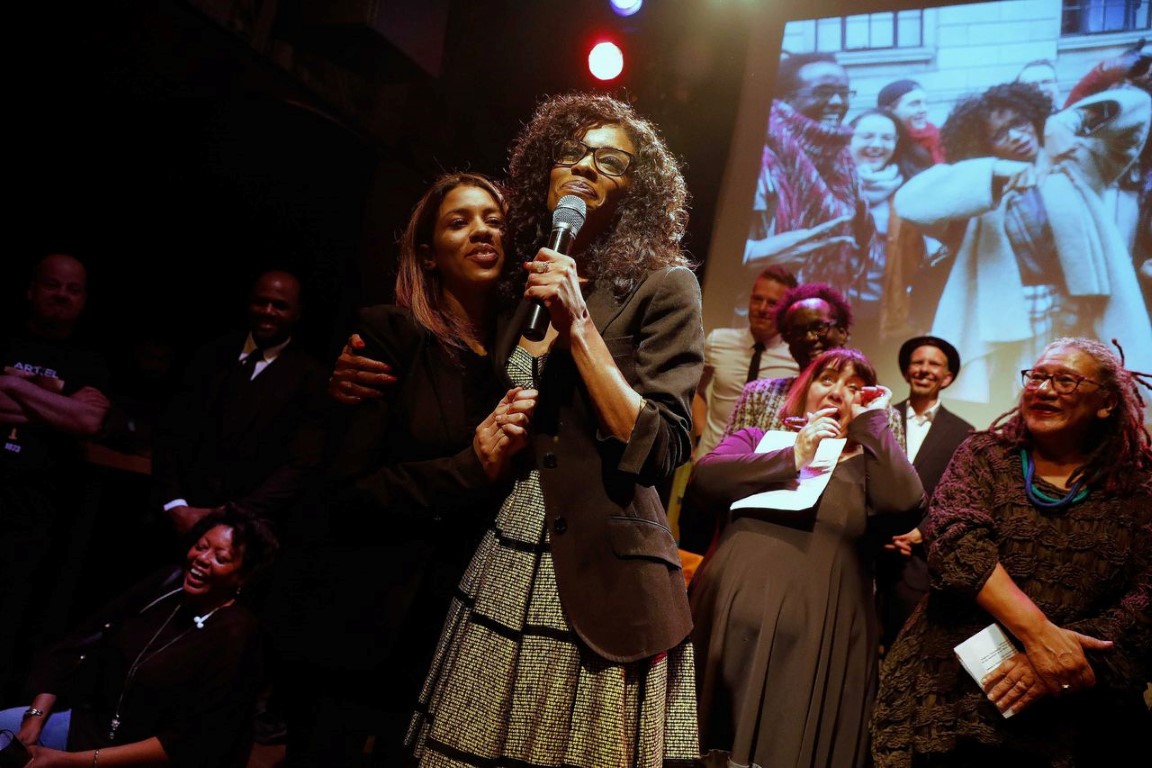
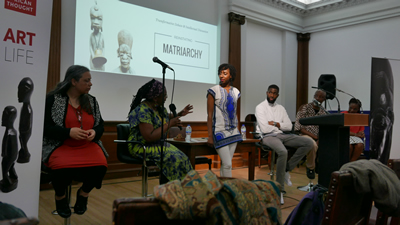
Get involved and help change our world