ART AND ACTIVISM
We attended the Steve Biko Foundation Memorial Lecture on ‘Art and Activism: Reflections on the Anti-Apartheid Struggle & Two Decades of South African Democracy’ which this year was given by Hugh Masekela at the London School of Economics. Having previously seen him perform a straight ahead gig and in the reflective drama ‘Songs of Migration’ at the Hackney Empire it was interesting to hear him speak in-depth about his craft, his inspirations and the role his music played in opposing apartheid and still plays in aiding the struggle against inequality and injustice. However, he wouldn’t be Hugh Masekela if he didn’t carry his flugel horn with him and he started his talk with a poignant solo version of ‘Stimela’, his classic song about the migrant workers who take the train to work in distant dangerous mines.
In a wide-ranging talk Hugh Masekela addressed the issues and crises facing South Africa, the Afrikan continent and diaspora and the wider humanity in a realistic, playful yet perceptive style that made the point and struck the right tone without haranguing or alienating the audience. It would be futile to expect him to pretend that in the two decades since the late Nelson Mandela was elected as President it has been plain sailing and all the goals and aspirations of the people repressed, oppressed, depressed and dispossessed during the centuries of white minority rule have all been addressed. He started by saying that people have been singing about bringing about peace but since he was born in 1939 the world has been at war.
He grew up in an environment of racism and discrimination where his grandmother ran a shebeen at a time when the European colonialists had made it illegal for Afrikans to drink alcohol. After experiencing vicious racism at school he realised that his future would be filled with racial hatred towards Afrikans that emboldened him and made him never fear anyone who looks down on his race. He included the Arabic slave raids across the Indian Ocean and east coast of Afrika as well as the holocaust perpetrated since the days when the Boer Jan van Riebeck first touched down in the region. It was the Dutch who first established the notorious Robben Island prison as a concentration camp for the Khoi-San before it housed some of its more famous anti-apartheid inmates.
The discovery of vast reserves of mineral wealth at the end of the 19th century led to inter-European tribal battles for control of the region between the British and the Dutch to the total exclusion of the entire Afrikan population who were to be the miners but not the beneficiaries. To counter this Afrikans developed organisations and petitioned the western powers to no avail. In 1912 John Dube, Sol T Plaatje and others set up the forerunner of the current African National Congress which would eventually see activists of the calibre of Chief Albert Luthuli, Oliver Tambo, Walter Sisulu and Nelson Mandela. Robert Sobukwe’s Pan-Africanist Congress would break away with the ANC over the adoption of the Kliptown Freedom Charter in 1955 as the PAC felt Afrikans should play a leading role in the struggle against injustice and be at the forefront of correcting historical economic, cultural and political marginalisation. Sobukwe had already been incarcerated on Robben Island for three years when the big hitters from the aftermath of the 1961 Sharpeville Massacre and 1963 Rivonia Trial arrived.
These were the years when a youthful Hugh Masekela became involved in political activities as he pursued his musical career on the international stage. The next generational shift in South Africa was towards the influence of Steve Biko and his Black Consciousness philosophy which was in step with the views of the psychiatrist and activist Frantz Fanon, the rise of the Black Power movement in the US and the armed liberation struggles in the remaining colonies in Afrika and the Caribbean. One of the pillars of Steve Biko’s credo was that seeking freedom on European terms was to abandon the uniqueness of Afrikans. The message struck a chord with the youth and Biko’s prominence drew the attention of the racist security services of the apartheid state who would murder him on Sep 12 1977.
Hugh Masekela ended his presentation by emphasising the need for us to build: institutions to learn about the empires and societies from across Afrika; monuments for those who chose to jump overboard rather than endure slavery; academies for musicians and singers; and institutions where we will learn again our praise poetry, arts and crafts. “We will be as visible as the Victoria Falls, the Nile and the Big Five of the Kruger National Park. We will zip up our boots and go back to our roots. Viva Bantu Biko and the eternal spirit of Afrikan excellence.”
Given the topic, the speaker and the venue the Q&A session was as wide-ranging as possible and revealed Hugh Masekela to have a grasp on historical and contemporary issues across the spectrum. The colonisers have not sincerely apologised for the rape, genocide, plunder, land dispossessions, incarcerations, brutal beatings, humiliation so the biggest aid required was for Afrikans to be able to recover their heritage. There was one white South African in the audience who tried to phrase a question exonerating the Europeans for the ongoing deficiencies in the economy in a style that wouldn’t impress a primary school pupil and was skilfully dealt with by the remark that his concern was that if there was really economic justice his parents might not be able to afford his ‘pocket money’.
Hugh Masekela was not a fan of the BRICS analysis invented by western economists as he did not see South Africa’s economic development in isolation from the rest of the continent. On the current socio-economic and political state of South Africa he had this to say: “The contemporary world was created by the media. We live in the African world of slums, squalor and cheap labour. We don’t own the wealth of Afrika. We fight over borders we have nothing to do with. If Afrikans got together people in Wall Street would have nightmares about that.”
Regarding the music industry he felt that songs should be dedicated to human liberation. The target was clearer during the anti-apartheid years when the big stars were Miriam Makeba, James Brown and Bob Marley. Now it is more diverse and diluted. He praised Harry Belafonte who took him under his wing when he arrived in the US. There he was surrounded by the political movements that brought him close to Malcolm X, Martin Luther King and Medgar Evers. “If you are not visionary about the freedom you have won it will not last. Too many contemporary artists from Afrika tend to compromise more than usual now due to the influence of American culture.”
He also pointed out that the music industry changed internationally once Michael Jackson sold 60 million records. The original labels and rights owners were bought out by an ever-decreasing number of big conglomerates and now the industry is about how many units you can sell. New technology means you can make music on your phone bypassing the studios but also quality control. Look at the Gangnam style phenomenon and the overload of banal lyrics about Cristal champagne, gold chains and ‘babes’.
On closing he was asked to recommend two pieces of advice he would give to the young, especially musicians. Completely unphased and without missing a beat he suggested don’t go into politics as it is dangerous and there is a two-term limit unless you become a dictator - and sex is overrated so don’t try and overdo it!!! A fantastic evening in the company of a truly inspirational force in the Afrikan world.
Steve Biko Foundation. Tel: 27 043 642 1177 / 27 011 403 0310. E-mail: admin@sbf.org.uk Web: www.sbf.org.uk
‘Imagining Nigeria 2114’
“Today Nigeria is the largest pan-Africa entity in the world, bringing together an unprecedented 170 million Africans under the same currency and laws. However, the well-worn narratives that attempt to capture Nigeria’s progress since amalgamation one hundred years ago, are generally bleak. A hundred years from now, will our imaginations as artists, cultural creators, enable us to draw on our past and invent a durable future? Does the idea of a hugely confident and culturally black super power in the Niger-Area stir the imagination?” – Onyekachi Wambu, ‘Nigeria@100: Transforming A British Experiment?’
The evening before we attended ‘Imagining Nigeria 2114’, a talk moderated by journalist and cultural commentator Onyekachi Wambu and organised by the Nigerian Art Society UK to coincide with their group exhibition, ‘Nigeria@100: Transforming A British Experiment?’, which ran for a month at the Waterloo Action Centre in London. The exhibiting artists were: Ade Ogundimu; Chike Azuonye; Chinwe Chukuogo Roy, MBE; Dotun Adegbite; Gbenga Orimoloye; Hassan Aliyu; Imoesi Imhonigie; Kunle Adegborioye; Lara Ige Jacks; Michael Echekoba; Obi Okigbo; Raymond Soko; Titus Agbara; and Toni Ndikanwu. Many of the artists and the widower of the late Chinwe Chukuogo Roy were in attendance and made vital contributions to the role artists can play in shaping Nigeria’s future.
The aesthetic quality of the exhibiting artists was of a very high standard. Some, like Hassan Aliyu and Obi Okigbo, we had seen other examples of their work previously while Chinwe Chukuogo Roy had prestigious exhibitions and were properly feted and acknowledged not just in Nigeria and Britain but on a truly global scale. The purpose of the Nigerian Art Society UK is to promote Nigerian art without being prescriptive about style or whether the artists had to adopt or avoid overtly political expressions.
Onyekachi had written the main essay in the exhibition brochure and his contribution was based around the role of water – Fela’s ‘Water No Get Enemy’ was a particular inspiration – and the water-based deities – such as Mami Wata, Idemili, Olokun, Osun, Oya and Yemoja - which will become even more relevant and powerful as we move deeper into the Age of Aquarius. Across the ECOWAS region Nigeria already makes up 70% of the population and the same size in terms of the economic activity thus making it a microcosm of the African Union. It is also part of the MINT group of countries, the second tier of developing economies after the BRICS. PriceWaterhouseCoopers expect Nigeria to be within the top 10 economies within our lifetimes, while the population could rise to over 300 million. For some of the neighbouring nation-states future fears of Nigerian regional domination is a source of deep concern.
While most of those present wanted or expected Nigeria to remain some form of a unitary state similar to its borders today, even if it is in a more federated form, Onyekachi repeated Chinua Achebe’s observation that together or apart it is always going to be the neighbours and the neighbourhood so people need to practice co-operation and find ways to bring about stability and economic prosperity that will benefit everybody across the region. Crises such as Ebola, the kidnapping of the Chibok girls and the migration of youth, skilled workers and intellectuals out of the region all show how porous the borders are and the fluid relations between communities across the artificially imposed colonial boundaries.
Chike Azuonye pointed out the fact that with only a few exceptions Afrikan artists and writers were often better known to westerners and Europeans than the politicians or business and professional class of Afrikan countries indicating the influence that culture can play in disseminating images and messages to a wider public than just their immediate cohorts as they always pushed the boundaries in whatever aspect they were addressing.
The role of new technology meant a speeding up in the time it takes messages to be conveyed around the world although that is not always a mark of success or influence when it can be so easily disposed of and replaced by the next fad. As with the majority of artists the role of cultivating sponsors to put on exhibitions and to purchase or support the art was highlighted. It was compared to the time when many artists worked for the court and so had guaranteed sources of income. Patrons may not always have any vision of an artistic legacy. Freelancing and individuality might give more freedom and variety of expression but livelihoods were even more precarious. There is still a push for students to enrol in the standard professions – lawyer, doctor, accountant – but how many more of them Nigeria needs and whether they have any impact on improving society’s morals is open to question.
Also in attendance were several members of the Nigeria Nostalgia Project, whose aim is to collect cultural artefacts reflecting the history of all peoples who live in, trade with and have had interactions with Nigerians both at home and in the diaspora. Initially, they will focus on the 1960-80 period then moving on to the remaining time frames with a Civil War sub-group already established. A discussion ensued about the state of curatorial professionalism, suitable buildings and security of exhibited works from removal by thieves, people who don’t appreciate the wider significance and value of allowing wider access to the public. There is also the problem of people taking items on display because they think they will look better in their house or office.
Hassan Aliyu observed that there has been little attempt in Nigeria to document even the most obvious periods of Nigerian history with the most traumatic and far-reaching effects - the enslavement / Maafa. In addition he pointed out that the oldest evidence of man’s civilisation is the art the Palaeolithic people left behind in caves. That was not always to be seen by other humans but as a communing and propitiation with the gods and ancestors. On art’s role as propaganda the UN has the Guernica piece which depicts the horrors of fascism during the Spanish Civil War. Although Hassan never said this during the meeting it is instructive that US Gen Colin Powell insisted it was reversed when he spoke at the UN justifying the invasion and destruction of Iraq based on the dodgy dossier that was plagiarised from a doctoral thesis off the internet. Hassan who attended Ahmadu Bello University in Kaduna state, northern Nigeria, addressed the issue of religious interventions on art as when he was studying there were no objections to figurative art or the widest possible creative expression. Some churches do support artists with Yusuf Grillo, who is a Muslim, working on stained glass windows – although Hassan, himself, had no such joy when he came forward to do church work some years ago. A final concern of his was the deficiency in the quality of writing on art and art criticism throughout Nigeria and this could be extended to the whole continent. The Nigerian Art Society brochure and all their publications have ISBN numbers for search and cataloguing purposes and there will be a legacy element in all their future projects and events.
E-mail: info@nigeriaartssociety.org Web: http://www.nigeriaartsociety.org
WEST AFRIKAN EBOLA UPDATE
African British Ebola Response - An Open Letter
Africans on the continent and in the Diaspora should lead in tackling the Ebola virus. Others can help, as Cuba and non Governmental Organisations such as Médecins Sans Frontières’ (MSF) / Doctors Without Borders are doing by sending doctors and health professionals to Ebola hit countries, but leadership must come from Africa and Africans. Senegal and Nigeria have been declared Ebola free by the World Health Organisation, and must be commended for the robust steps they took to contain the virus. It is important that good practice from countries that have contained the virus is shared.
Community activist Lee Jasper showed leadership by calling an emergency meeting in London aimed at finding solutions. BTWSC and African Histories Revisited have taken the initiative by organising a Fundraiser on 6th December in aid of MSF’s Ebola response in West Africa.
Ultimately, after the immediate task of containing the virus is solved, long term solutions must be implemented, or the cycle will continue. This is not the first time there has been an Ebola outbreak. Africa has respected scientists who can work on vaccines with the necessary support from African Governments.
Contrary to what is often portrayed, Africa is a rich continent with qualified professionals. We would not have had the scramble for Africa if it was a poor continent. The challenge Africa faces is that its vast resources are not benefiting the majority of its people. For example, Sierra Leone one of the countries hardest hit by the Ebola virus is one of the top 10 diamond producers, but years of war have not been helpful. Who benefits from these wars and the exploitation of Sierra Leone’s resources?
Africa does not need aid in the long term, it needs fair trade. In addition, delinquent Governments must be held accountable and encouraged to invest in infrastructure, health care and education.
Awula Serwah LLB (Hons) BL
BTWSC Co-ordinator
Former Mayoress of Harrow
Response To Black Activist Rising Against Cuts’ Urgent: Call Out to Humanity Ebola Crisis
Thanks for convening emergency meeting on how to respond to the Ebola crisis.
I am really sorry that Kwaku and I will be unable to attend due to a prior engagement, but we have circulated the information to our contacts.
We should thank Cuba for stepping in and quietly helping on the ground.
Our suggestions are as follows:
1. The Fundraisers are a good idea in the short term. BTWSC and African Histories Revisited are organising a Fundraising dinner on 6th December in aid of Médecins Sans Frontières’ (MSF) Ebola response in West Africa. Funds raised will be used to buy protective kits for health workers in the frontline, sadly a number have died. Further information is available at http://www.msf.org.uk/event/black-tie-fundraising-dinner-msfs-ebola-response
2. African Response is crucial. Africa is a rich continent, and we should demand accountability, and investment in health care and education from our leaders. What is our response to a situation disproportionally affecting us?
3. Support for African virologists and aspiring virologists. Scholarship schemes and measures to ensure that they remain in Africa after qualifying.
4. African countries should be encouraged to share good practice - my information is that Uganda contained the outbreak there years ago. There are also lessons to be learnt from Nigeria - for example use of mobile technology and dedicated social media.
5. Improvement of health care. Liaise with local doctors to find out what can be done to improve existing hospitals, and pressure to be put on leaders to build new ones or upgrade existing ones.
Kind regards
Awula Serwah & Kwaku
Harrow BHM Group
FORTHCOMING NUBIART PROFILES
NUBIART: Focus on arts, business, education, health, political developments and the media.
~ 17 Nov 2014: West Afrikan Ebola Update
NOV PROMOS
~ ‘FEEDBACK MADAGASCAR’ – Various Artists [ARC Music – Out Now] A stellar album of 17 tracks that shows the diverse range of musical influences on this Indian Ocean island – mbaqanqa, East Afrikan rumba, blues, sega, mangaliba, betsilebo, kolahota, kabosy and tsapiky. The album kicks off with ‘Madagasikara’, the Malagasy spelling of the island’s name, by Rossy - the only artist we had previously heard of - and the standard never drops. Every track here is a fire cracker that could get any party started with particular stand out tracks such as Oladad’s ‘Maintsokely (Little Green)’, Jaojoby’s ‘Somaiko Somaino (I Play It, You Play It)’, Zambey’s ‘Tsy Hagnatigno (I Will Never Forget You)’, Tiharea’s ‘Hoe Raho (This Is What I Say)’, Mam’be’s ‘Aia Hiboahanao Iny? (Where Do You Go?)’, Raprosy & Raoul’s ‘Sadamenabaka (The Red and White Bow-Horned Cow)’, Akoni Mania’s ‘Manina An-Droky (I Miss You)’ and Teta’s ‘Any Aminao Any (There, Where You Are Far Away)’.
Half the proceeds from the sale of the album goes to the artists while the other half goes on reforestation and community projects. The island has been facing ongoing political instability over the past few years meaning there has not been the government funds and focussed involvement for health and social issues so it falls to musicians and civil society activists to provide many of the essential services that most citizens expect from central government.
~ ‘IN THE LAND OF THE LION’ – Moipei Quartet [ARC Music – Out Now] A stunning acapella album of four part harmonies by the Moipei Quartet – triplets Mary Nenkai, Magdaline Namanyara and Marta
Siteiua and their younger sister Seraphine Setoon Moipei. There is something about families of singers that allows them to cover the necessary vocal range intuitively given their shared early musical influences and the sisters were appointed UNESCO’s first Child Ambassadors from Kenya in 2006. The album title is a reference to the lion, the king of the jungle whose numbers across Afrika have diminished by 90% to 21,000 in the last three decades. The 16 songs here are a mixture of hymns – ‘Ave Maria’, ‘Veni Sanctus Spiritus’ and ‘O Holy Night – traditional Kenyan songs – ‘Pole Musa’, ‘Malaika’ and ‘Ashe Naleng Enkai Ai’ – and songs from the American songbook such as the opener to the set John Denver’s ‘Country Road’.
NUBIART LIBRARY – NOV MEDIA
We will only review books we have read and DVDs we have seen and that are available at reasonable prices online or in shops or libraries. However, given the nature and current state of Afrikan publishing and film production there may be books and films on this list that are worth the extra effort to track down.
~ ‘IN THE NAME OF THE PEOPLE: ANGOLA’S FORGOTTEN MASSACRE’ – Lara Pawson [I.B.Tauris. ISBN: 978-1-78076-905-9] Former BBC Africa correspondent Lara Pawson delves into the barely discussed massacre of MPLA cadres by their own comrades – with Cuban support - in Angola in the aftermath of protests on 27 May 1977. From early on the reader knows there in for one of those notorious internecine left-wing splits when one faction following the deposed Minister of the Interior Nito Alves and his deputy Ze Van Dunem are called the ‘nitistas’ while those under the control of the President Agostinho Neto are called ‘netistas’.
Even now the dispute is mainly framed within the Marxist rhetoric language of the protestors being factionalists, pseudo Marxists, elitists and ‘abusers of the good faith of the People’. While the netistas were accused of being Maoist in a political spectrum that included terms such as Marxist-Leninist, Stalinist, Trotskyist, communist, socialist, nationalist, bourgeois, revisionist, etc. However, there is even more serious racial, regional and group politics at play as the Nitistas were accused of being ‘racist’ to non-Afrikans for pointing out that despite the slogans regarding equality even the most lowly educated or poor white person or mestico (mixed European and Afrikan ancestry) would be found a clerical or military job and not be expected to sweep the streets while the majority of cadres in influential political and economic positions were either Europeans, mesticos or their partners. Very few of the leadership spoke Kimbundu, the language spoken by the majority of the population and some insisted on being classed as mestico on their ID cards even when they were patently not so. There were fewer opportunities for educational scholarships for those of Afrikan descent.
An additional element was that those MPLA comrades from the north or of Bakongo origins were purged as they were assumed to have closer affinities to Holden Roberto’s Bakongo-dominated FNLA and were in touch with Jonas Savimbi’s UNITA regardless of the dedication they had shown to the Angolan liberation cause. We have spoken to Bakongo former MPLA comrades who escaped but many of their associates were killed, jailed, tortured or went into exile for no other reason than their ethnic origins. Pawson interviewed many of those involved and their relatives in Angola, Portugal and Britain and looked through the newspaper records but a true record of what the motives of the protestors were, how many were killed – ranging from ‘a few thousand’ to 50,000 – and why it is still rarely mentioned among Angolans at home and their diaspora remains elusive but she has a good stab at it.
.
~ CUBA AND ANGOLA: FIGHTING FOR AFRICA’S FREEDOM AND OUR OWN’ - Fidel Castro, Raul Castro, Nelson Mandela, et al. [Pathfinder Press. ISBN: 978-1-60488-046-5]
‘And if I fall, / What is life? / I already / Gave it up for lost / When, / Without fear, / I tore of the yoke / Of the slave.’ – Jose de Espronceda, The Pirate’s Song
This book explores another aspect of Angolan history – its longstanding relationship with Cuba and the political, military and social support the Cubans have extended as part of their international solidarity missions. Between 1975 and 1991 over 425,000 Cubans volunteered for to go to Angola in response to requests from the Angolan government to help defend the newly independent country against multiple invasions by apartheid South Africa backed by its allies in America, Israel and other white supremacist regimes. Here this history is told by those who lived it and made it.
Included here are: several speeches by then Cuban President Fidel Castro at the start of Operation Carlota in the run-up to Angolan independence in Nov 1975, the defeat of the apartheid forces at Cuito Cuanavale in 1988 and on Nelson Mandela’s visit; a speech by his brother, the current Cuban President and former Defence Minister Raúl Castro; Nelson Mandela on his visit to Cuba to receive the Jose Marti medal; accounts by three of the Cuban Five about their experiences in Angola; accounts of four Cuban generals several of whom were of Cuban-Chinese extraction but played their full role in the liberation struggle; and the 1977 essay ‘Operation Carlotta’ by Gabriel García Márquez about the early stages of the Cuban involvement in Angola which was named after a female Afrikan resistance fighter who led a rebellion on a sugar plantation in Cuba in 1843.
In ‘We Staked Everything In Angola’ Fidel says: “The imperialists can’t understand very well the reason for Cuba’s broad relations on the international scene, Cuba’s prestige on the international scene. But the African peoples, who have been so humiliated by apartheid and racism, have been able to appraise in all its dimensions the noble, generous gesture, the historical dimension, the heroism of our people who were capable not only of defending themselves here from such a powerful enemy but also help the Africans in their struggle against the fascists and racists.” (p47)
While in ‘All We Take With Us From Africa Are The Remains Of Our Combatants Who Died fighting For Freedom’ he says: “There is no just cause in Africa that has not received our people’s support. Che Guevara and a large group of Cuban revolutionaries fought white mercenaries in the eastern part of what is now Zaire, and today doctors and teachers are working generously and selflessly in the Western Sahara republic, helping its people, who are fighting for their freedom.” (p52) He followed this with his analysis of the destructive effects of rampant global capitalism which “means the neocolonization of billions of human beings through more sophisticated economic and political methods - methods that are cheaper, more effective, and more ruthless.” (p53-54) “It’s a well-known fact that a large part of the wealth of the developed capitalist world comes from unequal trade with these countries. For centuries, those nations were plundered as colonies. Millions of their sons and daughters were enslaved. In many instances their silver and other mineral resources were exhausted. They were pitilessly exploited and underdevelopment was imposed upon them. Underdevelopment was the most direct and clearest consequence of the period of colonial rule. Today they’re exploited through payment of interest on endless unpayable debt. Their basic commodities are extracted at ridiculously low prices. And they’re forced to pay ever higher prices for the industrial goods they import. Financial and human resources are constantly being drawn from those nations through the flight of capital and the brain drain. Their trade is blocked through “dumping,” high tariffs, import quotas, synthetic substitutes produced through advanced technological processes, and subsidizing production in the developed countries when they aren’t competitive.” (p55)
In one page in ‘Our Volunteers Learned What Cuba Used To Be Like’ Luis Alfonso Zayas gives an alternative account of the May 27 1977 protests led by Nito Alves and their aftermath which closely reflects the official MPLA government position. He outlines the different policies adopted by the Cubans and Soviets towards Angolan military strategy – while the Soviets preferred large battalions the Cubans favoured smaller units of at most 70 combatants as this made them more easy to supply and less likely to have large resources tied up if they got stranded in inclement weather or if a bridge had been blown up and rivers were impassable until it was repaired or a replacement constructed. Zayas also outlined how the Cabinda enclave came about when the Belgian genocidaire King Leopold needed access to the sea for the personal fiefdom he stole in the 1884-85 Berlin Conference carve-up. It is now the source of Angola’s oil wealth and three of the Cuban Five, who were jailed for their pro-Cuban activities in the US, served there.
One of the Five Rene Gonzalez in his piece ‘Angola Taught Me That The Most Beautiful Works Are Accomplished By Imperfect Men’ says: “The Angolan experience taught me that the most beautiful works are accomplished by imperfect men, each one of us a short impulse in history: that continual righting of wrongs that began with the first human injustice.” (p118)

We welcome feedback on any event you have attended that was listed in Nubiart Diary. It helps us with the selection of future listings and is also info we can pass on to the event organisers where appropriate.
~ AUTOGRAPH ABP PRESENTS BLACK CHRONICLES II’. A new exhibition exploring Afrikan presences in 19th and early 20th century Britain, through the prism of photography – particularly studio portraiture. Drawing on the metaphor of the chronicle, the exhibition presents over 200 photographs, the majority of which have never been exhibited or published before. This research also coincides with Autograph ABP’s continuous search for the earliest photographic image of a black person created in the UK. Curated by Renée Mussai and Mark Sealy. Exhibition runs until Mon 24 Nov at Autograph, Rivington Place, London, EC2A 3BA. Adm: Free.
- ‘Val Wilmer in Conversation with Margaret Busby’. On Tues 4 Nov at 6.30-8.30pm at Rivington Place, London, EC2. Adm: Free, booking recommended. A gallery talk with Margaret Busby and Val Wilmer, whose private collection of cabinet cards and cartes-de-visite depicting black presences in Victorian and Edwardian Britain is featured in Black Chronicles II.
- ‘The Missing Chapter Recitals’. On Fri 7 November 7pm at Rivington Place, London, EC2. Adm: Free, booking recommended. Join us for an evening performance of live music, spoken word and photography. Interweaving their personal responses to Black Chronicles II will be pianist Isata Kanneh Mason and musician Akala.
- ‘From Dusk Image Projections’. On Fri 7 – Sun 9 Nov from sunset at Rich Mix, 45-47 Bethnal Green Road, London, E2. Adm: Free, no booking required. Part of the ongoing project ‘The Missing Chapter, rarely seen images of the King’s Indian Orderly Army Officers (1903-1938)’, projected on the façade of Rich Mix.
- ‘Walking Tour’. On Sat 8 Nov at 4pm starting at Rivington Place, London, EC2. Adm: £5, booking essential. Starting at The Black Chronicles II exhibition at Rivington Place and ending at Rich Mix, discover notable Afrikans living around the Shoreditch and Hoxton areas during the nineteenth century.
- ‘The Family Album Roadshow’. On Sun 9 Nov at 11am-3pm at Rich Mix, 45-47 Bethnal Green Road, London, E2. Adm: Free, booking recommended. You are invited to bring along examples of photographs from your family album that relate to Britain’s multicultural history. Share your stories and have your photographs digitised.
~ BRENDA LEE VITAMIN D AND AFRIKAN DIET HEALTH TALKS
- ‘Vitamin D’. On Thurs 6 Nov at 6.30pm at Harlesden Library, Craven Park Road, Harlesden, London, NW10 8BE. Tel: 020 8937 3570.
- ‘Vitamin D’. On Thurs 20 Nov at Wembley Library, Brent Cross Centre, Engineers Way, Wembley, HA9 0PJ. Tel: 020 8937 3500.
E-mail: brenda@brendaleenutritionandhealth.com Web: http://www.vitamindafrikandiet.info/
~ DR LLAILA AFRIKA & DR MELANIE STEVENSON ENGLAND BLACK HISTORY TOUR
- ‘Lecture’. On Fri 7 Nov at 6pm at the Highland Centre, 96 Melbourne Road, Leicester, LE2 0DS.
- ‘The Cure For All Seasons’. On Sat 8 Nov at 6pm at Stamford Hill Community Centre, 103-105 Stamford Hill Estate, London, N16 6RS.
- ‘Unlocking Melanin Conference’. On Sat 15 Nov at 6pm at Stamford Hill Community Centre, 103-105 Stamford Hill Estate, London, N16 6RS.
Adm: £10. Tel: 07943 376 481 / 07475 664 735 / 07463 761 767. E-mail: england@llailaafrika.com Web: llailaafrika.com
~ BRITISH MUSEUM TALKS
- ‘New Discoveries From Ancient Egypt’. On Fri 7 Nov at 6.30pm. Adm: £5 / £3 – concs. Exhibition curators John Taylor and Daniel Antoine highlight research methods, CT scans and visualisation techniques used in the preparation of the current exhibition ‘Ancient Lives, New Discoveries’.
- ‘Egypt Before the Pharaohs’. On Sat 15 Nov at 1.15pm. Adm: Free. Gallery talk by George Hart.
- ‘Who Were The Ancient Egyptians’. On Fri 21 Nov at 1.30pm. Adm: Free, booking essential. Prof Joel D Irish gives an overview of the peoples of the Nile Valley, investigating population origins, biological affinities and migration patterns within and beyond Egypt drawn from his extensive work on dental anthropology.
- ‘Curator’s Introduction to ‘Ancient Lives, New Discoveries’ Exhibition with Daniel Antoine. On Fri 28 Nov at 1.30pm. Adm: Free.
All events at the British Museum, Great Russell Street, London, WC1B 3DG. Web: www.britishmuseum.org
~ BLACK HISTORY WALKS PRESENT
- ‘Medical Apartheid. European Experiments on African Bodies’. On Fri 7 Nov at 6.30-9pm at Khalil Lecture Theatre, Lower Ground Floor, SOAS. (School of Oriental and African Studies), Thornhaugh Street, London, WC1H.
- St Paul’s Walk. On Sat 8 Nov at 11am.
For all events e-mail: info@blackhistorywalks.co.uk Web: www.blackhistorywalks.co.uk
~ ‘BEAUTY IS’ SCREENING AND TALK WITH DIRECTOR TOYIN AGBETU. On Sat 8 Nov at Chats Palace, 42 Chatsworth Rd, London, E5. Web: http://www.ligali.org/beautyis/screeningsdvd.html
~ ROYAL AFRICAN SOCIETY PRESENT ‘FILM AFRICA’. Until Sun 9 Nov at venues across London. Web: www.filmafrica.org.uk
~ AFRICA IN MOTION FILM FESTIVAL: ‘LOOKING BACK REACHING FORWARD’. Partner event to ‘Film Africa’ until Sun 9 Nov at venues across Edinburgh and Glasgow. E-mail: info@africa-in-motion.org.uk Web: Africa-in-motion.org.uk
~ SANDBLAST PRESENT SOUNDS AND SOULS FOR RUN THE SAHARA 2015. An evening of music, photography and short film presentations to promote Run the Sahara on 24 Feb 2015. The international solidarity run helps raise funds for Sandblast’s Studio-Live music project in the Saharawi refugee camps in south-west Algeria where almost 200,000 Saharawis live. Music by singer song-writers Renny Jackson premiering his Free Western Sahara song, Pia de Keyser who is currently crowd-funding to record her first EP in the camps, and Luzmira Zerpa of Family Atlantica. Images by photographer Olivia Mann, a former Run the Sahara participant, will be projected and exhibited. On Sun 9 Nov at 6.30pm at The Forge in Camden, 3-7 Delancey Street, London, NW1 7NL. Adm: £5. Web: www.forgevenue.org
~ BLACK HISTORY STUDIES UNIA-ACL CENTENARY PRESENTS ‘MIDDLE OF NOWHERE’. Winner of the Best Director Award at the 2012 Sundance Film Festival, ‘Middle Of Nowhere’ follows Ruby, a bright medical student who sets aside her dreams and suspends her career when her husband is incarcerated. As the committed couple stares into the hollow end of an eight-year prison sentence, Ruby must learn to live another life, one marked by shame and separation. But through a chance encounter and a stunning betrayal that shakes her to her core, this steadfast wife is soon propelled in new and often shocking directions of self-discovery - caught between two worlds and two men in the search for herself. There will be a panel discussion after the screening with the main actress Emayatzy Corinealdi, Award winning Criminal Justice Safeguarding Consultant Empress Jai and author, filmmaker and journalist Stephen Graham on the ‘Impact of Black Male Incarceration on Black Relationships’ and are ‘Black Relationships Becoming Extinct?’ On Mon 10 Nov at 7-9.30pm at the Public & Commercial Services (PCS) Union Headquarters, 160 Falcon Road, Clapham Junction, London SW11 2LN. Adm: £10 / U-16 – Free. E-mail: info@blackhistorystudies.com Web: http://www.blackhistorystudies.com
~ HARROW BHM GROUP SEASON HIGHLIGHTS MARCUS GARVEY / UNIA @ 100. Pan-Africanist icon Marcus Garvey founded the Universal Negro Improvement Association-African Communities League (UNIA) in Jamaica in 1914. By the 1920s it had become the biggest Afrikan-focused organisation in the world. The UNIA advocated self-confidence, entrepreneurship, connection to Afrika, its history, and Afrikan pride. In marking UNIA@100, we aim to examine different aspects of Garvey’s organisation, and what we can take from it, going forward.
- ‘Reflecting On UNIA’s Enterprises’ (Hugh Francis). On Wed 12 Nov at 6.30-8.30pm at Civic Centre 1, Harrow Council, Station Road, Harrow, HA1 2XY. Adm: Free.
- ‘AfricanHistory+ @ Croydon’. On Sat 22 Nov at 12.30-9.30pm at 1 Matthews Yard, off Surrey Street, Croydon, CR0 1FF. Adm: £5. Web: www.AfricanHistoryPlus.eventbrite.com
- BTWSC and African Histories Revisited Fundraising Dinner in aid of Médecins Sans Frontières UK. On Sun 6 Dec at 7-11.30pm at Best Western Cumberland Hotel, Harrow. Web: www.AfricanHistoryPlus.eventbrite.com
- ‘Moving Forward: Taking From The Garvey / UNIA Legacy’ (Brother Andrew Muhammad) including Youth Opportunity. On Fri 19 Dec at 6.30-8.30pm at Civic Centre 1, Harrow Council, Station Road, Harrow, HA1 2XY. Adm: Free.
Booking for all events: www.harrowbhm.eventbrite.com E-mail: harrowBHM@hotmail.com Web: www.harrowbhm.co.uk
~ TIWANI CONTEMPORARY PRESENTS MIRRORS & ECHOES EXHIBITION. A collaboration between Mary Evans and Emeka Ogboh focussing on the interface between sound and image, ‘Mirrors & Echoes’ is an immersive installation and a portrait of Lagos, the ever-changing Nigerian megacity.
- Artist Talk: Paul Goodwin in conversation with Mary Evans and Emeka Ogboh. On Sat 15 Nov at 3pm at Tiwani Contemporary, 16 Little Portland Street, London, W1. Adm: Free. RSVP: info@tiwani.co.uk
- Exhibition runs until Sat 20 Dec on Tues-Fri at 11am-6pm and Sat at 12-5pm at Tiwani Contemporary, 16 Little Portland Street, London, W1. Adm: Free.
~ THE WINDRUSH FOUNDATION PRESENTS ‘STOLEN LEGACY BY GEORGE G. M. JAMES’, A PRESENTATION BY ROBIN WALKER. On Sat 15 Nov at 6.30-8.30pm at Croydon Supplementary Education Project, 32 Sydenham Road, Croydon, CR0 2EF.
~ DEFEND THE RIGHT TO PROTEST CONFERENCE 2014: ‘WE DO NOT CONSENT’. Speakers: Rob Evans, author; Carole Duggan; Merrick Badger, Campaign Opposing Police Violence; Susan Alexander, Azelle Rodney’s mother; Owen Jones, author; Jules Carey, lawyer; Dave Smith, Blacklist Support Group; John MacDonnell, MP; Jenny Jones, GLA; Fidel Santigi, Fully Focused; Hamja Ahsan; Free Talha Ahsan Campaign; Nina Power; Sheila Coleman, Hillsborough Justice Campaign; Kevin Blowe, NETPOL; Marcia Rigg, Sean Rigg’s sister; and Hannah Dee. Screening of Ken Fero’s ‘Burn’ looking at the police killing of Mark Duggan and its aftermath. On Sun 16 Nov at 11am at SOAS, Thornhaugh St, London, WC1H 0XG. Adm: £10 / £5 / £3-unwaged. Web: www.defendtherighttoprotest.org/conference
~ LONDON INTERNATIONAL GALLERY OF CHILDREN’S ART PRESENTS ‘LIVING AFRICA: THROUGH THE ART OF ITS CHILDREN’. Children’s artwork from Gambia, Nigeria, Tanzania, South Africa. Until 18 Nov at 10am-5pm at Islington Museum, St John Street, London, EC1. E-mail: trustee@ligca.org Web: ligca.org
~ HACKNEY MUSEUM EXHIBITIONS
- ‘Strike A Pose: Portraits From A Hackney Photo Studio’. Until 17 Jan 2015.
- ‘What A Journey! Retired Caribbean Nurses and the NHS’. Until 31 Jan 2015. E-mail: info@retiredcaribbeannurses.org.uk
- ‘The Slave Owners of Hackney’. Until 7 Feb 2015.
All exhibitions on Tues, Weds & Fri at 9.30am-5.30pm / Thurs 9.30am-8pm / Sat 10am-5pm at Hackney Museum, Technology and Learning Centre, 1 Reading Lane, London, E8 1GQ. Tel: 020 8356 3500. Web: www.hackney.gov.uk/museum Twitter: @hackneymuseum
~ CHI CREATIONS PRESENTS ‘THE GRIOT WAY STORYTELLING TRAINING’. On 13-15 Feb 2015 and 15-17 May 2015 at Etherly Farm, Dorking, RH5 6PA. E-mail: Info@shanti-chi.com Web: www.shanti-chi.com
~ BUNDU DIA KONGO (BDK). Afrikan cultural and spiritual group working towards the spiritual and psychological growth and development of Afrikans all over the world. Let us make a positive change now. Learn about Afrikan prophets, Afrikan history and Afrikan spiritual practices at our weekly Zikua.
- Sun at 1.30–4.30pm at Chestnuts Community & Arts Centre, 280 St Ann’s Road, Tottenham, London, N15 5BN. Tel: Makaba - 07951 059 853.
- Sun at 12.30–3.15pm at Malika House, 81 George Street, Lozells, Birmingham, B19 1Sl. Tel: Mbuta Mayala – 07404 789 329.
~ THE AUSAR AUSET SOCIETY GI GONG CLASSES. Every Monday at 7.30–9pm at Hazel Road Community Centre, Hazel Road, Kensal Green, London, NW10 5PP. Adm: £5 per class. Tel: 07951- 252-427. E-mail: Tauinetwork.europe@gmail.com
~ THE GREAT AFRIKAN BOOK SALE! Every book and CD is on sale at 50% off or more! There are over 5000 titles in the sale - never before have so many Afrikan interest books been offered on this scale in a sale. The finances raised will go towards the development of the MAA MAAT Project. On Fri & Sat at 5-10pm, Sat 12-8pm and Sun 12-5pm at Maa Maat Centre, 366a High Road, Tottenham, London, N17 9HT. Tel 07956 052 821.
Contact: Kubara Zamani, Afrikan Quest International, PO Box 35165, London, SE5 8WU. Tel: 07811 494 969. E-mail: afrikanquest@hotmail.com
External Links
Afrikan Quest International
We attended the Steve Biko Foundation Memorial Lecture on ‘Art and Activism: Reflections on the Anti-Apartheid Struggle & Two Decades of South African Democracy’ which this year was given by Hugh Masekela at the London School of Economics. Having previously seen him perform a straight ahead gig and in the reflective drama ‘Songs of Migration’ at the Hackney Empire it was interesting to hear him speak in-depth about his craft, his inspirations and the role his music played in opposing apartheid and still plays in aiding the struggle against inequality and injustice. However, he wouldn’t be Hugh Masekela if he didn’t carry his flugel horn with him and he started his talk with a poignant solo version of ‘Stimela’, his classic song about the migrant workers who take the train to work in distant dangerous mines.
In a wide-ranging talk Hugh Masekela addressed the issues and crises facing South Africa, the Afrikan continent and diaspora and the wider humanity in a realistic, playful yet perceptive style that made the point and struck the right tone without haranguing or alienating the audience. It would be futile to expect him to pretend that in the two decades since the late Nelson Mandela was elected as President it has been plain sailing and all the goals and aspirations of the people repressed, oppressed, depressed and dispossessed during the centuries of white minority rule have all been addressed. He started by saying that people have been singing about bringing about peace but since he was born in 1939 the world has been at war.
He grew up in an environment of racism and discrimination where his grandmother ran a shebeen at a time when the European colonialists had made it illegal for Afrikans to drink alcohol. After experiencing vicious racism at school he realised that his future would be filled with racial hatred towards Afrikans that emboldened him and made him never fear anyone who looks down on his race. He included the Arabic slave raids across the Indian Ocean and east coast of Afrika as well as the holocaust perpetrated since the days when the Boer Jan van Riebeck first touched down in the region. It was the Dutch who first established the notorious Robben Island prison as a concentration camp for the Khoi-San before it housed some of its more famous anti-apartheid inmates.
The discovery of vast reserves of mineral wealth at the end of the 19th century led to inter-European tribal battles for control of the region between the British and the Dutch to the total exclusion of the entire Afrikan population who were to be the miners but not the beneficiaries. To counter this Afrikans developed organisations and petitioned the western powers to no avail. In 1912 John Dube, Sol T Plaatje and others set up the forerunner of the current African National Congress which would eventually see activists of the calibre of Chief Albert Luthuli, Oliver Tambo, Walter Sisulu and Nelson Mandela. Robert Sobukwe’s Pan-Africanist Congress would break away with the ANC over the adoption of the Kliptown Freedom Charter in 1955 as the PAC felt Afrikans should play a leading role in the struggle against injustice and be at the forefront of correcting historical economic, cultural and political marginalisation. Sobukwe had already been incarcerated on Robben Island for three years when the big hitters from the aftermath of the 1961 Sharpeville Massacre and 1963 Rivonia Trial arrived.
These were the years when a youthful Hugh Masekela became involved in political activities as he pursued his musical career on the international stage. The next generational shift in South Africa was towards the influence of Steve Biko and his Black Consciousness philosophy which was in step with the views of the psychiatrist and activist Frantz Fanon, the rise of the Black Power movement in the US and the armed liberation struggles in the remaining colonies in Afrika and the Caribbean. One of the pillars of Steve Biko’s credo was that seeking freedom on European terms was to abandon the uniqueness of Afrikans. The message struck a chord with the youth and Biko’s prominence drew the attention of the racist security services of the apartheid state who would murder him on Sep 12 1977.
Hugh Masekela ended his presentation by emphasising the need for us to build: institutions to learn about the empires and societies from across Afrika; monuments for those who chose to jump overboard rather than endure slavery; academies for musicians and singers; and institutions where we will learn again our praise poetry, arts and crafts. “We will be as visible as the Victoria Falls, the Nile and the Big Five of the Kruger National Park. We will zip up our boots and go back to our roots. Viva Bantu Biko and the eternal spirit of Afrikan excellence.”
Given the topic, the speaker and the venue the Q&A session was as wide-ranging as possible and revealed Hugh Masekela to have a grasp on historical and contemporary issues across the spectrum. The colonisers have not sincerely apologised for the rape, genocide, plunder, land dispossessions, incarcerations, brutal beatings, humiliation so the biggest aid required was for Afrikans to be able to recover their heritage. There was one white South African in the audience who tried to phrase a question exonerating the Europeans for the ongoing deficiencies in the economy in a style that wouldn’t impress a primary school pupil and was skilfully dealt with by the remark that his concern was that if there was really economic justice his parents might not be able to afford his ‘pocket money’.
Hugh Masekela was not a fan of the BRICS analysis invented by western economists as he did not see South Africa’s economic development in isolation from the rest of the continent. On the current socio-economic and political state of South Africa he had this to say: “The contemporary world was created by the media. We live in the African world of slums, squalor and cheap labour. We don’t own the wealth of Afrika. We fight over borders we have nothing to do with. If Afrikans got together people in Wall Street would have nightmares about that.”
Regarding the music industry he felt that songs should be dedicated to human liberation. The target was clearer during the anti-apartheid years when the big stars were Miriam Makeba, James Brown and Bob Marley. Now it is more diverse and diluted. He praised Harry Belafonte who took him under his wing when he arrived in the US. There he was surrounded by the political movements that brought him close to Malcolm X, Martin Luther King and Medgar Evers. “If you are not visionary about the freedom you have won it will not last. Too many contemporary artists from Afrika tend to compromise more than usual now due to the influence of American culture.”
He also pointed out that the music industry changed internationally once Michael Jackson sold 60 million records. The original labels and rights owners were bought out by an ever-decreasing number of big conglomerates and now the industry is about how many units you can sell. New technology means you can make music on your phone bypassing the studios but also quality control. Look at the Gangnam style phenomenon and the overload of banal lyrics about Cristal champagne, gold chains and ‘babes’.
On closing he was asked to recommend two pieces of advice he would give to the young, especially musicians. Completely unphased and without missing a beat he suggested don’t go into politics as it is dangerous and there is a two-term limit unless you become a dictator - and sex is overrated so don’t try and overdo it!!! A fantastic evening in the company of a truly inspirational force in the Afrikan world.
Steve Biko Foundation. Tel: 27 043 642 1177 / 27 011 403 0310. E-mail: admin@sbf.org.uk Web: www.sbf.org.uk
‘Imagining Nigeria 2114’
“Today Nigeria is the largest pan-Africa entity in the world, bringing together an unprecedented 170 million Africans under the same currency and laws. However, the well-worn narratives that attempt to capture Nigeria’s progress since amalgamation one hundred years ago, are generally bleak. A hundred years from now, will our imaginations as artists, cultural creators, enable us to draw on our past and invent a durable future? Does the idea of a hugely confident and culturally black super power in the Niger-Area stir the imagination?” – Onyekachi Wambu, ‘Nigeria@100: Transforming A British Experiment?’
The evening before we attended ‘Imagining Nigeria 2114’, a talk moderated by journalist and cultural commentator Onyekachi Wambu and organised by the Nigerian Art Society UK to coincide with their group exhibition, ‘Nigeria@100: Transforming A British Experiment?’, which ran for a month at the Waterloo Action Centre in London. The exhibiting artists were: Ade Ogundimu; Chike Azuonye; Chinwe Chukuogo Roy, MBE; Dotun Adegbite; Gbenga Orimoloye; Hassan Aliyu; Imoesi Imhonigie; Kunle Adegborioye; Lara Ige Jacks; Michael Echekoba; Obi Okigbo; Raymond Soko; Titus Agbara; and Toni Ndikanwu. Many of the artists and the widower of the late Chinwe Chukuogo Roy were in attendance and made vital contributions to the role artists can play in shaping Nigeria’s future.
The aesthetic quality of the exhibiting artists was of a very high standard. Some, like Hassan Aliyu and Obi Okigbo, we had seen other examples of their work previously while Chinwe Chukuogo Roy had prestigious exhibitions and were properly feted and acknowledged not just in Nigeria and Britain but on a truly global scale. The purpose of the Nigerian Art Society UK is to promote Nigerian art without being prescriptive about style or whether the artists had to adopt or avoid overtly political expressions.
Onyekachi had written the main essay in the exhibition brochure and his contribution was based around the role of water – Fela’s ‘Water No Get Enemy’ was a particular inspiration – and the water-based deities – such as Mami Wata, Idemili, Olokun, Osun, Oya and Yemoja - which will become even more relevant and powerful as we move deeper into the Age of Aquarius. Across the ECOWAS region Nigeria already makes up 70% of the population and the same size in terms of the economic activity thus making it a microcosm of the African Union. It is also part of the MINT group of countries, the second tier of developing economies after the BRICS. PriceWaterhouseCoopers expect Nigeria to be within the top 10 economies within our lifetimes, while the population could rise to over 300 million. For some of the neighbouring nation-states future fears of Nigerian regional domination is a source of deep concern.
While most of those present wanted or expected Nigeria to remain some form of a unitary state similar to its borders today, even if it is in a more federated form, Onyekachi repeated Chinua Achebe’s observation that together or apart it is always going to be the neighbours and the neighbourhood so people need to practice co-operation and find ways to bring about stability and economic prosperity that will benefit everybody across the region. Crises such as Ebola, the kidnapping of the Chibok girls and the migration of youth, skilled workers and intellectuals out of the region all show how porous the borders are and the fluid relations between communities across the artificially imposed colonial boundaries.
Chike Azuonye pointed out the fact that with only a few exceptions Afrikan artists and writers were often better known to westerners and Europeans than the politicians or business and professional class of Afrikan countries indicating the influence that culture can play in disseminating images and messages to a wider public than just their immediate cohorts as they always pushed the boundaries in whatever aspect they were addressing.
The role of new technology meant a speeding up in the time it takes messages to be conveyed around the world although that is not always a mark of success or influence when it can be so easily disposed of and replaced by the next fad. As with the majority of artists the role of cultivating sponsors to put on exhibitions and to purchase or support the art was highlighted. It was compared to the time when many artists worked for the court and so had guaranteed sources of income. Patrons may not always have any vision of an artistic legacy. Freelancing and individuality might give more freedom and variety of expression but livelihoods were even more precarious. There is still a push for students to enrol in the standard professions – lawyer, doctor, accountant – but how many more of them Nigeria needs and whether they have any impact on improving society’s morals is open to question.
Also in attendance were several members of the Nigeria Nostalgia Project, whose aim is to collect cultural artefacts reflecting the history of all peoples who live in, trade with and have had interactions with Nigerians both at home and in the diaspora. Initially, they will focus on the 1960-80 period then moving on to the remaining time frames with a Civil War sub-group already established. A discussion ensued about the state of curatorial professionalism, suitable buildings and security of exhibited works from removal by thieves, people who don’t appreciate the wider significance and value of allowing wider access to the public. There is also the problem of people taking items on display because they think they will look better in their house or office.
Hassan Aliyu observed that there has been little attempt in Nigeria to document even the most obvious periods of Nigerian history with the most traumatic and far-reaching effects - the enslavement / Maafa. In addition he pointed out that the oldest evidence of man’s civilisation is the art the Palaeolithic people left behind in caves. That was not always to be seen by other humans but as a communing and propitiation with the gods and ancestors. On art’s role as propaganda the UN has the Guernica piece which depicts the horrors of fascism during the Spanish Civil War. Although Hassan never said this during the meeting it is instructive that US Gen Colin Powell insisted it was reversed when he spoke at the UN justifying the invasion and destruction of Iraq based on the dodgy dossier that was plagiarised from a doctoral thesis off the internet. Hassan who attended Ahmadu Bello University in Kaduna state, northern Nigeria, addressed the issue of religious interventions on art as when he was studying there were no objections to figurative art or the widest possible creative expression. Some churches do support artists with Yusuf Grillo, who is a Muslim, working on stained glass windows – although Hassan, himself, had no such joy when he came forward to do church work some years ago. A final concern of his was the deficiency in the quality of writing on art and art criticism throughout Nigeria and this could be extended to the whole continent. The Nigerian Art Society brochure and all their publications have ISBN numbers for search and cataloguing purposes and there will be a legacy element in all their future projects and events.
E-mail: info@nigeriaartssociety.org Web: http://www.nigeriaartsociety.org
WEST AFRIKAN EBOLA UPDATE
African British Ebola Response - An Open Letter
Africans on the continent and in the Diaspora should lead in tackling the Ebola virus. Others can help, as Cuba and non Governmental Organisations such as Médecins Sans Frontières’ (MSF) / Doctors Without Borders are doing by sending doctors and health professionals to Ebola hit countries, but leadership must come from Africa and Africans. Senegal and Nigeria have been declared Ebola free by the World Health Organisation, and must be commended for the robust steps they took to contain the virus. It is important that good practice from countries that have contained the virus is shared.
Community activist Lee Jasper showed leadership by calling an emergency meeting in London aimed at finding solutions. BTWSC and African Histories Revisited have taken the initiative by organising a Fundraiser on 6th December in aid of MSF’s Ebola response in West Africa.
Ultimately, after the immediate task of containing the virus is solved, long term solutions must be implemented, or the cycle will continue. This is not the first time there has been an Ebola outbreak. Africa has respected scientists who can work on vaccines with the necessary support from African Governments.
Contrary to what is often portrayed, Africa is a rich continent with qualified professionals. We would not have had the scramble for Africa if it was a poor continent. The challenge Africa faces is that its vast resources are not benefiting the majority of its people. For example, Sierra Leone one of the countries hardest hit by the Ebola virus is one of the top 10 diamond producers, but years of war have not been helpful. Who benefits from these wars and the exploitation of Sierra Leone’s resources?
Africa does not need aid in the long term, it needs fair trade. In addition, delinquent Governments must be held accountable and encouraged to invest in infrastructure, health care and education.
Awula Serwah LLB (Hons) BL
BTWSC Co-ordinator
Former Mayoress of Harrow
Response To Black Activist Rising Against Cuts’ Urgent: Call Out to Humanity Ebola Crisis
Thanks for convening emergency meeting on how to respond to the Ebola crisis.
I am really sorry that Kwaku and I will be unable to attend due to a prior engagement, but we have circulated the information to our contacts.
We should thank Cuba for stepping in and quietly helping on the ground.
Our suggestions are as follows:
1. The Fundraisers are a good idea in the short term. BTWSC and African Histories Revisited are organising a Fundraising dinner on 6th December in aid of Médecins Sans Frontières’ (MSF) Ebola response in West Africa. Funds raised will be used to buy protective kits for health workers in the frontline, sadly a number have died. Further information is available at http://www.msf.org.uk/event/black-tie-fundraising-dinner-msfs-ebola-response
2. African Response is crucial. Africa is a rich continent, and we should demand accountability, and investment in health care and education from our leaders. What is our response to a situation disproportionally affecting us?
3. Support for African virologists and aspiring virologists. Scholarship schemes and measures to ensure that they remain in Africa after qualifying.
4. African countries should be encouraged to share good practice - my information is that Uganda contained the outbreak there years ago. There are also lessons to be learnt from Nigeria - for example use of mobile technology and dedicated social media.
5. Improvement of health care. Liaise with local doctors to find out what can be done to improve existing hospitals, and pressure to be put on leaders to build new ones or upgrade existing ones.
Kind regards
Awula Serwah & Kwaku
Harrow BHM Group
FORTHCOMING NUBIART PROFILES
NUBIART: Focus on arts, business, education, health, political developments and the media.
~ 17 Nov 2014: West Afrikan Ebola Update
NOV PROMOS
~ ‘FEEDBACK MADAGASCAR’ – Various Artists [ARC Music – Out Now] A stellar album of 17 tracks that shows the diverse range of musical influences on this Indian Ocean island – mbaqanqa, East Afrikan rumba, blues, sega, mangaliba, betsilebo, kolahota, kabosy and tsapiky. The album kicks off with ‘Madagasikara’, the Malagasy spelling of the island’s name, by Rossy - the only artist we had previously heard of - and the standard never drops. Every track here is a fire cracker that could get any party started with particular stand out tracks such as Oladad’s ‘Maintsokely (Little Green)’, Jaojoby’s ‘Somaiko Somaino (I Play It, You Play It)’, Zambey’s ‘Tsy Hagnatigno (I Will Never Forget You)’, Tiharea’s ‘Hoe Raho (This Is What I Say)’, Mam’be’s ‘Aia Hiboahanao Iny? (Where Do You Go?)’, Raprosy & Raoul’s ‘Sadamenabaka (The Red and White Bow-Horned Cow)’, Akoni Mania’s ‘Manina An-Droky (I Miss You)’ and Teta’s ‘Any Aminao Any (There, Where You Are Far Away)’.
Half the proceeds from the sale of the album goes to the artists while the other half goes on reforestation and community projects. The island has been facing ongoing political instability over the past few years meaning there has not been the government funds and focussed involvement for health and social issues so it falls to musicians and civil society activists to provide many of the essential services that most citizens expect from central government.
~ ‘IN THE LAND OF THE LION’ – Moipei Quartet [ARC Music – Out Now] A stunning acapella album of four part harmonies by the Moipei Quartet – triplets Mary Nenkai, Magdaline Namanyara and Marta
Siteiua and their younger sister Seraphine Setoon Moipei. There is something about families of singers that allows them to cover the necessary vocal range intuitively given their shared early musical influences and the sisters were appointed UNESCO’s first Child Ambassadors from Kenya in 2006. The album title is a reference to the lion, the king of the jungle whose numbers across Afrika have diminished by 90% to 21,000 in the last three decades. The 16 songs here are a mixture of hymns – ‘Ave Maria’, ‘Veni Sanctus Spiritus’ and ‘O Holy Night – traditional Kenyan songs – ‘Pole Musa’, ‘Malaika’ and ‘Ashe Naleng Enkai Ai’ – and songs from the American songbook such as the opener to the set John Denver’s ‘Country Road’.
NUBIART LIBRARY – NOV MEDIA
We will only review books we have read and DVDs we have seen and that are available at reasonable prices online or in shops or libraries. However, given the nature and current state of Afrikan publishing and film production there may be books and films on this list that are worth the extra effort to track down.
~ ‘IN THE NAME OF THE PEOPLE: ANGOLA’S FORGOTTEN MASSACRE’ – Lara Pawson [I.B.Tauris. ISBN: 978-1-78076-905-9] Former BBC Africa correspondent Lara Pawson delves into the barely discussed massacre of MPLA cadres by their own comrades – with Cuban support - in Angola in the aftermath of protests on 27 May 1977. From early on the reader knows there in for one of those notorious internecine left-wing splits when one faction following the deposed Minister of the Interior Nito Alves and his deputy Ze Van Dunem are called the ‘nitistas’ while those under the control of the President Agostinho Neto are called ‘netistas’.
Even now the dispute is mainly framed within the Marxist rhetoric language of the protestors being factionalists, pseudo Marxists, elitists and ‘abusers of the good faith of the People’. While the netistas were accused of being Maoist in a political spectrum that included terms such as Marxist-Leninist, Stalinist, Trotskyist, communist, socialist, nationalist, bourgeois, revisionist, etc. However, there is even more serious racial, regional and group politics at play as the Nitistas were accused of being ‘racist’ to non-Afrikans for pointing out that despite the slogans regarding equality even the most lowly educated or poor white person or mestico (mixed European and Afrikan ancestry) would be found a clerical or military job and not be expected to sweep the streets while the majority of cadres in influential political and economic positions were either Europeans, mesticos or their partners. Very few of the leadership spoke Kimbundu, the language spoken by the majority of the population and some insisted on being classed as mestico on their ID cards even when they were patently not so. There were fewer opportunities for educational scholarships for those of Afrikan descent.
An additional element was that those MPLA comrades from the north or of Bakongo origins were purged as they were assumed to have closer affinities to Holden Roberto’s Bakongo-dominated FNLA and were in touch with Jonas Savimbi’s UNITA regardless of the dedication they had shown to the Angolan liberation cause. We have spoken to Bakongo former MPLA comrades who escaped but many of their associates were killed, jailed, tortured or went into exile for no other reason than their ethnic origins. Pawson interviewed many of those involved and their relatives in Angola, Portugal and Britain and looked through the newspaper records but a true record of what the motives of the protestors were, how many were killed – ranging from ‘a few thousand’ to 50,000 – and why it is still rarely mentioned among Angolans at home and their diaspora remains elusive but she has a good stab at it.
.
~ CUBA AND ANGOLA: FIGHTING FOR AFRICA’S FREEDOM AND OUR OWN’ - Fidel Castro, Raul Castro, Nelson Mandela, et al. [Pathfinder Press. ISBN: 978-1-60488-046-5]
‘And if I fall, / What is life? / I already / Gave it up for lost / When, / Without fear, / I tore of the yoke / Of the slave.’ – Jose de Espronceda, The Pirate’s Song
This book explores another aspect of Angolan history – its longstanding relationship with Cuba and the political, military and social support the Cubans have extended as part of their international solidarity missions. Between 1975 and 1991 over 425,000 Cubans volunteered for to go to Angola in response to requests from the Angolan government to help defend the newly independent country against multiple invasions by apartheid South Africa backed by its allies in America, Israel and other white supremacist regimes. Here this history is told by those who lived it and made it.
Included here are: several speeches by then Cuban President Fidel Castro at the start of Operation Carlota in the run-up to Angolan independence in Nov 1975, the defeat of the apartheid forces at Cuito Cuanavale in 1988 and on Nelson Mandela’s visit; a speech by his brother, the current Cuban President and former Defence Minister Raúl Castro; Nelson Mandela on his visit to Cuba to receive the Jose Marti medal; accounts by three of the Cuban Five about their experiences in Angola; accounts of four Cuban generals several of whom were of Cuban-Chinese extraction but played their full role in the liberation struggle; and the 1977 essay ‘Operation Carlotta’ by Gabriel García Márquez about the early stages of the Cuban involvement in Angola which was named after a female Afrikan resistance fighter who led a rebellion on a sugar plantation in Cuba in 1843.
In ‘We Staked Everything In Angola’ Fidel says: “The imperialists can’t understand very well the reason for Cuba’s broad relations on the international scene, Cuba’s prestige on the international scene. But the African peoples, who have been so humiliated by apartheid and racism, have been able to appraise in all its dimensions the noble, generous gesture, the historical dimension, the heroism of our people who were capable not only of defending themselves here from such a powerful enemy but also help the Africans in their struggle against the fascists and racists.” (p47)
While in ‘All We Take With Us From Africa Are The Remains Of Our Combatants Who Died fighting For Freedom’ he says: “There is no just cause in Africa that has not received our people’s support. Che Guevara and a large group of Cuban revolutionaries fought white mercenaries in the eastern part of what is now Zaire, and today doctors and teachers are working generously and selflessly in the Western Sahara republic, helping its people, who are fighting for their freedom.” (p52) He followed this with his analysis of the destructive effects of rampant global capitalism which “means the neocolonization of billions of human beings through more sophisticated economic and political methods - methods that are cheaper, more effective, and more ruthless.” (p53-54) “It’s a well-known fact that a large part of the wealth of the developed capitalist world comes from unequal trade with these countries. For centuries, those nations were plundered as colonies. Millions of their sons and daughters were enslaved. In many instances their silver and other mineral resources were exhausted. They were pitilessly exploited and underdevelopment was imposed upon them. Underdevelopment was the most direct and clearest consequence of the period of colonial rule. Today they’re exploited through payment of interest on endless unpayable debt. Their basic commodities are extracted at ridiculously low prices. And they’re forced to pay ever higher prices for the industrial goods they import. Financial and human resources are constantly being drawn from those nations through the flight of capital and the brain drain. Their trade is blocked through “dumping,” high tariffs, import quotas, synthetic substitutes produced through advanced technological processes, and subsidizing production in the developed countries when they aren’t competitive.” (p55)
In one page in ‘Our Volunteers Learned What Cuba Used To Be Like’ Luis Alfonso Zayas gives an alternative account of the May 27 1977 protests led by Nito Alves and their aftermath which closely reflects the official MPLA government position. He outlines the different policies adopted by the Cubans and Soviets towards Angolan military strategy – while the Soviets preferred large battalions the Cubans favoured smaller units of at most 70 combatants as this made them more easy to supply and less likely to have large resources tied up if they got stranded in inclement weather or if a bridge had been blown up and rivers were impassable until it was repaired or a replacement constructed. Zayas also outlined how the Cabinda enclave came about when the Belgian genocidaire King Leopold needed access to the sea for the personal fiefdom he stole in the 1884-85 Berlin Conference carve-up. It is now the source of Angola’s oil wealth and three of the Cuban Five, who were jailed for their pro-Cuban activities in the US, served there.
One of the Five Rene Gonzalez in his piece ‘Angola Taught Me That The Most Beautiful Works Are Accomplished By Imperfect Men’ says: “The Angolan experience taught me that the most beautiful works are accomplished by imperfect men, each one of us a short impulse in history: that continual righting of wrongs that began with the first human injustice.” (p118)
Nubiart Diary
We welcome feedback on any event you have attended that was listed in Nubiart Diary. It helps us with the selection of future listings and is also info we can pass on to the event organisers where appropriate. ~ AUTOGRAPH ABP PRESENTS BLACK CHRONICLES II’. A new exhibition exploring Afrikan presences in 19th and early 20th century Britain, through the prism of photography – particularly studio portraiture. Drawing on the metaphor of the chronicle, the exhibition presents over 200 photographs, the majority of which have never been exhibited or published before. This research also coincides with Autograph ABP’s continuous search for the earliest photographic image of a black person created in the UK. Curated by Renée Mussai and Mark Sealy. Exhibition runs until Mon 24 Nov at Autograph, Rivington Place, London, EC2A 3BA. Adm: Free.
- ‘Val Wilmer in Conversation with Margaret Busby’. On Tues 4 Nov at 6.30-8.30pm at Rivington Place, London, EC2. Adm: Free, booking recommended. A gallery talk with Margaret Busby and Val Wilmer, whose private collection of cabinet cards and cartes-de-visite depicting black presences in Victorian and Edwardian Britain is featured in Black Chronicles II.
- ‘The Missing Chapter Recitals’. On Fri 7 November 7pm at Rivington Place, London, EC2. Adm: Free, booking recommended. Join us for an evening performance of live music, spoken word and photography. Interweaving their personal responses to Black Chronicles II will be pianist Isata Kanneh Mason and musician Akala.
- ‘From Dusk Image Projections’. On Fri 7 – Sun 9 Nov from sunset at Rich Mix, 45-47 Bethnal Green Road, London, E2. Adm: Free, no booking required. Part of the ongoing project ‘The Missing Chapter, rarely seen images of the King’s Indian Orderly Army Officers (1903-1938)’, projected on the façade of Rich Mix.
- ‘Walking Tour’. On Sat 8 Nov at 4pm starting at Rivington Place, London, EC2. Adm: £5, booking essential. Starting at The Black Chronicles II exhibition at Rivington Place and ending at Rich Mix, discover notable Afrikans living around the Shoreditch and Hoxton areas during the nineteenth century.
- ‘The Family Album Roadshow’. On Sun 9 Nov at 11am-3pm at Rich Mix, 45-47 Bethnal Green Road, London, E2. Adm: Free, booking recommended. You are invited to bring along examples of photographs from your family album that relate to Britain’s multicultural history. Share your stories and have your photographs digitised.
~ BRENDA LEE VITAMIN D AND AFRIKAN DIET HEALTH TALKS
- ‘Vitamin D’. On Thurs 6 Nov at 6.30pm at Harlesden Library, Craven Park Road, Harlesden, London, NW10 8BE. Tel: 020 8937 3570.
- ‘Vitamin D’. On Thurs 20 Nov at Wembley Library, Brent Cross Centre, Engineers Way, Wembley, HA9 0PJ. Tel: 020 8937 3500.
E-mail: brenda@brendaleenutritionandhealth.com Web: http://www.vitamindafrikandiet.info/
~ DR LLAILA AFRIKA & DR MELANIE STEVENSON ENGLAND BLACK HISTORY TOUR
- ‘Lecture’. On Fri 7 Nov at 6pm at the Highland Centre, 96 Melbourne Road, Leicester, LE2 0DS.
- ‘The Cure For All Seasons’. On Sat 8 Nov at 6pm at Stamford Hill Community Centre, 103-105 Stamford Hill Estate, London, N16 6RS.
- ‘Unlocking Melanin Conference’. On Sat 15 Nov at 6pm at Stamford Hill Community Centre, 103-105 Stamford Hill Estate, London, N16 6RS.
Adm: £10. Tel: 07943 376 481 / 07475 664 735 / 07463 761 767. E-mail: england@llailaafrika.com Web: llailaafrika.com
~ BRITISH MUSEUM TALKS
- ‘New Discoveries From Ancient Egypt’. On Fri 7 Nov at 6.30pm. Adm: £5 / £3 – concs. Exhibition curators John Taylor and Daniel Antoine highlight research methods, CT scans and visualisation techniques used in the preparation of the current exhibition ‘Ancient Lives, New Discoveries’.
- ‘Egypt Before the Pharaohs’. On Sat 15 Nov at 1.15pm. Adm: Free. Gallery talk by George Hart.
- ‘Who Were The Ancient Egyptians’. On Fri 21 Nov at 1.30pm. Adm: Free, booking essential. Prof Joel D Irish gives an overview of the peoples of the Nile Valley, investigating population origins, biological affinities and migration patterns within and beyond Egypt drawn from his extensive work on dental anthropology.
- ‘Curator’s Introduction to ‘Ancient Lives, New Discoveries’ Exhibition with Daniel Antoine. On Fri 28 Nov at 1.30pm. Adm: Free.
All events at the British Museum, Great Russell Street, London, WC1B 3DG. Web: www.britishmuseum.org
~ BLACK HISTORY WALKS PRESENT
- ‘Medical Apartheid. European Experiments on African Bodies’. On Fri 7 Nov at 6.30-9pm at Khalil Lecture Theatre, Lower Ground Floor, SOAS. (School of Oriental and African Studies), Thornhaugh Street, London, WC1H.
- St Paul’s Walk. On Sat 8 Nov at 11am.
For all events e-mail: info@blackhistorywalks.co.uk Web: www.blackhistorywalks.co.uk
~ ‘BEAUTY IS’ SCREENING AND TALK WITH DIRECTOR TOYIN AGBETU. On Sat 8 Nov at Chats Palace, 42 Chatsworth Rd, London, E5. Web: http://www.ligali.org/beautyis/screeningsdvd.html
~ ROYAL AFRICAN SOCIETY PRESENT ‘FILM AFRICA’. Until Sun 9 Nov at venues across London. Web: www.filmafrica.org.uk
~ AFRICA IN MOTION FILM FESTIVAL: ‘LOOKING BACK REACHING FORWARD’. Partner event to ‘Film Africa’ until Sun 9 Nov at venues across Edinburgh and Glasgow. E-mail: info@africa-in-motion.org.uk Web: Africa-in-motion.org.uk
~ SANDBLAST PRESENT SOUNDS AND SOULS FOR RUN THE SAHARA 2015. An evening of music, photography and short film presentations to promote Run the Sahara on 24 Feb 2015. The international solidarity run helps raise funds for Sandblast’s Studio-Live music project in the Saharawi refugee camps in south-west Algeria where almost 200,000 Saharawis live. Music by singer song-writers Renny Jackson premiering his Free Western Sahara song, Pia de Keyser who is currently crowd-funding to record her first EP in the camps, and Luzmira Zerpa of Family Atlantica. Images by photographer Olivia Mann, a former Run the Sahara participant, will be projected and exhibited. On Sun 9 Nov at 6.30pm at The Forge in Camden, 3-7 Delancey Street, London, NW1 7NL. Adm: £5. Web: www.forgevenue.org
~ BLACK HISTORY STUDIES UNIA-ACL CENTENARY PRESENTS ‘MIDDLE OF NOWHERE’. Winner of the Best Director Award at the 2012 Sundance Film Festival, ‘Middle Of Nowhere’ follows Ruby, a bright medical student who sets aside her dreams and suspends her career when her husband is incarcerated. As the committed couple stares into the hollow end of an eight-year prison sentence, Ruby must learn to live another life, one marked by shame and separation. But through a chance encounter and a stunning betrayal that shakes her to her core, this steadfast wife is soon propelled in new and often shocking directions of self-discovery - caught between two worlds and two men in the search for herself. There will be a panel discussion after the screening with the main actress Emayatzy Corinealdi, Award winning Criminal Justice Safeguarding Consultant Empress Jai and author, filmmaker and journalist Stephen Graham on the ‘Impact of Black Male Incarceration on Black Relationships’ and are ‘Black Relationships Becoming Extinct?’ On Mon 10 Nov at 7-9.30pm at the Public & Commercial Services (PCS) Union Headquarters, 160 Falcon Road, Clapham Junction, London SW11 2LN. Adm: £10 / U-16 – Free. E-mail: info@blackhistorystudies.com Web: http://www.blackhistorystudies.com
~ HARROW BHM GROUP SEASON HIGHLIGHTS MARCUS GARVEY / UNIA @ 100. Pan-Africanist icon Marcus Garvey founded the Universal Negro Improvement Association-African Communities League (UNIA) in Jamaica in 1914. By the 1920s it had become the biggest Afrikan-focused organisation in the world. The UNIA advocated self-confidence, entrepreneurship, connection to Afrika, its history, and Afrikan pride. In marking UNIA@100, we aim to examine different aspects of Garvey’s organisation, and what we can take from it, going forward.
- ‘Reflecting On UNIA’s Enterprises’ (Hugh Francis). On Wed 12 Nov at 6.30-8.30pm at Civic Centre 1, Harrow Council, Station Road, Harrow, HA1 2XY. Adm: Free.
- ‘AfricanHistory+ @ Croydon’. On Sat 22 Nov at 12.30-9.30pm at 1 Matthews Yard, off Surrey Street, Croydon, CR0 1FF. Adm: £5. Web: www.AfricanHistoryPlus.eventbrite.com
- BTWSC and African Histories Revisited Fundraising Dinner in aid of Médecins Sans Frontières UK. On Sun 6 Dec at 7-11.30pm at Best Western Cumberland Hotel, Harrow. Web: www.AfricanHistoryPlus.eventbrite.com
- ‘Moving Forward: Taking From The Garvey / UNIA Legacy’ (Brother Andrew Muhammad) including Youth Opportunity. On Fri 19 Dec at 6.30-8.30pm at Civic Centre 1, Harrow Council, Station Road, Harrow, HA1 2XY. Adm: Free.
Booking for all events: www.harrowbhm.eventbrite.com E-mail: harrowBHM@hotmail.com Web: www.harrowbhm.co.uk
~ TIWANI CONTEMPORARY PRESENTS MIRRORS & ECHOES EXHIBITION. A collaboration between Mary Evans and Emeka Ogboh focussing on the interface between sound and image, ‘Mirrors & Echoes’ is an immersive installation and a portrait of Lagos, the ever-changing Nigerian megacity.
- Artist Talk: Paul Goodwin in conversation with Mary Evans and Emeka Ogboh. On Sat 15 Nov at 3pm at Tiwani Contemporary, 16 Little Portland Street, London, W1. Adm: Free. RSVP: info@tiwani.co.uk
- Exhibition runs until Sat 20 Dec on Tues-Fri at 11am-6pm and Sat at 12-5pm at Tiwani Contemporary, 16 Little Portland Street, London, W1. Adm: Free.
~ THE WINDRUSH FOUNDATION PRESENTS ‘STOLEN LEGACY BY GEORGE G. M. JAMES’, A PRESENTATION BY ROBIN WALKER. On Sat 15 Nov at 6.30-8.30pm at Croydon Supplementary Education Project, 32 Sydenham Road, Croydon, CR0 2EF.
~ DEFEND THE RIGHT TO PROTEST CONFERENCE 2014: ‘WE DO NOT CONSENT’. Speakers: Rob Evans, author; Carole Duggan; Merrick Badger, Campaign Opposing Police Violence; Susan Alexander, Azelle Rodney’s mother; Owen Jones, author; Jules Carey, lawyer; Dave Smith, Blacklist Support Group; John MacDonnell, MP; Jenny Jones, GLA; Fidel Santigi, Fully Focused; Hamja Ahsan; Free Talha Ahsan Campaign; Nina Power; Sheila Coleman, Hillsborough Justice Campaign; Kevin Blowe, NETPOL; Marcia Rigg, Sean Rigg’s sister; and Hannah Dee. Screening of Ken Fero’s ‘Burn’ looking at the police killing of Mark Duggan and its aftermath. On Sun 16 Nov at 11am at SOAS, Thornhaugh St, London, WC1H 0XG. Adm: £10 / £5 / £3-unwaged. Web: www.defendtherighttoprotest.org/conference
~ LONDON INTERNATIONAL GALLERY OF CHILDREN’S ART PRESENTS ‘LIVING AFRICA: THROUGH THE ART OF ITS CHILDREN’. Children’s artwork from Gambia, Nigeria, Tanzania, South Africa. Until 18 Nov at 10am-5pm at Islington Museum, St John Street, London, EC1. E-mail: trustee@ligca.org Web: ligca.org
~ HACKNEY MUSEUM EXHIBITIONS
- ‘Strike A Pose: Portraits From A Hackney Photo Studio’. Until 17 Jan 2015.
- ‘What A Journey! Retired Caribbean Nurses and the NHS’. Until 31 Jan 2015. E-mail: info@retiredcaribbeannurses.org.uk
- ‘The Slave Owners of Hackney’. Until 7 Feb 2015.
All exhibitions on Tues, Weds & Fri at 9.30am-5.30pm / Thurs 9.30am-8pm / Sat 10am-5pm at Hackney Museum, Technology and Learning Centre, 1 Reading Lane, London, E8 1GQ. Tel: 020 8356 3500. Web: www.hackney.gov.uk/museum Twitter: @hackneymuseum
~ CHI CREATIONS PRESENTS ‘THE GRIOT WAY STORYTELLING TRAINING’. On 13-15 Feb 2015 and 15-17 May 2015 at Etherly Farm, Dorking, RH5 6PA. E-mail: Info@shanti-chi.com Web: www.shanti-chi.com
~ BUNDU DIA KONGO (BDK). Afrikan cultural and spiritual group working towards the spiritual and psychological growth and development of Afrikans all over the world. Let us make a positive change now. Learn about Afrikan prophets, Afrikan history and Afrikan spiritual practices at our weekly Zikua.
- Sun at 1.30–4.30pm at Chestnuts Community & Arts Centre, 280 St Ann’s Road, Tottenham, London, N15 5BN. Tel: Makaba - 07951 059 853.
- Sun at 12.30–3.15pm at Malika House, 81 George Street, Lozells, Birmingham, B19 1Sl. Tel: Mbuta Mayala – 07404 789 329.
~ THE AUSAR AUSET SOCIETY GI GONG CLASSES. Every Monday at 7.30–9pm at Hazel Road Community Centre, Hazel Road, Kensal Green, London, NW10 5PP. Adm: £5 per class. Tel: 07951- 252-427. E-mail: Tauinetwork.europe@gmail.com
~ THE GREAT AFRIKAN BOOK SALE! Every book and CD is on sale at 50% off or more! There are over 5000 titles in the sale - never before have so many Afrikan interest books been offered on this scale in a sale. The finances raised will go towards the development of the MAA MAAT Project. On Fri & Sat at 5-10pm, Sat 12-8pm and Sun 12-5pm at Maa Maat Centre, 366a High Road, Tottenham, London, N17 9HT. Tel 07956 052 821.
Contact: Kubara Zamani, Afrikan Quest International, PO Box 35165, London, SE5 8WU. Tel: 07811 494 969. E-mail: afrikanquest@hotmail.com
Afrikan Quest International
External Links
Afrikan Quest International
Ligali is not responsible for the content of third party sites
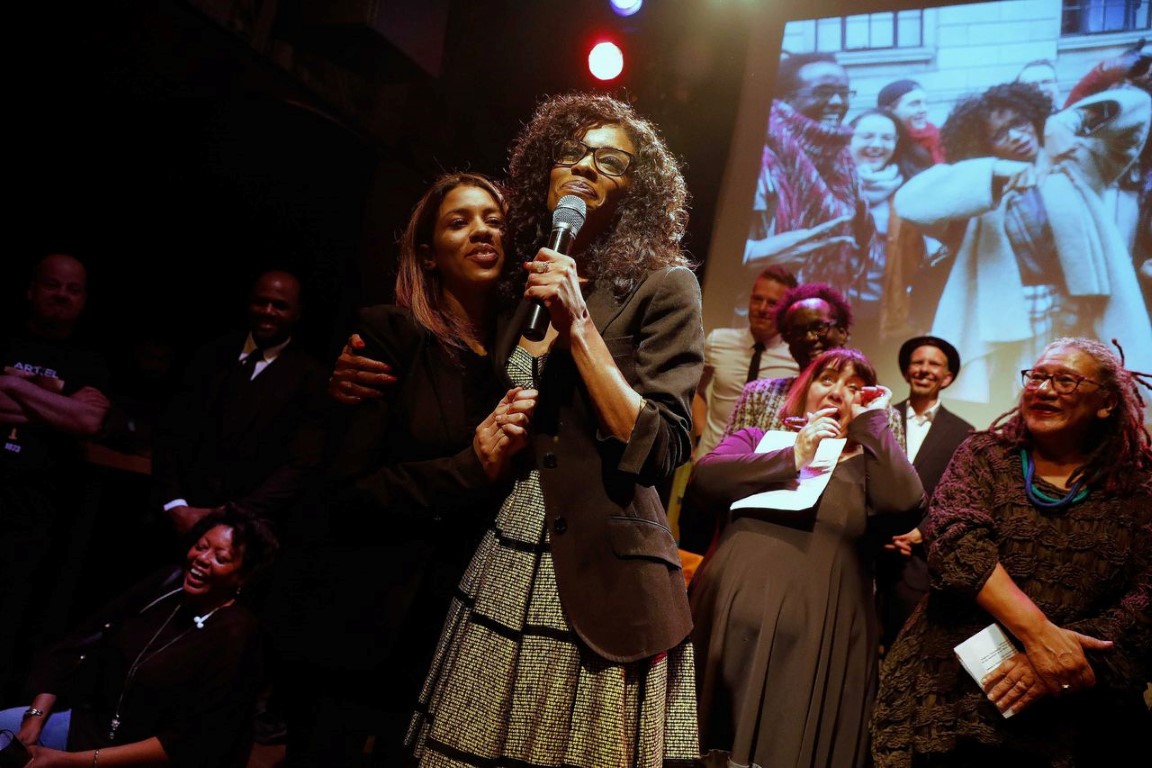
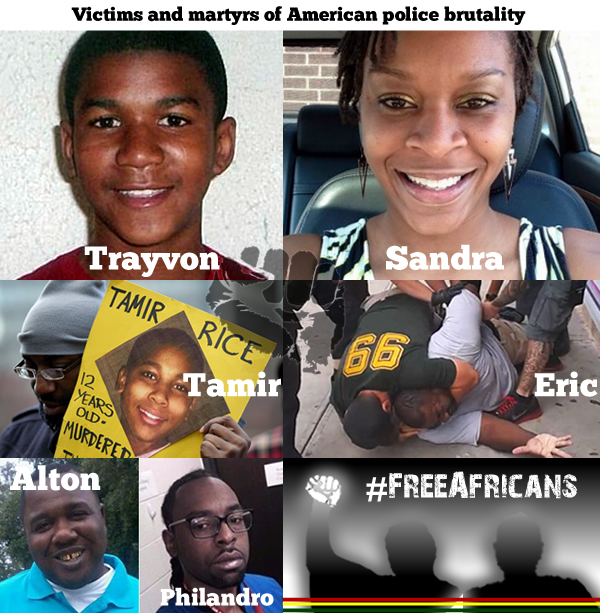
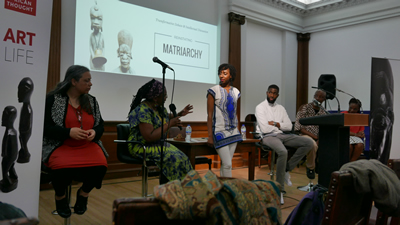
Get involved and help change our world