The rethink
Sometimes you just have this feeling when something is right. The past few days had been grey with rain, it was cold and the idea of travelling across London for a meeting during the early morning crush hour was not appealing. Yet today the sun was out, it was warm and as I entered the park come stylish cafe to meet Jon Daniel and Michael Liburd of ebb&flow it suddenly became clear that today was going to be something special.
It’s easy to be tempted to rethink the definition of cool after meeting them both, indeed the very name of the organisation epitomises the way they work together not only when seeking creative solutions to business challenges, but also when expressing their vision and amazing achievements. They remind me of my days as a musician when I was inspired by the genius but reclusive producers Jam and Lewis.
Like many, I had without even knowing it seen much of ebb&flow’s work in the public domain but remained totally unaware of the duo behind it. I was drawn to learning more about them after seeing the design for a brilliant new project on Africa named rethink. Who were they? What was their ethos, aspirations and of course - community contributions.
Jon started by explaining that in seeking to understand the ethos of ebb&flow we needed to first start to have an understanding of self, a holistic appreciation of what it is we ourselves are about. As he spoke his confidence and passion was infectious, there was no hesitation, no doubt in his awareness that African enterprises no matter how small are capable of competing in a global market. He stated that one of the keys to being successful in our endeavours is to first recognise that collectively we have the required skills to succeed and do not have to over compensate when coming to market. Instead of losing confidence by focusing on outside challenges - we simply just need to ‘do what we can do and be the best we can be.’
Michael joins in and refers to what Jon has labelled ‘undeniable professionalism’. It is a perfect term to explain the aura the pair emit as he explains why we shouldn’t need to shout about this or use a different language to articulate it. Indeed the value of ebb&flow is demonstrated by the quality of their work. I remark that it sets an impressive benchmark, a compliment which Jon and Michael accept with humility.
I ask how can community enterprises progress beyond their immediate local market and we start talking about the internet. They explain how one of the biggest mistakes made when using the online media is not to recognise its potential to create a level playing field.
‘If I have prejudices and see a ‘black’ face I’m going to decide what you can deliver. However, effective branding creates a level playing field with any other business. Then it becomes not about who you are but what you do, irrespective of whether you are operating from your bedroom or are based in a massive office located in the west end.’
Jon explains how some businesses are failing simply because we don’t have the right language. He identifies how for example we may be talking about a hair salon and spell the business as hair ‘kutz’ – a decision I surmise that could perpetuate unwanted assumptions.
Michael agrees. He continues ‘we have an amazing amount of skills, resources and creativity in our community but I believe our community has an issue in realising it. The solution centres around our identity – how we portray who we are.’
The theme of identity is a recurring topic during our conversation and as I look at these two men I realise they can really help. Their creative genius has already contributed to assisting major companies move themselves into new markets. Yet what I am sensing in their hearts is a desire to awaken our community and give something that can help stimulate our collective growth and development. Not by hiding who we are but by respecting, protecting and effectively projecting that identity.
I tease Michael into explaining in more depth. He responds.
‘We have to understand our value. This is where the power we have to obtain the things we desire for ourselves and family lies. What we are not doing is thinking about ourselves as a collective or working collaboratively to add value to our eco system.’
One of the projects ebb&flow worked on was the 1824 Collective with Harriet Harman. Their engagement in the world of voter registration touched a nerve as it brought home how so many young people don’t believe they make a difference to the world they inhabit. The project was a success as it helped five million young people come together and realise that when they act collectively they have power.
Michael continues, ‘There is a light bulb that needs to come on. We need to learn how to engage our audiences and therefore effect change. We need to say - this is what I do, I do it very well, now how do we present ourselves at our best to showcase who we are?’
Jon offers the band of Toni & Guy as an effective example of branding as the pair continues;
‘African men and women including those from the Caribbean are the biggest consumer of the hair industry, where are our hair care products? If I want to buy a comb where does it come from? We are over represented in sports, so where is the African Adidas? Where in the music industry is the African Sony? Take a look at our cultural enterprises, our foods and clothes, we have beautiful textiles, designs and an abundance of talent – where are our products?’
I am impressed at how easy they both identify the challenges without adopting a fatalistic pessimism. This is a topic they have clearly discussed and are both determined to work towards becoming a part of the solution.
‘Look at it on a global level, let’s take oil’ continues Michael. ‘Where are we? There are some smaller organisations that exist in pockets without fractious vision but are they competing with BP? Are they competing with Nike? If we can get people asking these questions we can take that why and turn it into how.’
As the topic turns to Africa Jon points to the need for us to adopt a new paradigm that is encapsulated by the rethink project.
‘There’s this perception of Africa, that is typically always overwhelmingly negative, i.e. its all disease, all negative when the reality is that Africa is the emerging market, its where all the mobile companies are going, the fashion markets are going, with the economic downturn big companies have exhausted the western markets and now regions like Africa and India for example are seen as being on the rise.
Our perceptions are being thwarted by what we are seeing. Why have we not got a global media company that can compete with the Murdoch’s of this world - I mean we do have billionaires amongst us.’
Michael adds an important caveat stating its not just about having the media as it still needs to be watchable, it still must have purposeful content.
‘Real power is silent and reserved as opposed to boastful over confidence. It’s not about whacking a gold chain around our neck in order to say we are rich. It’s about walking into a space and being comfortable there irrespective of how we are dressed.’
I ask them if our image compromises us. In western media African people are predominantly associated with the sports and entertainment industry or criminality. How does this impact on us? Should we be concerned?
Michael responds; ‘I do have concerns, when we talk to companies and they want to talk to our community they often have a prescribed view of how they should engage with us. For example if a client wants to do something ‘urban’ they often feel the need to include graffiti and some guys wearing hoods and baseball caps. [As a community many of us] have contributed to creating this stereotype of who we are and need to [now work to] undo some of this thinking...
You don’t need to patronise an audience to reach them. The challenge is to select the right medium. Take for example if we decided to do a campaign for MTV. The advert that would stand out is the one that is silent and doesn’t move. It’s about how you communicate.’
Communication and branding plays a major factor in the way ebb&flow approach their work. We touch on the current use of flyers by organisations and question whether sufficient thought goes into thinking who am I, who do I want to attract and how am I going to have the greatest effect?
‘Many people don’t understand what branding is and how it works. If you see it akin to building a house then branding is its architecture. If you put all the work and thinking in at the start of the project then good branding is an investment that provides longevity, it understands that whilst the values may remain the same, what you are today may not be what you are tomorrow.’
They have me smiling and more crucially – rethinking. These guys are serious. I know the work, now I know the names but I also want to know who they are. We could settle for trivia, for example Michael spent seven years on submarines in the Royal Navy whilst Jon petitioned the Royal Mail for several years to commission stamps on the African contribution. But this doesn’t tell even a fraction of their story.
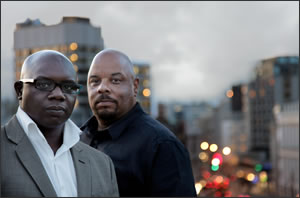
I ask for the origins of the creative company and they tell me they’ve been working together as ebb& flow for six years. When you witness the humorous banter between them you can instantly understand how the creative ebb flows.
Michael worked with clients in corporate industry. Often addressing marketing and sales issues he became frustrated after becoming aware of the missed opportunities that could be fulfilled by companies that could deliver solutions based on creative thinking. Similarly, Jon was working in mainstream advertising. He liked the idea of developing concepts and working with the best people to realise them but his frustration grew following the inability of mainstream clients to sometimes break with safe and tired conventions. Jon often wondered how could we take the philosophy of an event or product and present it to people by making it something that is relevant to their lifestyle.
The both of them met one day and after discussing these frustrations thought - why don’t we do something about it. That was when ebb&flow was born and together they created a methodology they felt able to apply to their clients. One of the biggest fear was the financial one, how can I look after my family.
‘You realise yes money is an issue but it’s about freedom of expression, flexibility - it changes your outlook on life. You start to ask what value do you bring? We did not want to be shackled by convention. We realised we could do anything if we put our minds to it, and applying the ebb&flow philosophy is absolutely paramount.’
I ask aren’t they crazy to take such a huge risk leaving the security of their jobs to enter such a closed industry? They both laugh.
‘There are easier ways to make a living and we certainly had our ups and downs but you can’t go into anything like that without confidence in your value. The ethos of the creative industry is that you are only as good as your last piece of work.’
I want to know of the challenges, what were they and how they overcame them. They reveal tales of clients who ask for innovation but in truth are unwilling to change and how some clients have preconceived perception of their ability when becoming aware of their ethnicity and assume they will think a certain way. They look for synergy when working on a project and enjoy working where the client has no preconceived ideas of how things ‘should’ go and is open to alternative ways of working. They explain the irony of those rare clients that do not appreciating their value who are characterised by not having worked with large agencies or experienced global thinking;
‘This is the true value of what we bring in that we can compete with large players... the failure is sometimes that the client does not share the relevant information or does not understand the need for honesty to effect the economy of the solution... because we work in an industry [where] there’s level of subjectivity to it. For example if a plumber comes in to fix your pipes whatever he tells you to do, you do. In the creative field this is not the same – but we are not a ‘pretty pictures’ firm. When we are coming to you with a solution we are providing a solution that we believe is sound.’
I want to close on exploring how their work benefits the pan African community. Jon and Michael list a series of high profile projects from helping African and African Caribbean men with parenting to giving back to Africa through their work with the singer Alicia Keys’ Aids charity, Keep a Child Alive. These are laudable projects but I suspect the benefits go far deeper than that. Having worked and supported grassroots organisations ebb&flow have changed perception within governments and corporate industries about the perception of Africans as a whole not only by the quality of their work but also by their approach in how they do it. By challenging them when they come with prescribed stereotypes they have clearly articulated that we can’t be perceived in a set way if we are to move forward towards persistent solutions and that our value which goes far beyond any stereotypical image is deserving of further investment. Michael closes our conversation by explaining that we should not be afraid to have global vision as a business.
‘We do like international projects so it would be good to find an African brand that wants to compete in a global market. We want to help find a pan African brand become the next BP, Microsoft or Estée Lauder. That’s what we want to do’
Jon agrees. As we leave I become aware that I have forgotten to ask what does the ebb&flow logo symbolise?
Based on the ancient African Adinkra symbol. ‘Nykinkyim’ it stands for ‘Initiative, dynamism and versatility as do we’ says Michael with a grin that makes clear they had purposely chosen a symbol that best reflected the values of the company. I smile back, with that much attention to detail it’s hardly surprising these guys success comes from thinking that is clearly a cut above the rest.
Visit the website www.ebb-flow.com

External Links
ebb&flow
Sometimes you just have this feeling when something is right. The past few days had been grey with rain, it was cold and the idea of travelling across London for a meeting during the early morning crush hour was not appealing. Yet today the sun was out, it was warm and as I entered the park come stylish cafe to meet Jon Daniel and Michael Liburd of ebb&flow it suddenly became clear that today was going to be something special.
It’s easy to be tempted to rethink the definition of cool after meeting them both, indeed the very name of the organisation epitomises the way they work together not only when seeking creative solutions to business challenges, but also when expressing their vision and amazing achievements. They remind me of my days as a musician when I was inspired by the genius but reclusive producers Jam and Lewis.
Like many, I had without even knowing it seen much of ebb&flow’s work in the public domain but remained totally unaware of the duo behind it. I was drawn to learning more about them after seeing the design for a brilliant new project on Africa named rethink. Who were they? What was their ethos, aspirations and of course - community contributions.
Jon started by explaining that in seeking to understand the ethos of ebb&flow we needed to first start to have an understanding of self, a holistic appreciation of what it is we ourselves are about. As he spoke his confidence and passion was infectious, there was no hesitation, no doubt in his awareness that African enterprises no matter how small are capable of competing in a global market. He stated that one of the keys to being successful in our endeavours is to first recognise that collectively we have the required skills to succeed and do not have to over compensate when coming to market. Instead of losing confidence by focusing on outside challenges - we simply just need to ‘do what we can do and be the best we can be.’
Michael joins in and refers to what Jon has labelled ‘undeniable professionalism’. It is a perfect term to explain the aura the pair emit as he explains why we shouldn’t need to shout about this or use a different language to articulate it. Indeed the value of ebb&flow is demonstrated by the quality of their work. I remark that it sets an impressive benchmark, a compliment which Jon and Michael accept with humility.
I ask how can community enterprises progress beyond their immediate local market and we start talking about the internet. They explain how one of the biggest mistakes made when using the online media is not to recognise its potential to create a level playing field.
‘If I have prejudices and see a ‘black’ face I’m going to decide what you can deliver. However, effective branding creates a level playing field with any other business. Then it becomes not about who you are but what you do, irrespective of whether you are operating from your bedroom or are based in a massive office located in the west end.’
Jon explains how some businesses are failing simply because we don’t have the right language. He identifies how for example we may be talking about a hair salon and spell the business as hair ‘kutz’ – a decision I surmise that could perpetuate unwanted assumptions.
Michael agrees. He continues ‘we have an amazing amount of skills, resources and creativity in our community but I believe our community has an issue in realising it. The solution centres around our identity – how we portray who we are.’
The theme of identity is a recurring topic during our conversation and as I look at these two men I realise they can really help. Their creative genius has already contributed to assisting major companies move themselves into new markets. Yet what I am sensing in their hearts is a desire to awaken our community and give something that can help stimulate our collective growth and development. Not by hiding who we are but by respecting, protecting and effectively projecting that identity.
I tease Michael into explaining in more depth. He responds.
‘We have to understand our value. This is where the power we have to obtain the things we desire for ourselves and family lies. What we are not doing is thinking about ourselves as a collective or working collaboratively to add value to our eco system.’
One of the projects ebb&flow worked on was the 1824 Collective with Harriet Harman. Their engagement in the world of voter registration touched a nerve as it brought home how so many young people don’t believe they make a difference to the world they inhabit. The project was a success as it helped five million young people come together and realise that when they act collectively they have power.
Michael continues, ‘There is a light bulb that needs to come on. We need to learn how to engage our audiences and therefore effect change. We need to say - this is what I do, I do it very well, now how do we present ourselves at our best to showcase who we are?’
Jon offers the band of Toni & Guy as an effective example of branding as the pair continues;
‘African men and women including those from the Caribbean are the biggest consumer of the hair industry, where are our hair care products? If I want to buy a comb where does it come from? We are over represented in sports, so where is the African Adidas? Where in the music industry is the African Sony? Take a look at our cultural enterprises, our foods and clothes, we have beautiful textiles, designs and an abundance of talent – where are our products?’
I am impressed at how easy they both identify the challenges without adopting a fatalistic pessimism. This is a topic they have clearly discussed and are both determined to work towards becoming a part of the solution.
‘Look at it on a global level, let’s take oil’ continues Michael. ‘Where are we? There are some smaller organisations that exist in pockets without fractious vision but are they competing with BP? Are they competing with Nike? If we can get people asking these questions we can take that why and turn it into how.’
As the topic turns to Africa Jon points to the need for us to adopt a new paradigm that is encapsulated by the rethink project.
‘There’s this perception of Africa, that is typically always overwhelmingly negative, i.e. its all disease, all negative when the reality is that Africa is the emerging market, its where all the mobile companies are going, the fashion markets are going, with the economic downturn big companies have exhausted the western markets and now regions like Africa and India for example are seen as being on the rise.
Our perceptions are being thwarted by what we are seeing. Why have we not got a global media company that can compete with the Murdoch’s of this world - I mean we do have billionaires amongst us.’
Michael adds an important caveat stating its not just about having the media as it still needs to be watchable, it still must have purposeful content.
‘Real power is silent and reserved as opposed to boastful over confidence. It’s not about whacking a gold chain around our neck in order to say we are rich. It’s about walking into a space and being comfortable there irrespective of how we are dressed.’
I ask them if our image compromises us. In western media African people are predominantly associated with the sports and entertainment industry or criminality. How does this impact on us? Should we be concerned?
Michael responds; ‘I do have concerns, when we talk to companies and they want to talk to our community they often have a prescribed view of how they should engage with us. For example if a client wants to do something ‘urban’ they often feel the need to include graffiti and some guys wearing hoods and baseball caps. [As a community many of us] have contributed to creating this stereotype of who we are and need to [now work to] undo some of this thinking...
You don’t need to patronise an audience to reach them. The challenge is to select the right medium. Take for example if we decided to do a campaign for MTV. The advert that would stand out is the one that is silent and doesn’t move. It’s about how you communicate.’
Communication and branding plays a major factor in the way ebb&flow approach their work. We touch on the current use of flyers by organisations and question whether sufficient thought goes into thinking who am I, who do I want to attract and how am I going to have the greatest effect?
‘Many people don’t understand what branding is and how it works. If you see it akin to building a house then branding is its architecture. If you put all the work and thinking in at the start of the project then good branding is an investment that provides longevity, it understands that whilst the values may remain the same, what you are today may not be what you are tomorrow.’
They have me smiling and more crucially – rethinking. These guys are serious. I know the work, now I know the names but I also want to know who they are. We could settle for trivia, for example Michael spent seven years on submarines in the Royal Navy whilst Jon petitioned the Royal Mail for several years to commission stamps on the African contribution. But this doesn’t tell even a fraction of their story.
Michael Liburd (left) and Jon Daniel of ebb&flow [image: ebb&flow | dp daniel]
Michael worked with clients in corporate industry. Often addressing marketing and sales issues he became frustrated after becoming aware of the missed opportunities that could be fulfilled by companies that could deliver solutions based on creative thinking. Similarly, Jon was working in mainstream advertising. He liked the idea of developing concepts and working with the best people to realise them but his frustration grew following the inability of mainstream clients to sometimes break with safe and tired conventions. Jon often wondered how could we take the philosophy of an event or product and present it to people by making it something that is relevant to their lifestyle.
The both of them met one day and after discussing these frustrations thought - why don’t we do something about it. That was when ebb&flow was born and together they created a methodology they felt able to apply to their clients. One of the biggest fear was the financial one, how can I look after my family.
‘You realise yes money is an issue but it’s about freedom of expression, flexibility - it changes your outlook on life. You start to ask what value do you bring? We did not want to be shackled by convention. We realised we could do anything if we put our minds to it, and applying the ebb&flow philosophy is absolutely paramount.’
I ask aren’t they crazy to take such a huge risk leaving the security of their jobs to enter such a closed industry? They both laugh.
‘There are easier ways to make a living and we certainly had our ups and downs but you can’t go into anything like that without confidence in your value. The ethos of the creative industry is that you are only as good as your last piece of work.’
I want to know of the challenges, what were they and how they overcame them. They reveal tales of clients who ask for innovation but in truth are unwilling to change and how some clients have preconceived perception of their ability when becoming aware of their ethnicity and assume they will think a certain way. They look for synergy when working on a project and enjoy working where the client has no preconceived ideas of how things ‘should’ go and is open to alternative ways of working. They explain the irony of those rare clients that do not appreciating their value who are characterised by not having worked with large agencies or experienced global thinking;
‘This is the true value of what we bring in that we can compete with large players... the failure is sometimes that the client does not share the relevant information or does not understand the need for honesty to effect the economy of the solution... because we work in an industry [where] there’s level of subjectivity to it. For example if a plumber comes in to fix your pipes whatever he tells you to do, you do. In the creative field this is not the same – but we are not a ‘pretty pictures’ firm. When we are coming to you with a solution we are providing a solution that we believe is sound.’
I want to close on exploring how their work benefits the pan African community. Jon and Michael list a series of high profile projects from helping African and African Caribbean men with parenting to giving back to Africa through their work with the singer Alicia Keys’ Aids charity, Keep a Child Alive. These are laudable projects but I suspect the benefits go far deeper than that. Having worked and supported grassroots organisations ebb&flow have changed perception within governments and corporate industries about the perception of Africans as a whole not only by the quality of their work but also by their approach in how they do it. By challenging them when they come with prescribed stereotypes they have clearly articulated that we can’t be perceived in a set way if we are to move forward towards persistent solutions and that our value which goes far beyond any stereotypical image is deserving of further investment. Michael closes our conversation by explaining that we should not be afraid to have global vision as a business.
‘We do like international projects so it would be good to find an African brand that wants to compete in a global market. We want to help find a pan African brand become the next BP, Microsoft or Estée Lauder. That’s what we want to do’
Jon agrees. As we leave I become aware that I have forgotten to ask what does the ebb&flow logo symbolise?
Based on the ancient African Adinkra symbol. ‘Nykinkyim’ it stands for ‘Initiative, dynamism and versatility as do we’ says Michael with a grin that makes clear they had purposely chosen a symbol that best reflected the values of the company. I smile back, with that much attention to detail it’s hardly surprising these guys success comes from thinking that is clearly a cut above the rest.
Visit the website www.ebb-flow.com
External Links
ebb&flow
Ligali is not responsible for the content of third party sites
Speak Out!
Click here to speak out and share your perspective on this article.We have to understand our value. This is where the power we have to obtain the things we desire for ourselves and family lies. What we are not doing is thinking about ourselves as a collective or working collaboratively to add value to our eco system.
Michael Liburd, ebb&flow
See Related:

Get involved and help change our world